
Pulp Fiction, 1920 · page 39 of 160
Argosy, Vol. 120, No. 1 — page 39: what you’re looking at
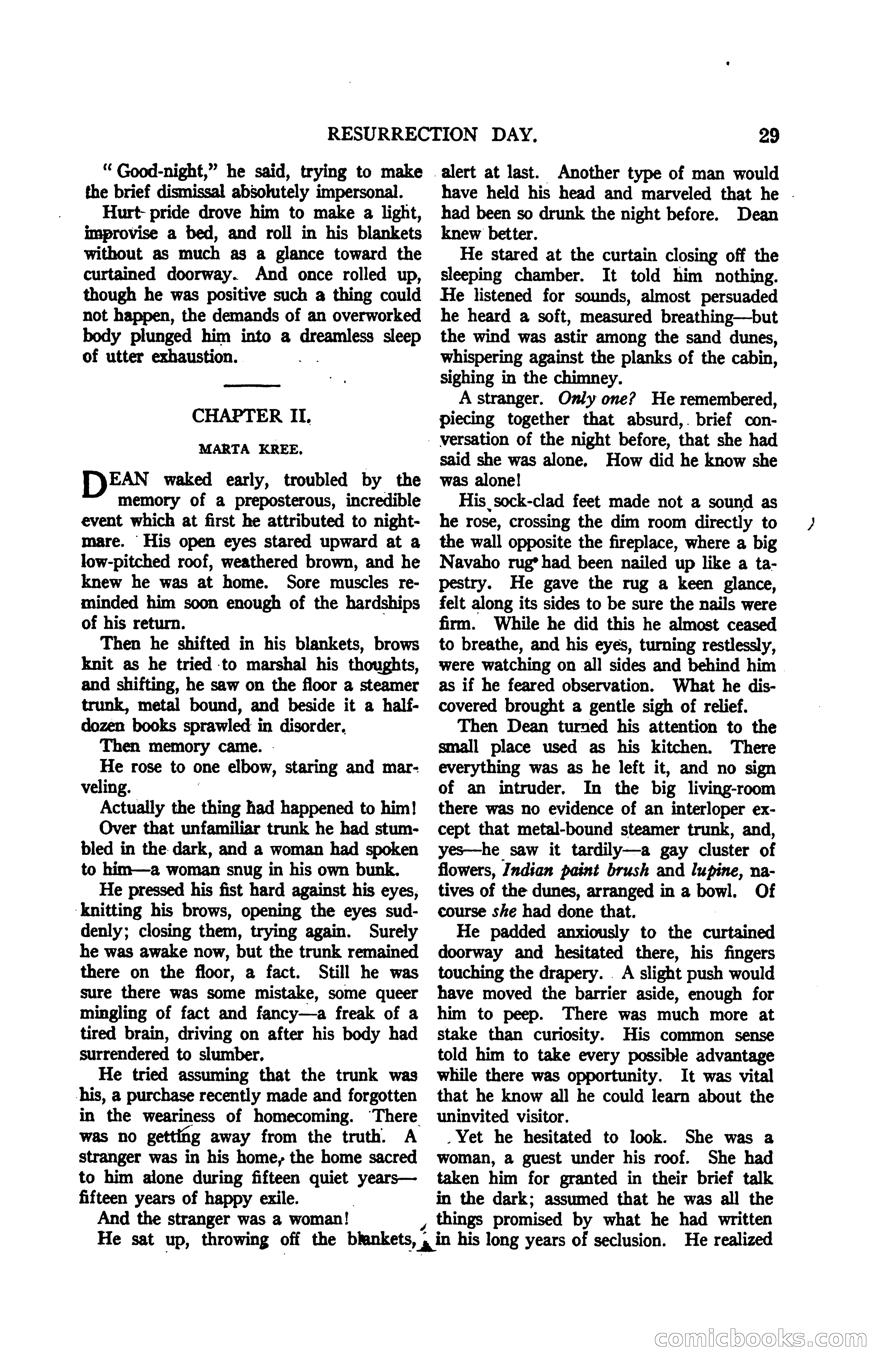
A restored page from Pulp Fiction, 1920. Page through the whole issue in the reader above.
📄 Transcribed text from this page (OCR, searchable)
Machine-transcribed from the original scan — historical spelling and the odd misread are preserved.
RESURRECTION DAY. “ Good-night,” he said, trying to make the brief dismissal absolutely impersonal. Hurt- pride drove him to make a light, improvise a bed, and roll in his blankets without as much as a glance toward the curtained doorway. And once rolled up, though he was positive such a thing could not happen, the demands of an overworked body plunged him into a dreamless sleep of utter exhaustion. CHAPTER II. MARTA KREE, DEAN waked early, troubled by the memory of a preposterous, incredible event which at first he attributed to night- mare. His open eyes stared upward at a low-pitched roof, weathered brown, and he knew he was at home. Sore muscles re- minded him soon enough of the hardships of his return. Then he shifted in his blankets, brows knit as he tried to marshal his thoughts, and shifting, he saw on the floor a steamer trunk, metal bound, and beside it a half- dozen books sprawled in disorder. Then memory came. . He rose to one elbow, staring and mar- veling. Actually the thing had happened to him! Over that unfamiliar trunk he had stum- bled in the dark, and a woman had spoken to him—a woman snug in his own bunk. He pressed his fist hard against his eyes, ‘knitting his brows, opening the eyes sud- denly; closing them, trying again. Surely he was awake now, but the trunk remained there on the floor, a fact. Still he was sure there was some mistake, some queer mingling of fact and fancy—a freak of a tired brain, driving on after his body had surrendered to slumber. He tried assuming that the trunk was his, a purchase recently made and forgotten in the weariness of homecoming. ‘There was no getting away from the truth. A stranger was in his home, the home sacred to him alone during fifteen quiet years— fifteen years of happy exile. And the stranger was a woman! He sat up, throwing off the bmankets, ; ain his long years of seclusion. alert at last. 29 Another type of man would have held his head and marveled that he . had been so drunk the night before. Dean knew better. He stared at the curtain closing off the sleeping chamber. It told him nothing. He listened for sounds, almost persuaded he heard a soft, measured breathing—but the wind was astir among the sand dunes, whispering against the planks of the cabin, sighing in the chimney. A stranger. Only one? He remembered, piecing together that absurd,. brief con- - Versation of the night before, that she had said she was alone, How did he know she was alone! His sock-clad feet made not a sound as he rose, crossing the dim room directly to the wall opposite the fireplace, where a big Navaho rug’ had been nailed up like a ta- pestry. He gave the rug a keen glance, felt along its sides to be sure the nails were firm. While he did this he almost ceased to breathe, and his eyes, turning restlessly, were watching on all sides and behind him | as if he feared observation. What he dis- covered brought a gentle sigh of relief. Then Dean turned his attention to the small place used as his kitchen. There everything was as he left it, and no sign of an intruder. In the big living-room there was no evidence of an interloper ex- cept that metal-bound steamer trunk, and, yes—he saw it tardily—a gay cluster of flowers, Indian paint brush and lupine, na- tives of the dunes, arranged in a bowl. Of course she had done that. He padded anxiously to the curtained doorway and hesitated there, his fingers touching the drapery. A slight push would have moved the barrier aside, enough for him to peep. There was much more at stake than curiosity. His common sense told him to take every possible advantage while there was opportunity. It was vital that he know all he could learn about the uninvited visitor. . Yet he hesitated to look. She was a woman, a guest under his roof. She had taken him for granted in their brief talk in the dark; assumed that he was all the , things promised by what he had written He realized C@ DOOLK CO