
Pulp Fiction, 1920 · page 30 of 160
Argosy, Vol. 120, No. 1 — page 30: what you’re looking at
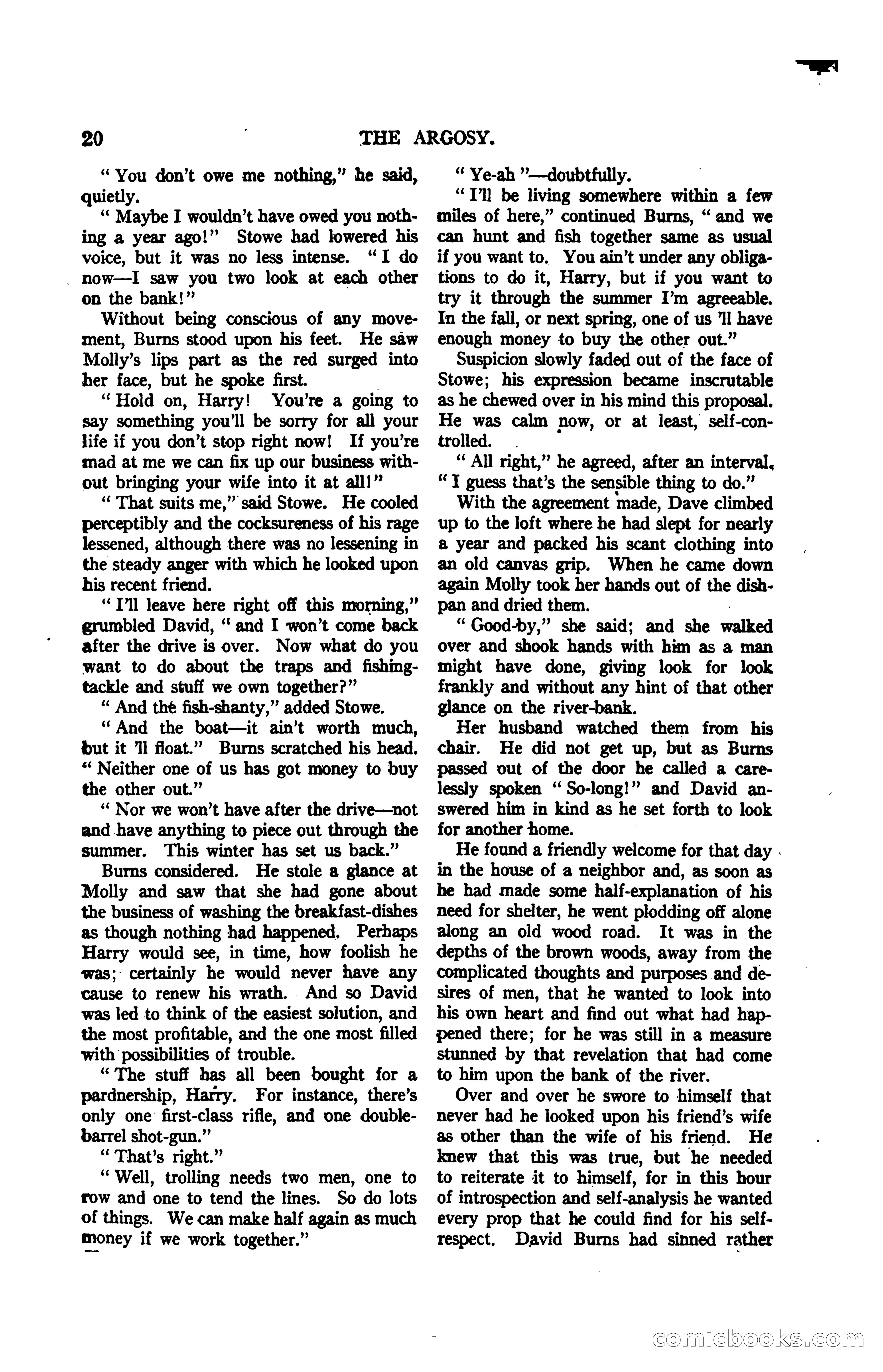
A restored page from Pulp Fiction, 1920. Page through the whole issue in the reader above.
📄 Transcribed text from this page (OCR, searchable)
Machine-transcribed from the original scan — historical spelling and the odd misread are preserved.
20 “You don’t owe me nothing,” he said, quietly. ‘“‘ Maybe I wouldn’t have owed you noth- ing a year ago!” Stowe had lowered his voice, but it was no less intense. “I do . now—I saw you two look at each other on the bank!” Without being conscious of any move- ment, Burns stood upon his feet. He saw Molly’s lips part as the red surged into her face, but he spoke first. “Hold on, Harry! You're a going to say something you’ll be sorry for all your life if you don’t stop right now! If you’re mad at me we can fix up our business with- out bringing your wife into it at all!” ‘“‘ That suits me,” said Stowe. He cooled perceptibly and the cocksureness of his rage lessened, although there was no lessening in the steady anger with which he looked upon his recent friend. “‘T’ll leave here right off this morning,”’ grumbled David, “and I won’t come back after the drive is over. Now what do you want to do about the traps and fishing- tackle and stuff we own together?”’ “ And the fish-shanty,” added Stowe. “And the boat—it ain’t worth much, but it 7l float.”” Burns scratched his head. “‘ Neither one of us has got money to buy the other out.” “Nor we won’t have after the drive—not and have anything to piece out through the summer. This winter has set us back.” Burns considered. He stole a glance at Molly and saw that she had gone about the business of washing the breakfast-dishes as though nothing had happened. Perhaps Harry would see, in time, how foolish he was; certainly he would never have any cause to renew his wrath. And so David was led to think of the easiest solution, and the most profitable, and the one most filled with possibilities of trouble. “The stuff has all been bought for a pardnership, Harry. For instance, there’s only one first-class rifle, and one double- barrel shot-gun.”’ “ That’s right.” “Well, trolling needs two men, one to row and one to tend the lines. So do lots of things. We can make half again as much money if we work together.” THE ARGOSY. “ Ye-ah ”—doubtfully. “Tl be living somewhere within a few miles of here,” continued Burns, “and we can hunt and fish together same as usual if you want to. You ain’t under any obliga- tions to do it, Harry, but if you want to try it through the summer I’m agreeable. In the fall, or next spring, one of us ‘ll have enough money to buy the other out.” Suspicion slowly faded out of the face of Stowe; his expression became inscrutable as he chewed over in his mind this proposal. He was calm now, or at least, self-con- trolled... ‘* All right,” he agreed, after an interval, “YT guess that’s the sensible thing to do.”’ With the agreement made, Dave climbed up to the loft where he had slept for nearly a year and packed his scant clothing into an old canvas grip. When he came down again Molly took her hands out of the dish- pan and dried them. “ Good-by,”’ she said; and she walked over and shook hands with him as a man might have done, giving look for look frankly and without any hint of that other glance on the river-bank. Her husband watched them from his chair. He did not get up, but as Burns passed out of the door he called a care- lessly spoken “ So-long!” and David an- swered him in kind as he set forth to look for another home. He found a friendly welcome for that day . in the house of a neighbor and, as soon as he had made some half-explanation of his need for shelter, he went plodding off alone along an old wood road. It was in the depths of the brown woods, away from the complicated thoughts and purposes and de- sires of men, that he wanted to look into his own heart and find out what had hap- pened there; for he was still in a measure stunned by that revelation that had come to him upon the bank of the river. Over and over he swore to himself that never had he looked upon his friend’s wife as other than the wife of his friend. He knew that this was true, but he needed to reiterate it to himself, for in this hour of introspection and self-analysis he wanted every prop that he could find for his self- respect. David Burns had sinned rather CoOMmiicloo CO@