
Pulp Fiction, 1920 · page 119 of 160
Argosy, Vol. 120, No. 1 — page 119: what you’re looking at
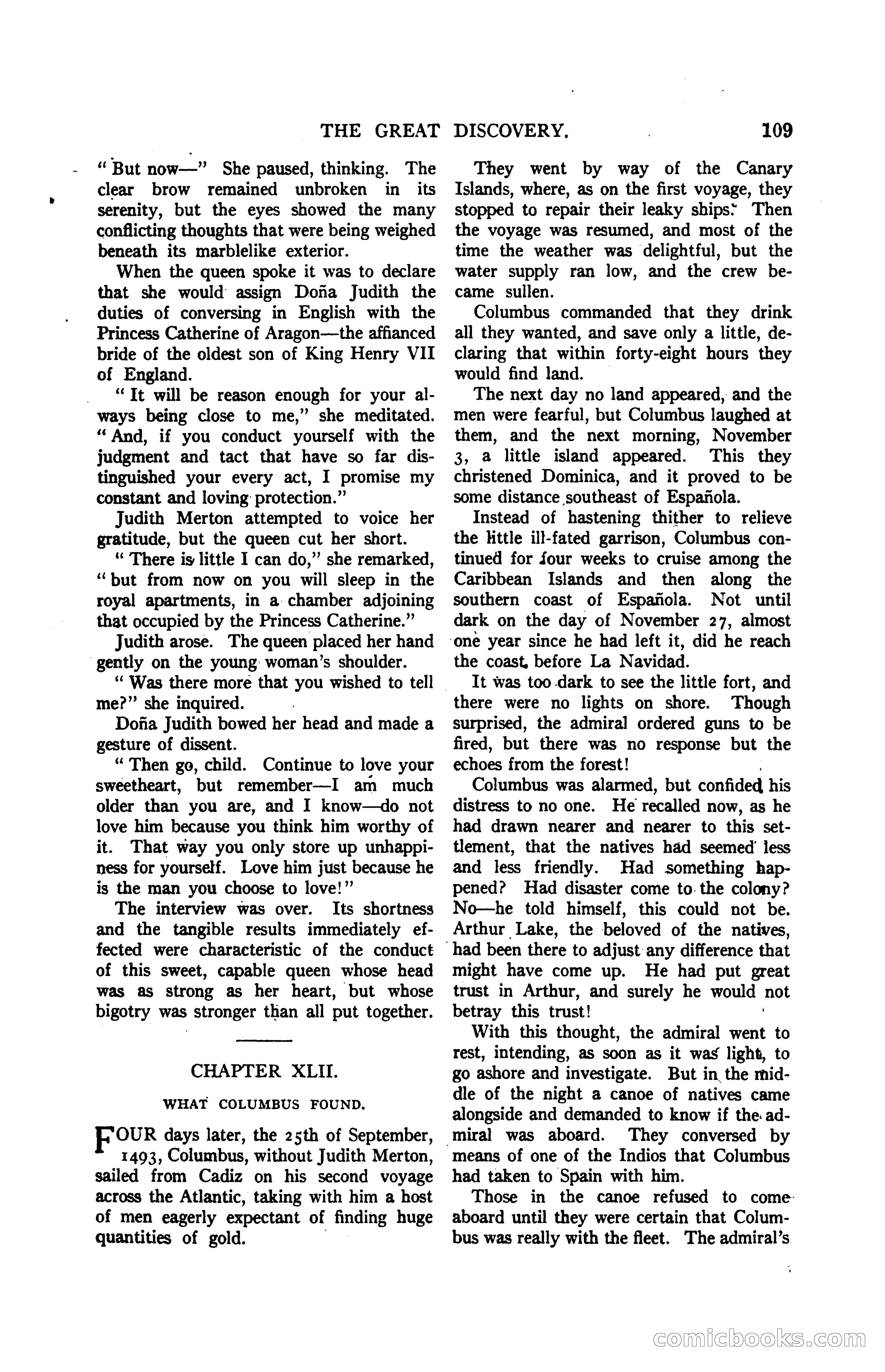
A restored page from Pulp Fiction, 1920. Page through the whole issue in the reader above.
📄 Transcribed text from this page (OCR, searchable)
Machine-transcribed from the original scan — historical spelling and the odd misread are preserved.
THE GREAT “But now—” She paused, thinking. The clear brow remained unbroken in_ its serenity, but the eyes showed the many conflicting thoughts that were being weighed beneath its marblelike exterior. When the queen spoke it was to declare that she would assign Dofa Judith the duties of conversing in English with the Princess Catherine of Aragon—the affianced bride of the oldest son of King Henry VII of England. “It will be reason enough for your al- ways being close to me,” she meditated. “And, if you conduct yourself with the judgment and tact that have so far dis- tinguished your every act, I promise my constant and loving protection.” Judith Merton attempted to voice her gratitude, but the queen cut her short. “ There is little I can do,” she remarked, “but from now on you will sleep in the royal apartments, in a chamber adjoining that occupied by the Princess Catherine.” Judith arose. The queen placed her hand gently on the young woman’s shoulder. ‘“‘ Was there more that you wished to tell | me?” she inquired. , Dojfia Judith bowed her head and made a gesture of dissent. “ Then go, child. Continue to love your sweetheart, but remember—I am much older than you are, and I know—do not love him because you think him worthy of it. That way you only store up unhappi- ness for yourself. Love him just because he is the man you choose to love!”’ The interview was over. Its shortness and the tangible results immediately ef- fected were characteristic of the conduct of this sweet, capable queen whose head was as strong as her heart, but whose bigotry was stronger than all put together. CHAPTER XLII. WHAT COLUMBUS FOUND. FroOUR days later, the 25th of September, 1493, Columbus, without Judith Merton, sailed from Cadiz on his second voyage across the Atlantic, taking with him a host of men eagerly expectant of finding huge quantities of gold. -miral was aboard. DISCOVERY. 109 They went by way of the Canary Islands, where, as on the first voyage, they stopped to repair their leaky ships* Then the voyage was resumed, and most of the time the weather was delightful, but the water supply ran low, and the crew be- came sullen. Columbus commanded that they drink all they wanted, and save only a little, de- claring that within forty-eight hours they would find land. The next day no land appeared, and the men were fearful, but Columbus laughed at them, and the next morning, November 3, a little island appeared. This they christened Dominica, and it proved to be some distance southeast of Espanola. Instead of hastening thither to relieve the httle ill-fated garrison, Columbus con- tinued for four weeks to cruise among the Caribbean Islands and then along the southern coast of Espanola. Not until dark on the day of November 27, almost ‘one year since he had left it, did he reach the coast, before La Navidad. It was too dark to see the little fort, and there were no lights on shore. Though surprised, the admiral ordered guns to be fired, but there was no response but the echoes from the forest! Columbus was alarmed, but confided his distress to no one. He recalled now, as he had drawn nearer and nearer to this set- tlement, that the natives had seemed less and less friendly. Had something hap- pened? Had disaster come to. the colony? No—he told himself, this could not be. Arthur Lake, the beloved of the natives, had been there to adjust any difference that might have come up. He had put great trust in Arthur, and surely he would not betray this trust! With this thought, the admiral went to rest, intending, as soon as it was light, to go ashore and investigate. But in the mid- dle of the night a canoe of natives came alongside and demanded to know if the. ad- They conversed by means of one of the Indios that Columbus had taken to Spain with him. Those in the canoe refused to come aboard until they were certain that Colum- bus was really with the fleet. The admiral’s GOMMlepoo (-) S CO@