
Pulp Fiction, 1920 · page 111 of 160
Argosy, Vol. 120, No. 1 — page 111: what you’re looking at
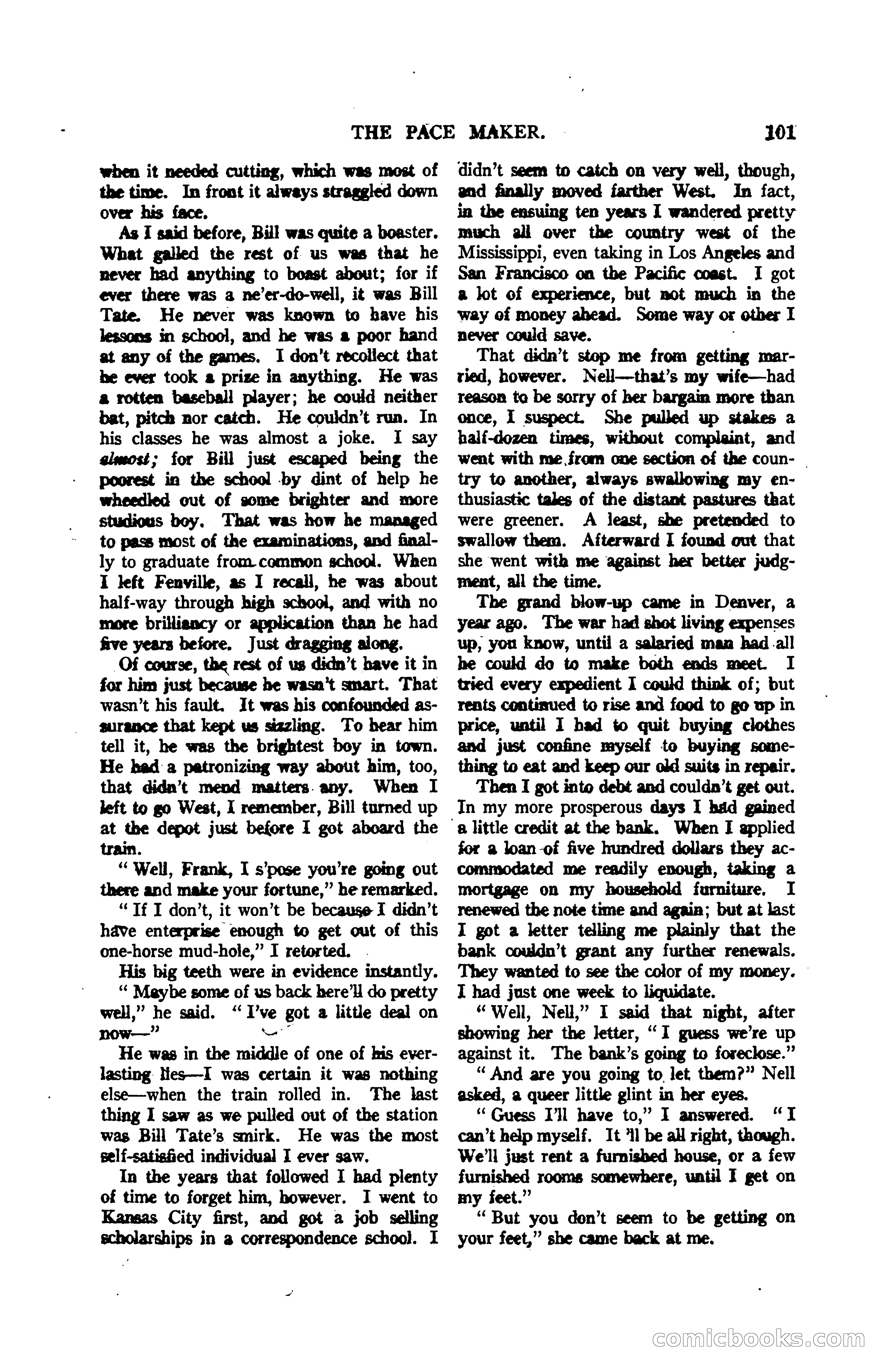
A restored page from Pulp Fiction, 1920. Page through the whole issue in the reader above.
📄 Transcribed text from this page (OCR, searchable)
Machine-transcribed from the original scan — historical spelling and the odd misread are preserved.
THE PACE MAKER. when it needed cutting, which was most of the time. In front it always straggled down over his face. As I said before, Bill was quite a boaster. What galled the rest of us was that he never had anything to boast about; for if ever there was a ne’er-do-well, it was Bill Tate. He never was known to have his lessons in school, and he was a poor hand at any of the games. I don’t recollect that he ever took a prize in anything. He was a rotten baseball player; he could neither bat, pitch nor catch. He couldn’t run. In his classes he was almost a joke. I say glmost; for Bill just escaped being the poorest in the school by dint of help he wheedled out of some brighter and more studious boy. That was how he managed to pass most of the examinations, and final- ly to graduate from. common school. When I left Fenville, as I recall, he was about half-way through high school, and with no more brilliancy or application than he had fave years before. Just dragging along. Of course, the rest of us didn’t have it in for him just because be wasn’t smart. That wasn’t his fault. It was his confounded as- surance that kept us sizzling. To hear him tell it, he was the brightest boy in town. He had a patronizing way about him, too, that didn’t mend matters. any. When I left to go West, | remember, Bill turned up at the depot just before I got aboard the train. “ Well, Frank, I s’pose you’re going out there and make your fortune,” he remarked. “Tf I don’t, it won’t be because I didn’t have enterprise enough to get out of this one-horse mud-hole,” I retorted. . His big teeth were in evidence instantly. “‘ Meybe some of us back here’ll do pretty well,” he said. “I’ve got a little deal on now—” ta “ He was in the middle of one of his ever- lasting lies—I was certain it was nothing else—when the train rolled in. The last thing I saw as we pulled out of the station was Bill Tate’s smirk. He was the most self-satiefied individual I ever saw. In the years that followed I had plenty of time to forget him, however. I went to Kansas City first, and got a job selling scholarships in a correspondence school. I ’ ~ 101 didn’t seem to catch on very well, though, and finally moved farther West. In fact, in the ensuing ten years I wandered pretty much all over the country west of the Mississippi, even taking in Los Angeles and San Francisco on the Pacific coast. I got a lot of experience, but not much in the way of money ahead. Some way or other I never could save. That didn’t stop me from getting mar- tied, however. Nell—thai’s my wife—had reason to be sorry of her bargain more than once, I suspect. She pulled up stakes a hali-dozen times, without complaint, and went with me from one section of the coun- — try to another, always swallowing my en- thusiastic tales of the distant pastures that were greener. <A least, she pretended to swallow them. Afterward I found out that she went with me against her better judg- ment, all the time. The grand blow-up came in Denver, a year ago. The war had shot living expenses up, you know, until 2 salaried man had .all he could do to make both ends meet. I tried every expedient I could think of; but rents continued to rise and food to go up in price, until ] had to quit buying clothes and just confine myself to buying some- thing to eat and keep our old suits in repair. Then I got into debt and couldn’t get out. In my more prosperous days I hdd gained 8 little credit at the bank. When I applied for a loan -of five hundred dollars they ac- commodated me readily enough, taking a mortgage on my household furniture. I renewed the note time and again; but at last I got a letter telling me plainly that the bank couldn’t grant any further renewals. They wanted to see the color of my money. — I had just one week to liquidate. “Well, Nell,” I said that night, after showing her the letter, “I guess we’re up against it. The bank’s going to foreclose.” “ And are you going to let them?” Nell asked, a queer little glint in her eyes. “‘ Guess Jl have to,” I answered. “I can’t help myself. It ‘ll be all right, though. We'll just rent a furnished house, or a few furnished rooms somewhere, until I get on my feet.” “But you don’t seem to be getting on your feet,” she came back at me. CO LONOOLKS CO@