
Pulp Fiction, 1920 · page 94 of 160
Argosy, Vol. 119, No. 2 — page 94: what you’re looking at
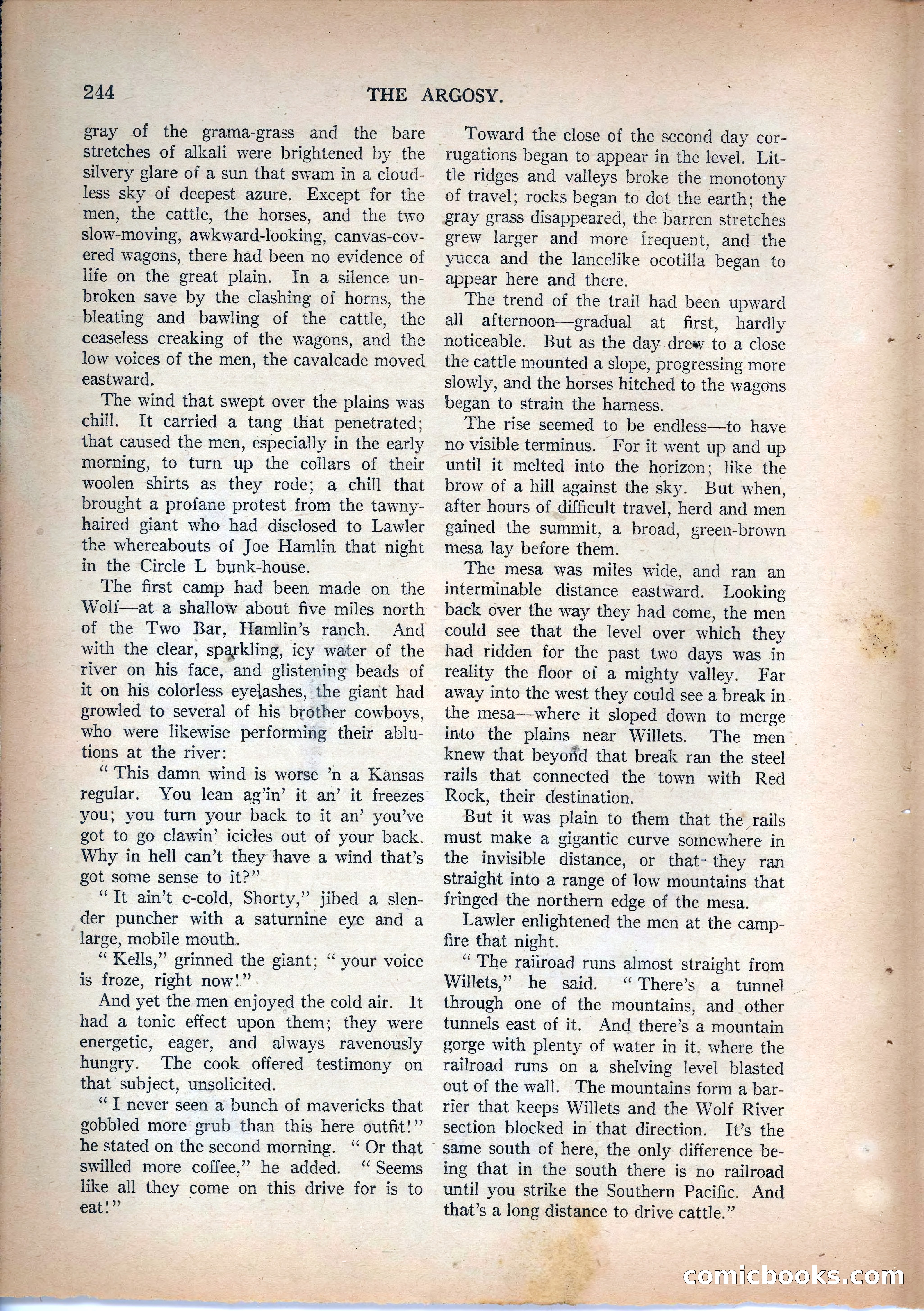
A restored page from Pulp Fiction, 1920. Page through the whole issue in the reader above.
📄 Transcribed text from this page (OCR, searchable)
Machine-transcribed from the original scan — historical spelling and the odd misread are preserved.
, He vi m F 4 * 4 “: 244 | THE ARGOSY. gray of the grama-grass and the bare stretches of alkali were brightened by the silvery glare of a sun that swam in a cloud- less sky of deepest azure. Except for the men, the cattle, the horses, and the two slow-moving, awkward-looking, canvas-cov- ered wagons, there had been no evidence of life on the great plain. In a silence un- broken save by the clashing of horns, the bleating and bawling of the cattle, the ceaseless creaking of the wagons, and the low voices of the men, ‘the cavalcade moved eastward. The wind that swept over the plains was chill. It carried a tang that penetrated; that caused the men, especially in the early morning, to turn up the collars of their woolen shirts as they rode; a chill that brought a profane protest from the tawny- haired giant who had disclosed to Lawler the whereabouts of Joe Hamlin that night in the Circle L bunk-house. The first camp had been made on the - Wolf—at a shallow about five miles north of the Two Bar, Hamlin’s ranch. And with the clear, sparkling, icy water of the river on his face, and glistening beads of it on his colorless eyelashes, the giant had growled to several of his brother cowboys, who were likewise performing their ablu- tions at the river: “This damn wind is worse ’n a Kansas regular. You lean ag’in’ it an’ it freezes you; you turn your back to it an’ you’ve got to go clawin’ icicles out of your back. Why in hell can’t they have a wind that’s got some sense to it?” “It ain’t c-cold, Shorty,” jibed a slen- der puncher with a saturnine eye and a large, mobile mouth. “ Kells,” grinned the giant; “‘ your voice is froze, right now!.” And yet the men enjoyed the cold air. It had a tonic effect upon them; they were energetic, eager, and always ravenously hungry. The cook offered testimony on that subject, unsolicited. ““T never seen a bunch of mavericks that gobbled more grub than this here outfit! ”’ he stated on the second morning. ‘“ Or that swilled more coffee,” he added. ‘‘ Seems like all they come on this drive for is to eat!” Toward the close of the second day cor- ‘rugations began to appear in the level. Lit- tle ridges and valleys broke the monotony of travel; rocks began to dot the earth; the gray grass disappeared, the barren stieeehies grew larger and more frequent, and the yucca and the lancelike ocotilla began to appear here and there. The trend of the trail had been upward all afternoon—gradual at first, hardly noticeable. But as the day-drew to a close the cattle mounted a slope, progressing more slowly, and the horses hitched to the wagons began to strain the harness. The rise seemed to be endless—to have no visible terminus. For it went up and up until it melted into the horizon; like the brow of a hill against the sky. But when, after hours of difficult travel, herd and men gained the summit, a broad, green-brown mesa lay before them. The mesa was miles wide, and ran an interminable distance eastward. Looking back over the way they had come, the men could see that the level over which they had ridden for the past two days was in reality the floor of a mighty valley. Far away into the west they could see a break in the mesa—where it sloped down to merge into the plains near Willets. The men knew that beyond that break ran the steel rails that connected the town with Red Rock, their destination. But it was plain to them that the rails must make a gigantic curve somewhere in the invisible distance, or that- they ran straight into a range of low mountains that fringed the northern edge of the mesa. Lawler enlightened the men at the camp- fire that night. “The raiiroad runs almost straight from Willets,” he said. ‘“There’s a tunnel through one of the mountains, and other tunnels east of it. And there’s a mountain gorge with plenty of water in it, where the railroad runs on a shelving level blasted out of the wall. The mountains form a bar- rier that keeps Willets and the Wolf River section blocked in that direction. It’s the same south of here, the only difference be- ing that in the south there is no railroad until you strike the Southern Pacific. And that’s a long distance to drive cattle.” <S (E(0) ~ - y < yat y shay Pte Et Se Gomicboo