
Pulp Fiction, 1920 · page 21 of 160
Argosy, Vol. 119, No. 2 — page 21: what you’re looking at
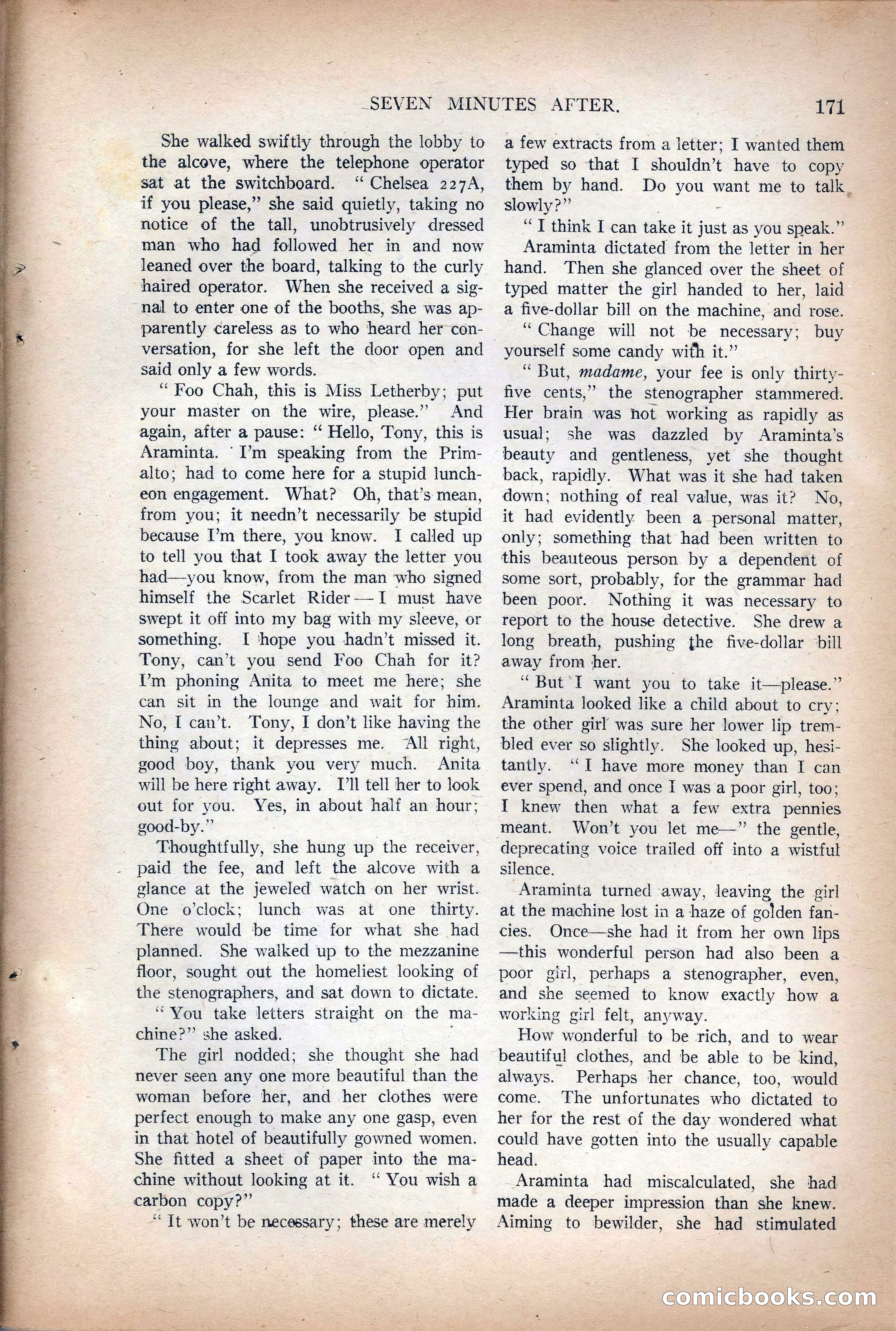
A restored page from Pulp Fiction, 1920. Page through the whole issue in the reader above.
📄 Transcribed text from this page (OCR, searchable)
Machine-transcribed from the original scan — historical spelling and the odd misread are preserved.
haired operator. ‘nal to enter one of the booths, she was ap- SEVEN MINUTES AFTER. ie She walked swiftly through the lobby io the alceve, where the telephone operator sat at the switchboard. ‘“ Chelsea 227A, if you please,” she said quietly, taking no notice of the tall, unobtrusively dressed man who had followed her in and now leaned over the board, talking to the curly When she received a sig- parently careless as to who heard her con- versation, for she left the door open and said only a few words. “Foo Chah, this is Miss Letherby; put your master on the wire, please.” And again, after a pause: ‘ Hello, Tony, this is Araminta. ‘I’m speaking from the Prim- alto; had to come here for a stupid lunch- eon engagement. What? Oh, that’s mean, from you; it needn’t necessarily be stupid because I’m there, you know. I called up to tell you that I took away the letter you had—you know, from the man who signed himself the Scarlet Rider-——I must have swept it off into my bag with my sleeve, or something. I ‘hope you hadn’t missed it. Tony, can’t you send Foo Chah for it? I’m phoning Anita to meet me here; she can sit in the lounge and wait for him. No, I can’t. Tony, I don’t like having the thing about; it depresses me. “All right, good boy, thank you very much. Anita_ will be here right away. Ill tell her to look out for you. Yes, in about half an hour; good-by.”’ | Thoughtfully, she hung up the receiver, : paid the fee, and left the alcove with a glance at the jeweled watch on her wrist. One o’clock; lunch was at one thirty. There would be time for what she had planned. She waiked up to the mezzanine floor, sought out the homeliest looking of the stenographers, and sat down to dictate. “You take letters straight on the ma- chine?” she asked. The girl nodded; she thought she had never seen any one more beautiful than the woman before her, and her clothes were perfect enough to make any one gasp, even in that hotel of beautifully gowned women. She fitted a sheet of paper into the ma- chine without looking at it. ‘‘ You wish a carbon copy?”’ ‘It won’t be necessary; these are merely a few extracts from a letter; I wanted them typed so that I shouldn’t have to copy them by hand. Do you want me to talk_ slowly?” = ‘I think I can take it just as you speak.” Araminta dictated from the letter in her hand. Then she glanced over the sheet of typed matter the girl handed to her, laid a five-dollar bill on the machine, and rose. “Change will not be necessary; buy yourself some candy with it.” “ But, madame, your fee is only thirty- five cents,” the stenographer stammered. Her brain was not working as rapidly as usual; she was dazzled by Araminta’s beauty and gentleness, yet she thought. back, rapidly. What was it she had taken down; nothing of real value, was it? No, it had evidently been a personal matter, only; something that had been written to this beauteous person by a dependent of some sort, probably, for the grammar had been poor. Nothing it was necessary to report to the house detective. She drew a long breath, pushing the five-dollar bill away from her. “But I want you to take it—please.” Araminta looked like a child about to cry; the other girl was sure her lower lip trem- bled ever so slightly. She looked up, hesi- tantly. ‘‘I have more money than I can~ ever spend, and once I was a poor girl, too; I knew then what a few extra pennies meant. Won’t you let me—” the gentle, deprecating voice trailed off into a wistful silence. 7 Araminta turned away, leaving the girl at the machine lost in a haze of golden fan- cies. Once—she had it from her own lips —this wonderful person had also been a poor girl, perhaps a stenographer, even, and she seemed to know exactly how a working girl felt, anyway. How wonderful to be rich, and to wear beautiful clothes, and be able to be kind, always. Perhaps her chance, too, would come. The unfortunates who dictated to her for the rest of the day wondered what could have gotten into the usually capable head. Araminta had miscalculated, she had made a deeper impression than she knew. Aiming to bewilder, she had stimulated ( comicbooks:. co! i os ix a :