
Pulp Fiction, 1920 · page 86 of 180
Argosy, Vol. 118, No. 2 — page 86: what you’re looking at
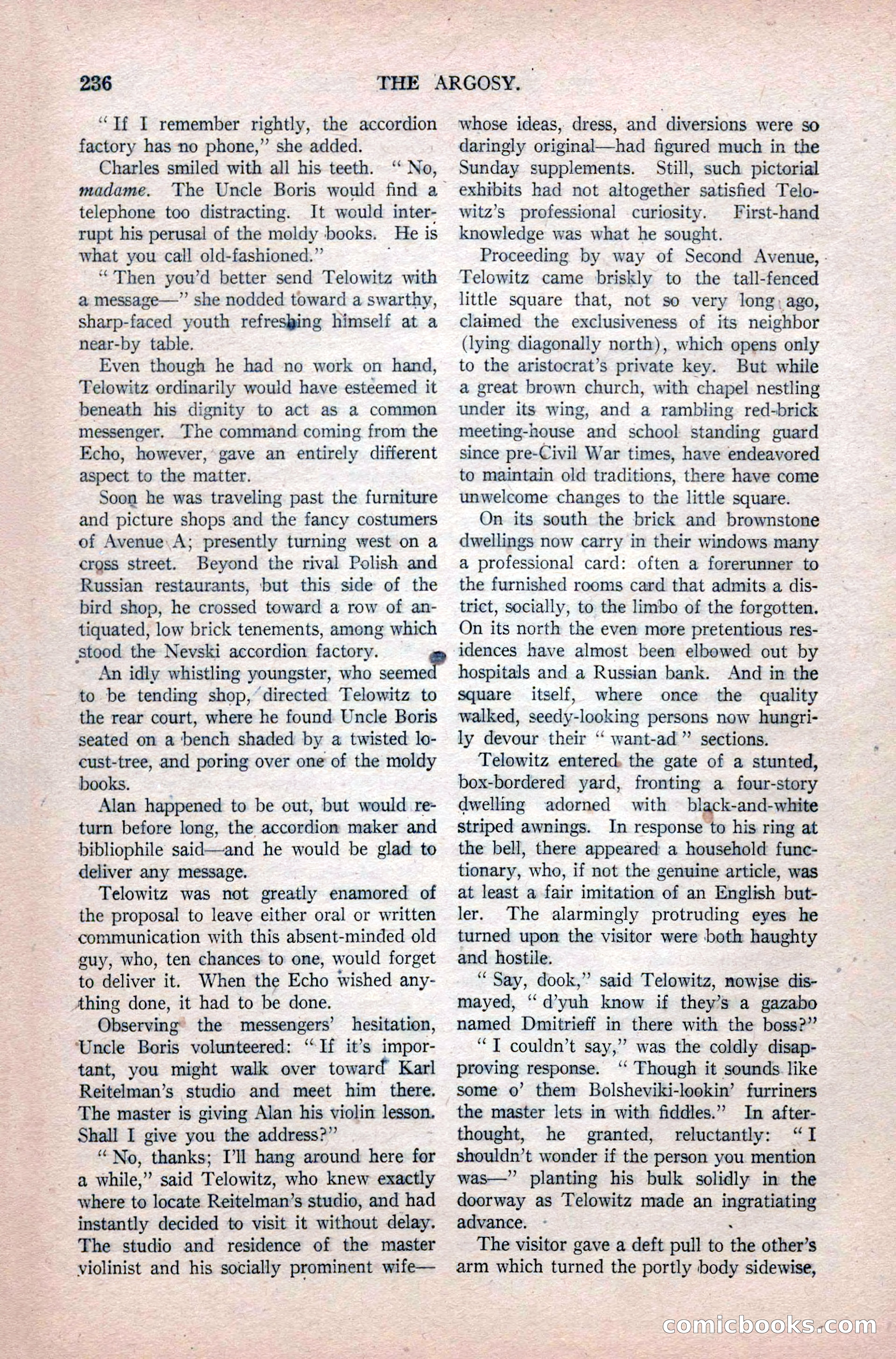
A restored page from Pulp Fiction, 1920. Page through the whole issue in the reader above.
📄 Transcribed text from this page (OCR, searchable)
Machine-transcribed from the original scan — historical spelling and the odd misread are preserved.
236 “Tf I remember rightly, the accordion factory has no phone,” she added. Charles smiled with all his teeth. madame. telephone too distracting. It would inter- rupt his perusal of the moldy books. He is what you call old-fashioned.” : “Then you’d better send Telowitz with a message—”’ she nodded toward a swarthy, sharp-faced youth refreshing himself at a near-by table. Even though he had no work on hand, Telowitz ordinarily would have esteemed it beneath his dignity to act as a common messenger, The command coming from the Echo, however,’ gave an entirely different aspect to the matter. Soon he was traveling past the furniture and picture shops and the fancy costumers of Avenue. A; presently turning west on a cross street. Beyond the rival Polish and Russian restaurants, but this side of the bird shop, he crossed toward a row of an- tiquated, low brick tenements, among which rT No, stood the Nevski accordion factory. = An idly whistling youngster, who seeme to be tending shop, directed Telowitz to the rear court, where he found Uncle Boris seated on a ‘bench shaded by a twisted lo- cust-tree, and poring over one of the moldy books. Alan happened to be out, but would re- turn before long, the accordion maker and bibliophile said—and he would be glad to deliver any message. Telowitz was not greatly enamored of the proposal to leave either oral or written -communication with this absent-minded old guy, who, ten chances to one, would forget to deliver it. When the Echo wished any- thing done, it had to be done. Observing the messengers’ hesitation, Uncle Boris volunteered: “If it’s impor- tant, you might walk over toward Karl Reitelman’s studio and meet him there. The master is giving Alan his violin lesson. Shall I give you the address?” ‘No, thanks; I’ll hang around here for a while,” said Telowitz, who knew exactly where to locate Reitelman’s studio, and had instantly decided to visit it without delay. The studio and residence of the master violinist and his socially prominent wife— The Uncle Boris would find a_ THE ARGOSY. whose ideas, dress, and diversions were so daringly original—had figured much in the Sunday supplements. Still, such pictorial exhibits had not altogether satisfied Telo- witz’s professional curiosity. First-hand knowledge was what he sought. Proceeding by way of Second Avenue, - Telowitz came briskly to the tall-fenced little square that, not so very long, ago, claimed the exclusiveness of its neighbor (lying diagonally north), which opens only to the aristocrat’s private key. But while a great brown church, with chapel nestling under its wing, and a rambling red-brick meeting-house and school standing guard since pre-Civil War times, have endeavored to maintain old traditions, there have come unwelcome changes to the little square. On its south the brick and brownstone dwellings now carry in their windows many a professional card: often a forerunner to the furnished rooms card that admits a dis- trict, socially, to the limbo of the forgotten. On its north the even more pretentious res- idences have almost been elbowed out by hospitals and a Russian bank. And in the square itself, where once the quality walked, seedy-looking persons now huneri- ly devour their ‘‘ want-ad ” sections. Telowitz entered. the gate of a stunted, box-bordered yard, fronting a four-story dwelling adorned with black-and-white striped awnings. In response to his ring at the bell, there appeared a household func- tionary, who, if not the genuine article, was at least a fair imitation of an English but- ler. The alarmingly protruding eyes he turned upon the visitor were both haughty and hostile. ‘Say, dook,” said Telowitz, mowise dis- mayed, “d’yuh know if they’s a gazabo named Dmitrieff in there with the boss?” ‘“T couldn’t say,” was the coldly disap- proving response. ‘‘ Though it sounds. like some 0’ them Bolsheviki-lookin’ furriners the master lets in with fiddles.” In after- thought, he granted, reluctantly: “I shouldn’t wonder if the person you mention was—” planting his bulk solidly in the doorway as Telowitz made an ingratiating advance. - ‘ The visitor gave a deft pull to the other’s arm which turned the portly body sidewise, EOPIC OOO KSxe©) LAL