
Pulp Fiction, 1920 · page 67 of 180
Argosy, Vol. 118, No. 2 — page 67: what you’re looking at
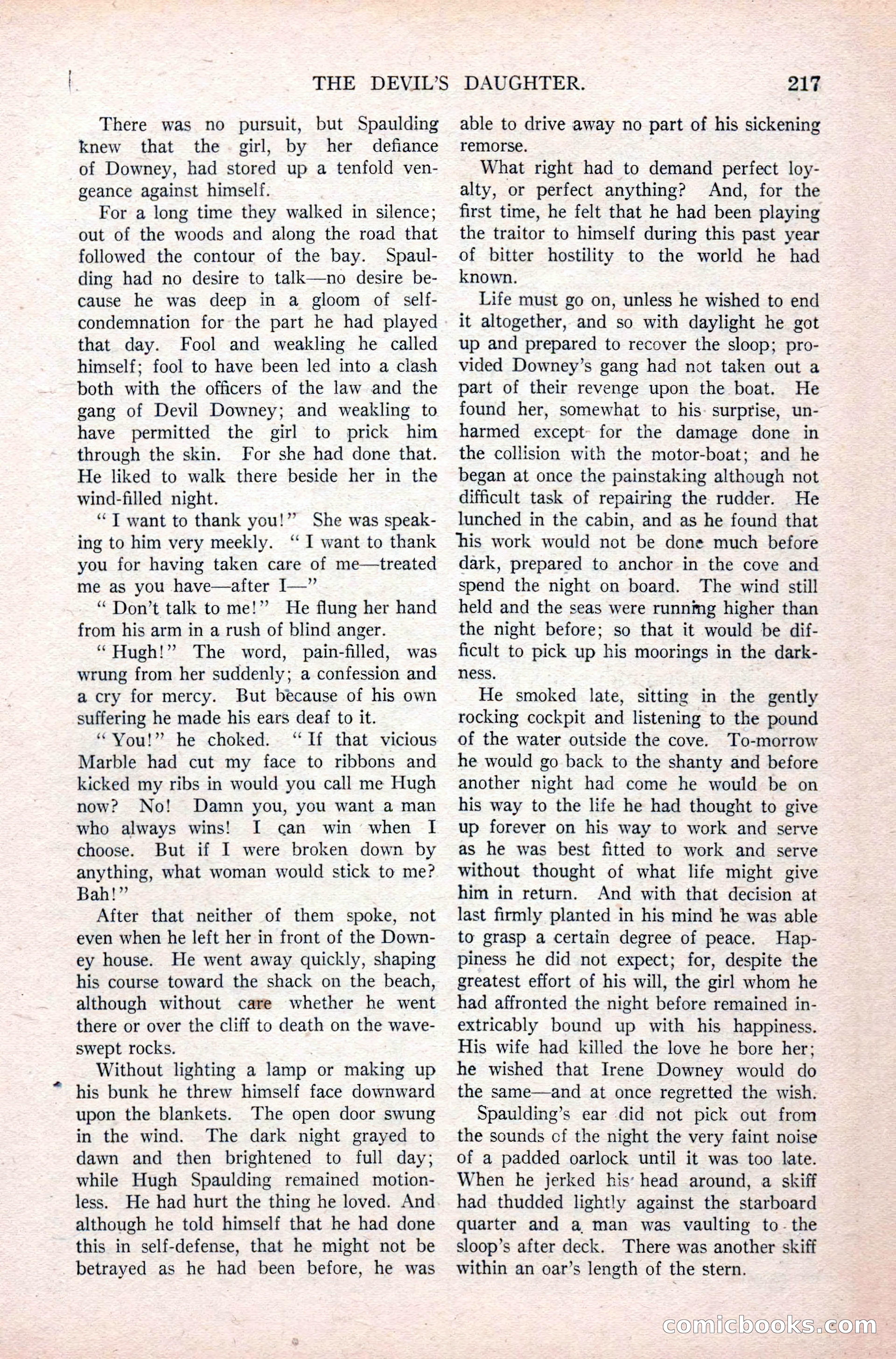
A restored page from Pulp Fiction, 1920. Page through the whole issue in the reader above.
📄 Transcribed text from this page (OCR, searchable)
Machine-transcribed from the original scan — historical spelling and the odd misread are preserved.
THE DEVIL’S DAUGHTER. There was no pursuit, but Spaulding knew that the. girl, by her defiance of Downey, had stored up a tenfold ven- geance against himself. For a long time they walked in silence; out of the woods and along the road that followed the contour of the bay. Spaul- ding had no desire to talk—no desire be- cause he was deep in a gloom of self- condemnation for the part he had played that day. Fool and weakling he called himself; fool to have been led into a clash both with the officers of the law and the gang of Devil Downey; and weakling to have permitted the girl to prick him through the skin. For she had done that. He liked to walk there beside her in the wind-filled night. ‘“‘T want to thank you!” She was speak- ing to him very meekly. ‘I want to thank you for having taken care of me—treated me as you have—after I—” “ Don’t talk to me!” He flung her hand from his arm in a rush of blind anger. “Hugh!” The word, pain-filled, was wrung from her suddenly; a confession and a cry for mercy. But because of his own suffering he made his ears deaf to it. “Vou!” he choked. “If that vicious Marble had cut my face to ribbons and kicked my ribs in would you call me Hugh now? No! Damn you, you want a man who always wins! I can win when [ choose. But if I were broken down by anything, what woman would stick to me? Bah!” After that neither of them spoke, not even when he left her in front of the Down- ey house. He went away quickly, shaping his course toward the shack on the beach, although without care whether he went there or over the cliff to death on the wave- swept rocks. Without lighting a lamp or making up his bunk he threw himself face downward upon the blankets. The open door swung in the wind. The dark night grayed to dawn and then brightened to full day; while Hugh Spaulding remained motion- less. He had hurt the thing he loved. And although he told himself that he had done this in self-defense, that he might not be betrayed as he had been before, he was 217 able to drive away no part of his sickening remorse. What right had to demand perfect loy- alty, or perfect anything? And, for the first time, he felt that he had been playing the traitor to himself during this past year of bitter hostility to the world he had known. Life must go on, unless he wished to end it altogether, and so with daylight he got up and prepared to recover the sloop; pro- vided Downey’s gang had not taken out a part of their revenge upon the boat. He found her, somewhat to his: surprise, un- harmed except for the damage done in the collision with the motor-boat; and he began at once the painstaking although not difficult task of repairing the rudder. He lunched in the cabin, and as he found that his work would not be done much before dark, prepared to anchor in the cove and spend the night on board. The wind still held and the seas were runnmg higher than the night before; so that it would be dif- ficult to pick up his moorings in the dark- ness. He smoked late, sitting in the gently rocking cockpit and listening to the pound of the water outside the cove. To-morrow he would go back to the shanty and before another night had come he would be on his way to the life he had thought to give up forever on his way to work and serve as he was best fitted to work and serve without thought of what life might give him in return. And with that decision at last firmly planted in his mind he was able to grasp a certain degree of peace. Hap- piness he did not expect; for, despite the greatest effort of his will, the girl whom he had affronted the night before remained in- extricably bound up with his happiness. His wife had killed the love he bore her; he wished that Irene Downey would do the same—and at once regretted the wish. Spaulding’s ear did not pick out from the sounds cf the night the very faint noise of a padded oarlock until it was too late. When he jerked his’ head around, a skiff had thudded lightly against the starboard quarter and a man was vaulting to-the sloop’s after deck. There was another skiff within an oar’s length of the stern. COMICLOOOLK< (E@)