
Pulp Fiction, 1920 · page 61 of 180
Argosy, Vol. 118, No. 2 — page 61: what you’re looking at
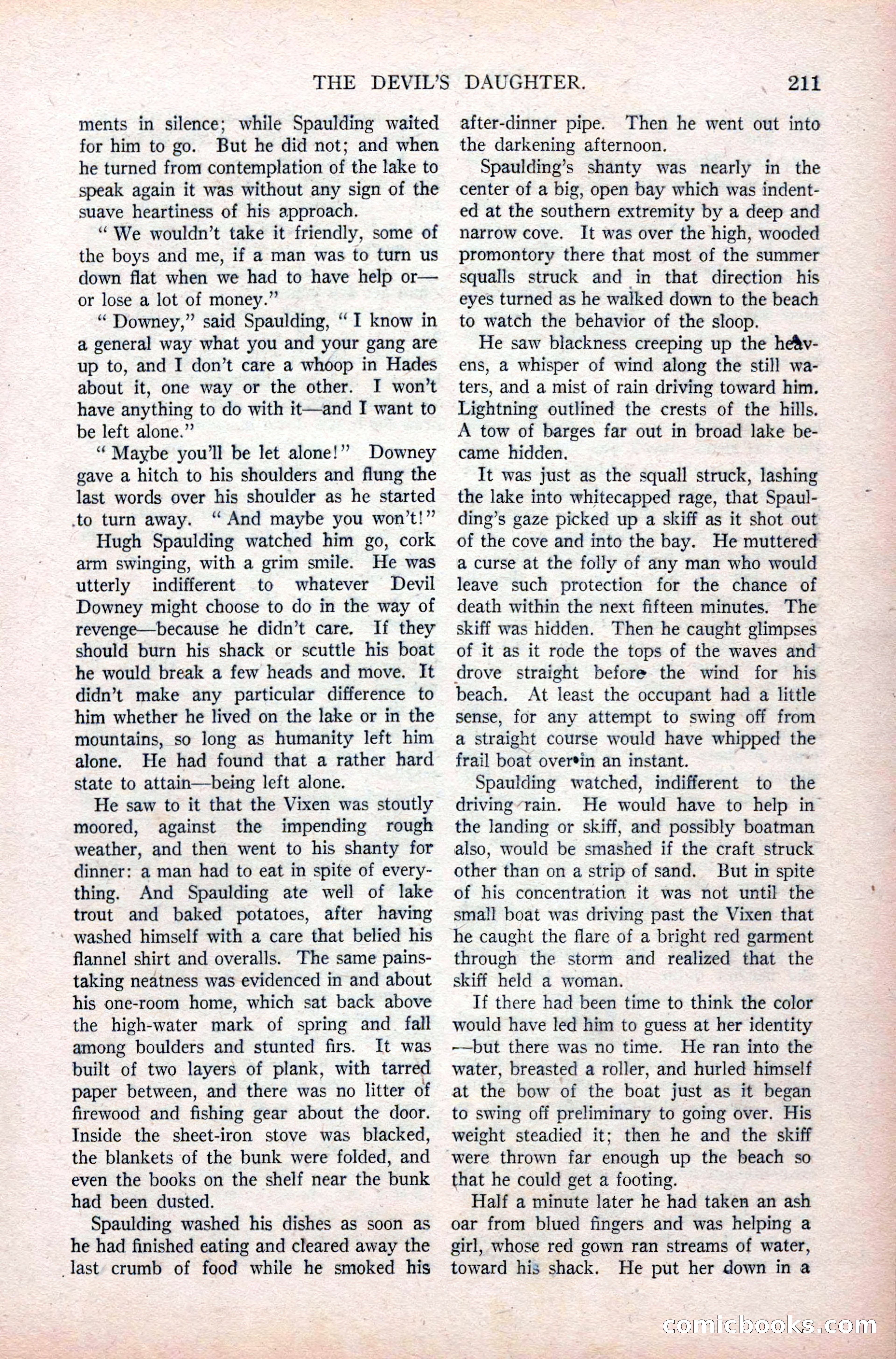
A restored page from Pulp Fiction, 1920. Page through the whole issue in the reader above.
📄 Transcribed text from this page (OCR, searchable)
Machine-transcribed from the original scan — historical spelling and the odd misread are preserved.
THE DEVIL’S DAUGHTER. ments in silence; while Spaulding waited for him to go. But he did not; and when he turned from contemplation of the lake to speak again it was without any sign of the suave heartiness of his approach. “We wouldn’t take it friendly, some of the boys and me, if a man was to turn us down flat when we had to have help or— or lose a lot of money.” “ Downey,” said Spaulding, “I know in a general way what you and your gang are up to, and I don’t care a whoop in Hades about it, one way or the other. I won’t have anything to do with it—and I want to be left alone.” “Maybe you'll be let alone!” Downey gave a hitch to his shoulders and flung the last words over his shoulder as he started to turn away. “ And maybe you won’t!” Hugh Spaulding watched him go, cork arm swinging, with a grim smile. He was utterly indifferent to whatever Devil Downey might choose to do in the way of revenge—because he didn’t care. If they should burn his shack or scuttle his boat he would break a few heads and move. It didn’t make any particular difference to him whether he lived on the lake or in the mountains, so long as humanity left him alone. He had found that a rather hard state to attain—being left alone. He saw to it that the Vixen was stoutly moored, against the impending rough weather, and then went to his shanty for dinner: a man had to eat in spite of every- thing. And Spaulding ate well of lake trout and baked potatoes, after having ' washed himself with a care that belied his flannel shirt and overalls. The same pains- taking neatness was evidenced in and about his one-room home, which sat back above the high-water mark of spring and _ fall among boulders and stunted firs. It was built of two layers of plank, with tarred paper between, and there was no litter of firewood and fishing gear about the door. Inside the sheet-iron stove was blacked, the blankets of the bunk were folded, and even the books on the shelf near the bunk had been dusted. Spaulding washed his dishes as soon as he had finished eating and cleared away the _last crumb of food while he smoked his 211 after-dinner pipe. Then he went out into the darkening afternoon. Spaulding’s shanty was nearly in the center of a big, open bay which was indent- ed at the southern extremity by a deep and narrow cove. It was over the high, wooded promontory there that most of the summer squalls struck and in that direction his eyes turned as he walked down to the beach to watch the behavior of the sloop. He saw blackness creeping up the he&v- ens, a whisper of wind along the still wa- ters, and a mist of rain driving toward him. Lightning outlined the crests of the hills. A tow of barges far out in broad lake be- came hidden. It was just as the squall struck, lashing the lake into whitecapped rage, that Spaul- ding’s gaze picked up a skiff as it shot out of the cove and into the bay. He muttered a curse at the folly of any man who would leave such protection for the chance of death within the next fifteen minutes. The skiff was hidden. Then he caught glimpses of it as it rode the tops of the waves and drove straight before the wind for his beach. At least the occupant had a little sense, for any attempt to swing off from a straight course would have whipped the frail boat over*in an instant. Spaulding watched, indifferent to the driving “rain. the landing or skiff, and possibly boatman also, would be smashed if the craft struck other than on a strip of sand. But in spite of his concentration it was not until the small boat was driving past the Vixen that he caught the flare of a bright red garment through the storm and realized that the skiff held a woman. If there had been time to think the color would have led him to guess at her identity -—but there was no time. He ran into the water, breasted a roller, and hurled himself at the bow of the boat just as it began to swing off preliminary to going over. His weight steadied it; then he and the skiff were thrown far enough up the beach so that he could get a footing. Half a minute later he had taken an ash oar from blued fingers and was helping a girl, whose red gown ran streams of water, toward his shack. He put her down in a COPNICLOOKS He would have to help in (©)