
Pulp Fiction, 1920 · page 152 of 180
Argosy, Vol. 118, No. 2 — page 152: what you’re looking at
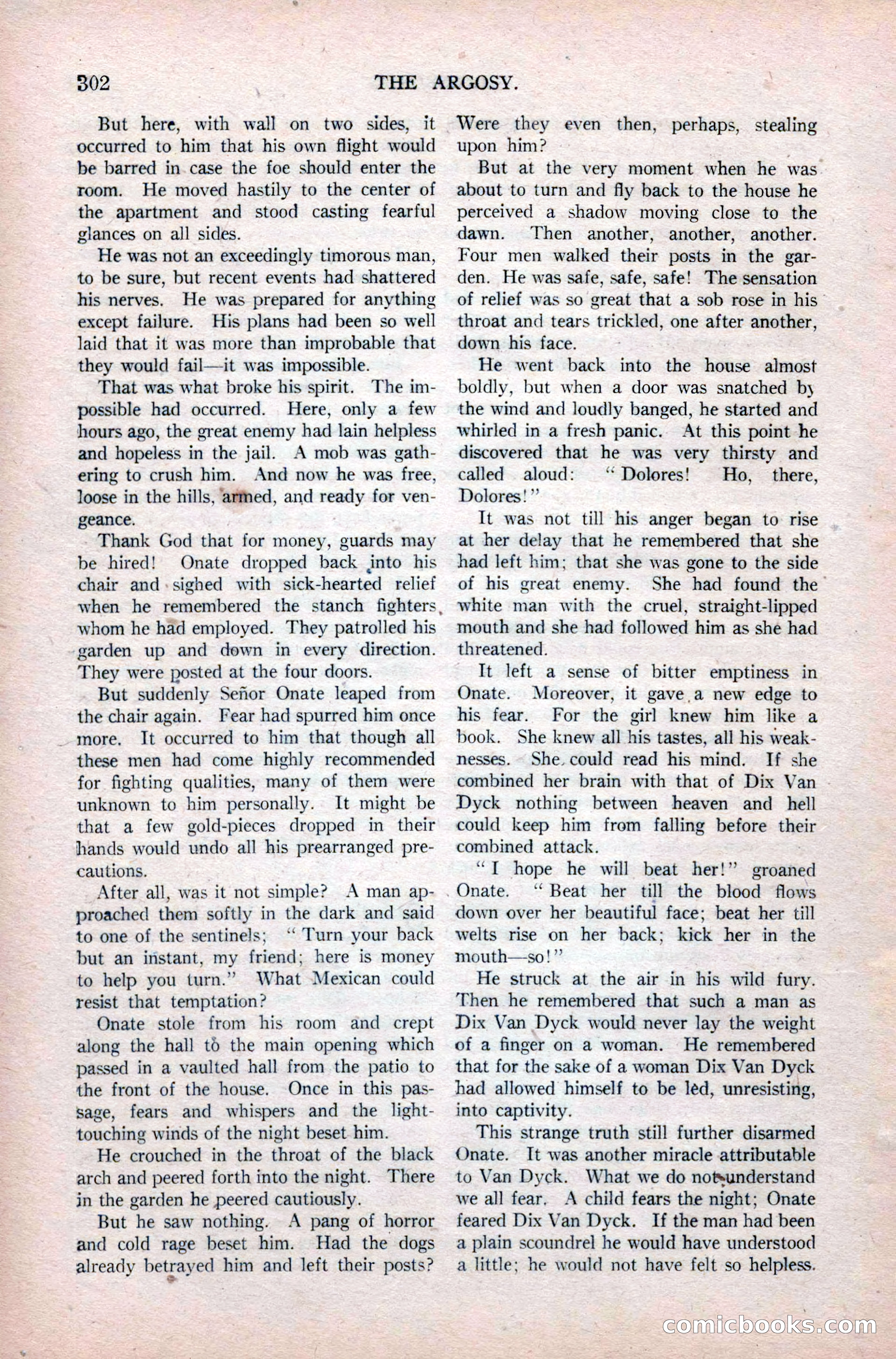
A restored page from Pulp Fiction, 1920. Page through the whole issue in the reader above.
📄 Transcribed text from this page (OCR, searchable)
Machine-transcribed from the original scan — historical spelling and the odd misread are preserved.
_ more, B02 But here, with wall on two sides, it occurred to him that his own flight would be barred in. case the foe should enter the room. He moved hastily to the center of the apartment and stood casting fearful glances on all sides. He was not an exceedingly timorous man, to be sure, but recent events had shattered his nerves. He was prepared for anything except failure. His plans had been so well laid that it was more than improbable that they would fail—it was impossible. That was what broke his spirit. The im- possible had occurred. Here, only a few hours ago, the great enemy had lain helpless and hopeless in the jail. A mob was gath- ering to crush him. And now he was free, loose in the hills, arfned, and ready for ven- geance. Thank God that for money, guards may be hired! Onate dropped back into his chair and-+sighed with sick-hearted relief when he remembered the stanch fighters, whom he had employed. They patrolled his garden up and dewn in every direction. They were posted at the four doors. But suddenly Senor Onate leaped from the chair again. Fear had spurred him once It occurred to him that though all these men had come highly recommended for fighting qualities, many of them were unknown to him personally. It might be that a few gold-pieces dropped in their hands would undo all his prearranged pre- cautions. After all, was it not simple? A man ap- proached them softly in the dark and said to one of the sentinels; ‘‘ Turn your back but an instant, my friend; here is money to help you turn.” What Mexican could resist that temptation? Onate stole from his room and crept along the hall td the main opening which passed in a vaulted hall from the patio to the front of the house. Once in this pas- sage, fears and whispers and the light- touching winds of the night beset him. He crouched in the throat of the black arch and peered forth into the night. There in the garden he peered cautiously. But he saw nothing. A pang of horror and cold rage beset him. Had the dogs already betrayed him and left their posts? -Onate. THE ARGOSY. Were they even then, perhaps, stealing upon him? But at the very moment when he was about to turn and fly back to the house he perceived a shadow moving close to the dawn. Then another, another, another. Four men walked their posts in the gar- den. He was safe, safe, safe! The sensation of relief was so great that a sob rose in his’ throat and tears trickled, one after another, down his face. He went back into the house almost boldly, but when a door was snatched by the wind and loudly banged, he started and whirled in a fresh panic. At this point he discovered that he was very thirsty and called aloud: ‘ Dolores! Ho, there, Dolores!”’ It was not till his anger began to rise at her delay that he remembered that she had left him; that she was gone to the side of his great enemy. She had found the white man with the cruel, straight-lipped mouth and she had followed him as she had threatened. It left a sense of bitter emptiness in Onate. Moreover, it gave.a new edge to his fear. For the girl knew him like a book. She knew all his tastes, all his weak- nesses. She. could read his mind. If she combined her brain with that of Dix Van - Dyck nothing between heaven and _ hell could keep him from falling before their combined attack. “T hope he will beat her!” peoutied ‘Beat her till the blood flows down over her beautiful face; beat her till welts rise on her back; kick her in the mouth—so!”’ He struck at the air in his wild fury. Then he remembered that such a man as Dix Van Dyck would never lay the weight of a finger on a woman. He remembered that for the sake of a woman Dix Van Dyck had allowed himself to be led, unresisting, into captivity. This strange truth still further disarmed Onate. It was another miracle attributable to Van Dyck. What we do notsunderstand we all fear. A child fears the night; Onate feared Dix Van Dyck. If the man had been a plain scoundrel he would have understood a little; he would not have felt so helpless. S (E@) ANIC .OO (E@)