
Pulp Fiction, 1920 · page 146 of 180
Argosy, Vol. 118, No. 2 — page 146: what you’re looking at
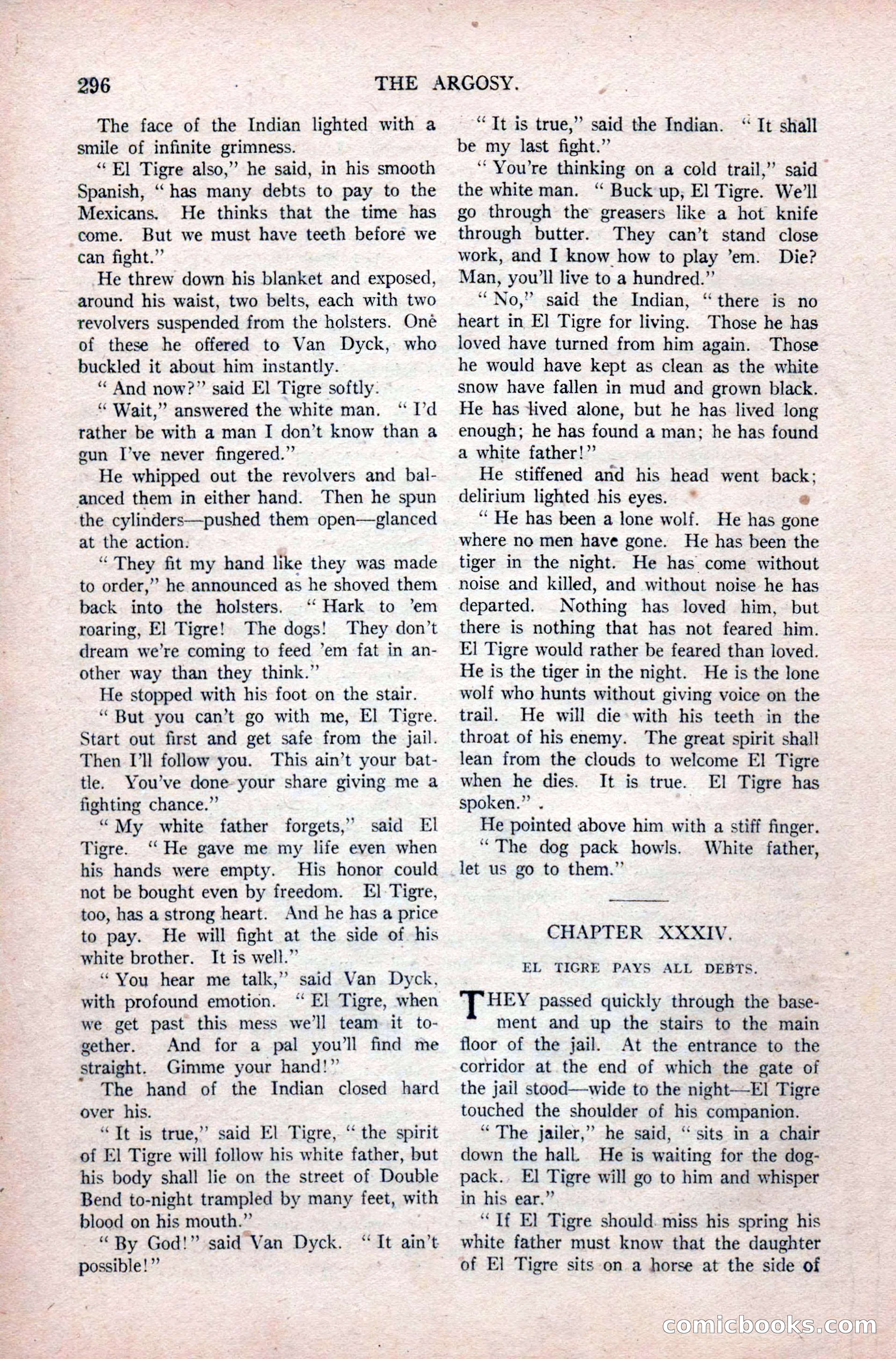
A restored page from Pulp Fiction, 1920. Page through the whole issue in the reader above.
📄 Transcribed text from this page (OCR, searchable)
Machine-transcribed from the original scan — historical spelling and the odd misread are preserved.
296 The face of the Indian lighted with a smile of infinite grimness. “El Tigre also,” he said, in his smooth Spanish, “has many debts to pay to the Mexicans. He thinks that the time has come. But we must have teeth before we can fight.”’ He threw down his blanket and exposed, around his waist, two belts, each with two revolvers suspended from the holsters. One of these he offered to Van Dyck, who buckled it about him instantly. “ And now?” said El Tigre softly. ‘“ Wait,” answered the white man. “ Id rather be with a man I don’t know than a gun I’ve never fingered.” He whipped out the revolvers and bal- anced them in either hand. Then he spun the cylinders—pushed them open—glanced at the action. “ They fit my hand like they was made to order,” he announced as he shoved them back into the holsters. “Hark to ’em roaring, El Tigre! The dogs! They don’t dream we're coming to feed ’em fat in an- other way than they think.” He stopped with his foot on the stair. “But you can’t go with me, El Tigre. Start out first and get safe from the jail. Then Ill follow you. This ain’t your bat- tle. You’ve done-your share giving me a fighting chance.”’ “My white father forgets,’ said El Tigre. “He gave me my life even when his hands were empty. His honor could not be bought even by freedom. EE] Tigre, too, has a strong heart. And he has a price to pay. He will fight at the side of his white brother. It is well.” “You hear me talk,” said Van Dyck, with profound emotion. “ El Tigre, when we get past this mess we'll team it to- gether. And for a pal you'll find me straight. Gimme your hand!” " The hand of the Indian closed hard over his. “Tt is true,” said El Tigre, “the spirit of El Tigre will follow his white father, but his body shall lie on the street of Double Bend to-night trampled by many feet, with blood on his mouth.” _ “By God!” said Van Dyck. “It ain’t possible!” THE ARGOSY. “Tt is true,” said the Indian. “ It shall be my last fight.” ‘You're thinking on a cold trail,” said the white man. “ Buck up, El Tigre. We'll go through the greasers like a hot knife through butter. They can’t stand close work, and I know how to play ’em. Die? Man, you'll live to a hundred.”’ “No,” said the Indian, “there is no heart in El Tigre for living. Those he has loved have turned from him again. Those he would have kept as clean as the white snow have fallen in mud and grown black. He has tived alone, but he has lived long enough; he has found a man; he has found a white father!” He stiffened and his head went back: delirium lighted his eyes. ~* a ‘‘ He has been a lone wolf. He has gone where no men have gone. He has been the tiger in the night. He has come without noise and killed, and without noise he has departed. Nothing has loved him, but there is nothing that has not feared him. El Tigre would rather be feared than loved. He is the tiger in the night. He is the lone wolf who hunts without giving voice on the trail. He will die with his teeth in the throat of his enemy. The great spirit shall lean from the clouds to welcome El Tigre when he dies. It is true. El Tigre has spoken.” . He pointed above him with a stiff finger. ‘The dog pack howls. White father, let us go to them.” CHAPTER XXXIV, EL TIGRE PAYS ALL DEBTS. HEY passed quickly through the base- ment and up the stairs to the main floor of the jail. At the entrance to the corridor at the end of which the gate of the jail stood—wide to the night—El Tigre touched the shoulder of his companion. “ The jailer,” he said, “sits in a chair down the hall. He is waiting for the dog- pack. El Tigre will go to him and whisper in his ear.” ‘If El Tigre should. miss his spring his white father must know that the daughter of El Tigre sits on a horse at the side of (EO) .OO mie S (E@)