
Pulp Fiction, 1920 · page 144 of 180
Argosy, Vol. 118, No. 2 — page 144: what you’re looking at
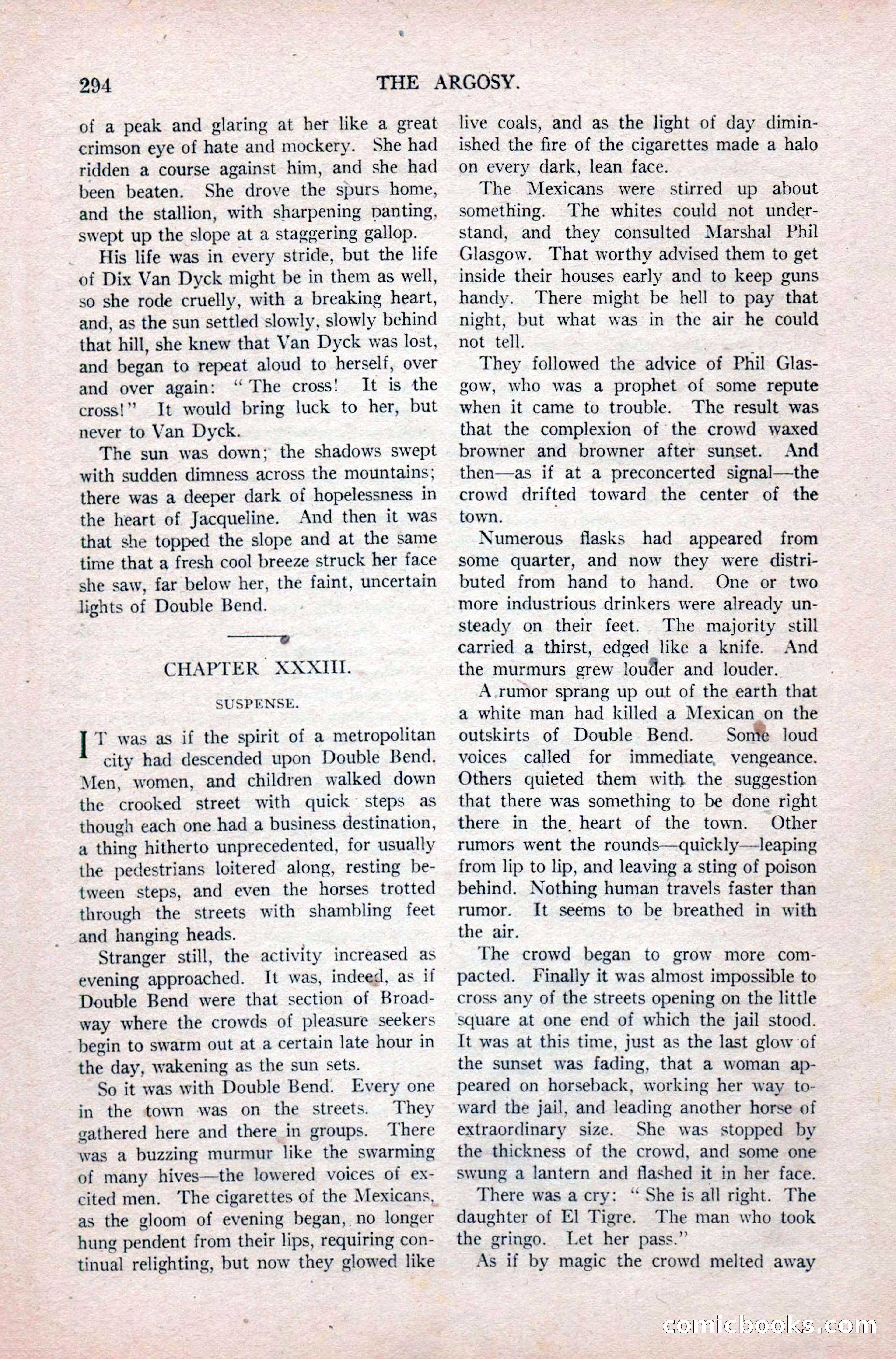
A restored page from Pulp Fiction, 1920. Page through the whole issue in the reader above.
📄 Transcribed text from this page (OCR, searchable)
Machine-transcribed from the original scan — historical spelling and the odd misread are preserved.
294 of a peak and glaring at her like a great crimson eye of hate and mockery. She had ridden a course against him, and she had been beaten. She drove the spurs home, and the stallion, with sharpening panting, swept up the slope at a staggering gallop. His life was in every stride, but the life of Dix Van Dyck might be in them as well, so she rode cruelly, with a breaking heart, and, as the sun settled slowly, slowly behind that hill, she knew that Van Dyck was lost, and began to repeat aloud to herself, over and over again: ‘“‘ The cross! It is the cross!” It would bring luck to her, but never to Van Dyck. The sun was down; the shadows swept with sudden dimness across the mountains; there was a deeper dark of hopelessness in the heart of Jacqueline. And then it was that she topped the slope and at the same time that a fresh cool breeze struck her face she saw, far below her, the faint, uncertain lights of Double Bend. So a CHAPTER XXXIII. SUSPENSE. T was as if the spirit of a metropolitan city had descended upon Double Bend. Men, women, and children walked down the crooked street with quick steps as though each one had a business destination, a thing hitherto unprecedented, for usually the pedestrians loitered along, resting be- tween steps, and even the horses trotted through the streets with shambling feet and hanging heads. 7 Stranger still, the activity increased as evening approached. It was, indeed, as if Double Bend were that section of Broad- way where the crowds of pleasure seekers begin to swarm out at a certain late hour in the day, wakening as the sun sets. So it was with Double Bend. Every one in the town was on the streets. They gathered here and there in groups. There was a buzzing murmur like the swarming of many hives—the lowered voices of ex- cited men. The cigarettes of the Mexicans, as the gloom of evening began, no longer hung pendent from their lips, requiring con- tinual relighting, but now they glowed like THE ARGOSY. live coals, and as the light of day dimin- ished the fire of the cigarettes made a halo on every dark, lean face. The Mexicans were stirred up about something. The whites could not under- stand, and they consulted Marshal Phil Glasgow. That worthy advised them to get inside their houses early and to keep guns handy. There might be hell to pay that night, but what was in the air he could not tell. | : They followed the advice of Phil Glas- gow, who was a prophet of some repute when it came to trouble. The result was that the complexion of the crowd waxed browner and browner after sunset. And then—as if at a preconcerted signal—the crowd drifted toward the center of the town. Numerous flasks had appeared from some quarter, and now they were distri- buted from hand to hand. One or two more industrious drinkers were already un- steady on their feet. The majority still carried a thirst, edged like a knife. And the murmurs grew louder and louder. A rumor sprang up out of the earth that a white man had killed a Mexican on the outskirts of Double Bend. Some loud voices called for immediate, vengeance. Others quieted them with the suggestion that there was something to be done right there in the heart of the town. Other rumors went the rounds—quickly—leaping from lip to lip, and leaving a sting of poison behind. Nothing human travels faster than rumor. It seems to be breathed in with the air. The crowd began to grow more com- pacted. Finally it was almost impossible to cross any of the streets opening on the little square at one end of which the jail stood. It was at this time, just as the last glow of the sunset was fading, that a woman ap- peared on horseback, working her way to- ward the jail, and leading another horse of extraordinary size. She was stopped by the thickness of the crowd, and some one swung a lantern and flashed it in her face. There was acry: “ She is all right. The daughter of El Tigre. The man who took the gringo. Let her pass.” As if by magic the crowd melted away COPMICLOOOKS (E@)