
Pulp Fiction, 1920 · page 137 of 180
Argosy, Vol. 118, No. 2 — page 137: what you’re looking at
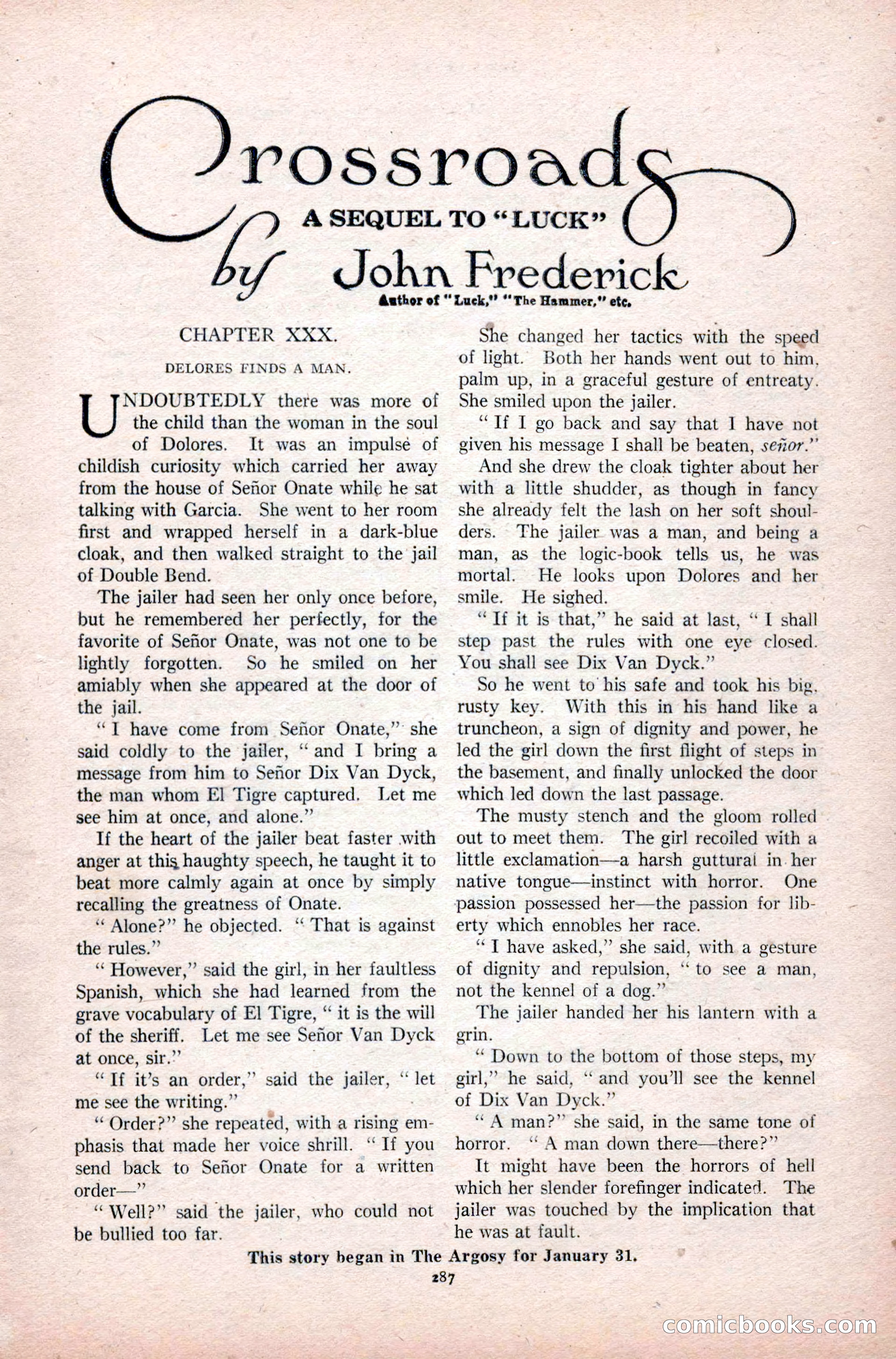
A restored page from Pulp Fiction, 1920. Page through the whole issue in the reader above.
📄 Transcribed text from this page (OCR, searchable)
Machine-transcribed from the original scan — historical spelling and the odd misread are preserved.
rossroa A SEQUEL TO “LUCK” John Frederick. Author of “ Luck,"’ “The Hammer,” ete, Y CHAPTER XXX. DELORES FINDS A MAN. NDOUBTEDLY there was more of U the child than the woman in the soul of Dolores. It was an impulsé of childish curiosity which carried her away from the house of Senor Onate while he sat talking with Garcia. She went to her room first and wrapped herself in a dark-blue cloak, and then walked straight to the jail of Double Bend. The jailer had seen her only once before, but he remembered her perfectly, for the favorite of Senor Onate, was not one to be lightly forgotten. So he smiled on her amiably when she appeared at the door of the jail. “T have come from Senor Onate,” she said coldly to the jailer, “and I bring a message from him to Senor Dix Van Dyck, the man whom E] Tigre captured. Let me see him at once, and alone.”’ If the heart of the jailer beat faster with anger at this haughty speech, he taught it to beat more calmly again at once by simply recalling the greatness of Onate. ‘‘ Alone?” he objected. ‘“* That is against the rules.” “However,” said the girl, in her faultless Spanish, which she had learned from the grave vocabulary of El Tigre, “ it is the will of the sheriff. Let me see Senor Van Dyck at once, sir.”’ : “Tf it’s an order,’ me see the writing.” __ . “Order?” she repeated, with a rising em- phasis that made her voice shrill. “If you send back to Sefor Onate for a written order—” “Well?” said the jailer, who could not be bullied too far. ’ said the jailer, “ let She changed her tactics with the speed of light. Both her hands went out to him, palm up, in a graceful gesture of entreaty. She smiled upon the jailer. “Tf I go back and say that I have not given his message I shall be beaten, sezor.”’ And she drew the cloak tighter about her with a little shudder, as though in fancy she already felt the lash on her soft shoul- ders. The jailer was a man, and being a man, as the logic-book tells us, he was mortal. He looks upon Dolores and her smile. He sighed. “If it is that,” he said at last, “ I shall step past the rules with one eye closed. You shall see Dix Van Dyck.” So he went to his safe and took his big. rusty key. With this in his hand like a truncheon, a sign of dignity and power, he led the girl down the first flight of steps in the basement, and finally unlocked the door which led down the last passage. The musty stench and the gloom rolled out to meet them. The girl recoiled with a little exclamation—a harsh guttural in. her native tongue—instinct with horror. One passion possessed her—the passion for lib- erty which ennobles her race. ‘“{ have asked,” she said, with a gesture of dignity and repulsion, “‘ to see a man, not the kennel of a dog.” The jailer handed her his lantern with a grin. “Down to the bottom of those steps, my girl,” he said, ‘‘ and you'll see the kennel of Dix Van Dyck.” ‘““A man?” she said, in the same tone of horror. ‘‘ A man down there—there?” It might have been the horrors of hell which her slender forefinger indicated. The jailer was touched by the implication that he was at fault. This story began in The Argosy for January 31. 287 Gomichoo (E@)