
Pulp Fiction, 1920 · page 134 of 180
Argosy, Vol. 118, No. 2 — page 134: what you’re looking at
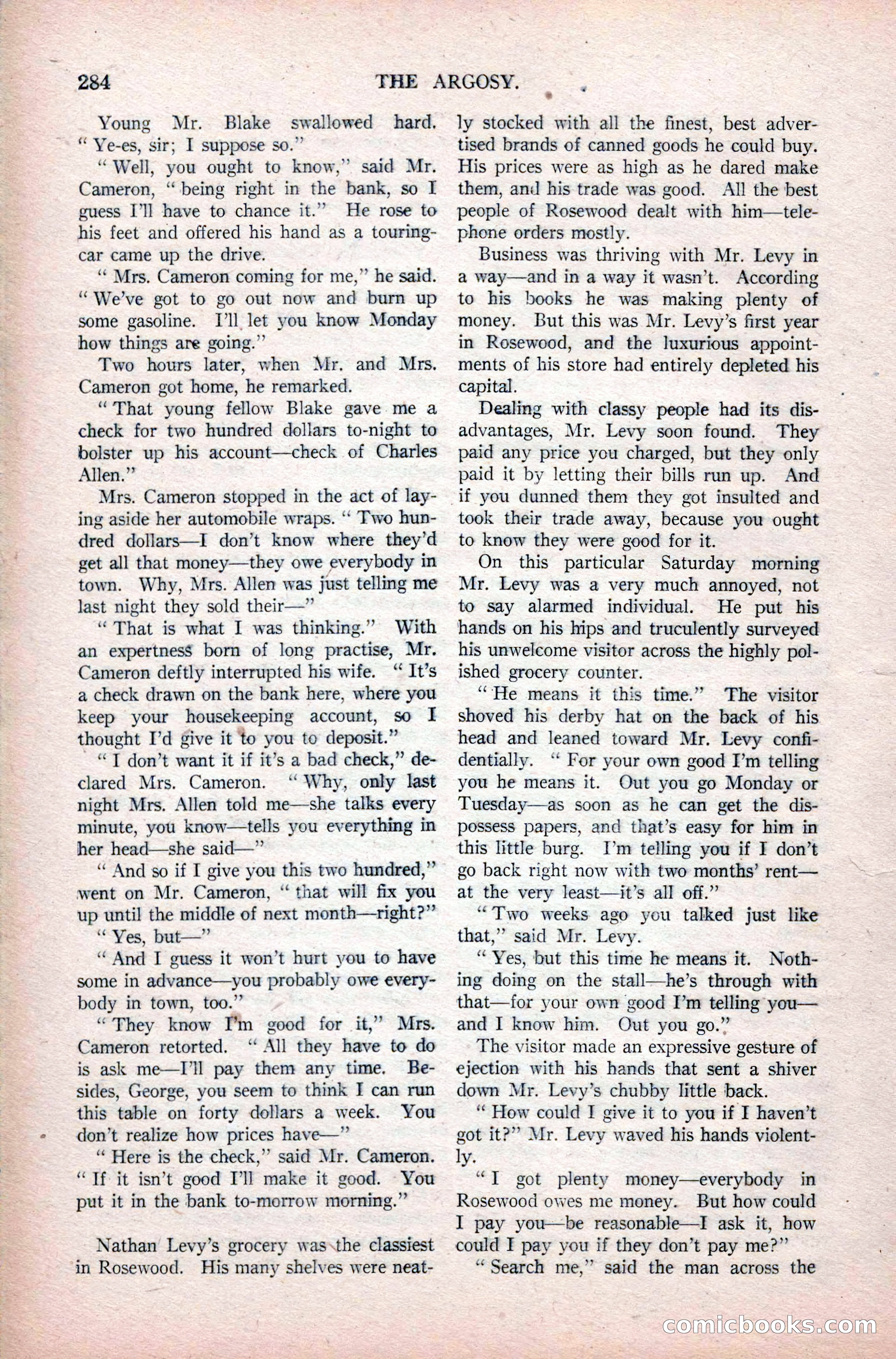
A restored page from Pulp Fiction, 1920. Page through the whole issue in the reader above.
📄 Transcribed text from this page (OCR, searchable)
Machine-transcribed from the original scan — historical spelling and the odd misread are preserved.
284 Young Mr. Blake swallowed hard. “ Ye-es, sir; I suppose so.” “Well, you ought to know,” said Mr. Cameron, “ being right in the bank, so I guess I'll have to chance it.” He rose to his feet and offered his hand as a touring- car came up the drive. ‘Mrs. Cameron coming for me,” he said. “We've got to go out now and burn up some gasoline. I’ll let you know Monday how things are going.”’ Two hours later, when Mr. and Mrs. Cameron got home, he remarked. “That young fellow Blake gave me a check for two hundred dollars to-night to bolster up his account—check of Charles Allen.” Mrs. Cameron stopped in the act of lay- ing aside her automobile wraps. ‘“ Two hun- dred dollars—I don’t know where they’d get all that money—they owe everybody in town. Why, Mrs. Allen was just telling me last night they sold their—” “That is what I was thinking.” With an expertness born of long practise, Mr. Cameron deftly interrupted his wife. “It’s a check drawn on the bank here, where you keep your housekeeping account, so I thought I’d give it to you to deposit.” —“T don’t want it if it’s a bad check,” de- clared Mrs. Cameron. ‘“ Why, only last night Mrs. Allen told me—she talks every minute, you know—tells you everything in her head—she said—”’ “And so if I give you this two hundred,” went on Mr. Cameron, “ that will fix you up until the middle of next month—right?” “Yes, but—” ‘And I guess it won’t hurt you to have some in advance—you probably owe every- body in town, too.” “They know I’m good for it,” Mrs. Cameron retorted. ‘“ All they have to do is ask me—lI’ll pay them any time. Be- sides, George, you seem to think I can run this table on forty dollars a week. You don’t realize how prices have—”’ “ Here is the check,”’ said Mr. Cameron. “Tf it isn’t good I'll make it good. You put it in the bank to-morrow morning.” Nathan Levy’s grocery was-the classiest in Rosewood. His many shelves were neat- THE ARGOSY. . ly stocked with all the finest, best adver- tised brands of canned goods he could buy. His prices were as high as he dared make them, and his trade was good. All the best people of Rosewood dealt with him—tele- phone orders mostly. Business was thriving with Mr. Levy in a way—and in a way it wasn’t. According to his books he was making plenty of money. But this was Mr. Levy’s first year in Rosewood, and the luxurious appoint- ments of his store had entirely depleted his capital. Dealing with classy people had its dis- advantages, Mr. Levy soon found. They paid any price you charged, but they only paid it by letting their bills run up. And if you dunned them they got insulted and took their trade away, because you ought to know they were good for it. On this particular Saturday morning Mr. Levy was a very much annoyed, not to say alarmed individual. He put his hands on his hips and truculently surveyed his unwelcome visitor across the highly pol- ished grocery counter. “He means it this time.” The visitor shoved his derby hat on the back of his head and leaned toward Mr. Levy confi- dentially. ‘‘ For your own good I’m telling you he means it. Out you go Monday or Tuesday—as soon as he can get the dis- possess papers, and that’s easy for him in this little burg. I’m telling you if I don’t go back right now with two months’ rent— at the very least—it’s all off.” “Two weeks ago you talked just like that,” said Mr. Levy. “Yes, but this time he means it. Noth- ing doing on the stall—he’s through with that—for your own good I’m telling you— and I know him. Out you go.” The visitor made an expressive gesture of ejection with his hands that sent a shiver down Mr. Levy’s chubby little back. ‘“ How could I give it to you if I haven’t got it?” Mr. Levy waved his hands violent- ly. “I got plenty money—everybody in Rosewood owes me money. But how could I pay you—be reasonable—I ask it, how could I pay you if they don’t pay me?” “Search me,” said the man across the (E@) mice S .OO (E@)