
Pulp Fiction, 1920 · page 122 of 180
Argosy, Vol. 118, No. 2 — page 122: what you’re looking at
A restored page from Pulp Fiction, 1920. Page through the whole issue in the reader above.
📄 Transcribed text from this page (OCR, searchable)
Machine-transcribed from the original scan — historical spelling and the odd misread are preserved.
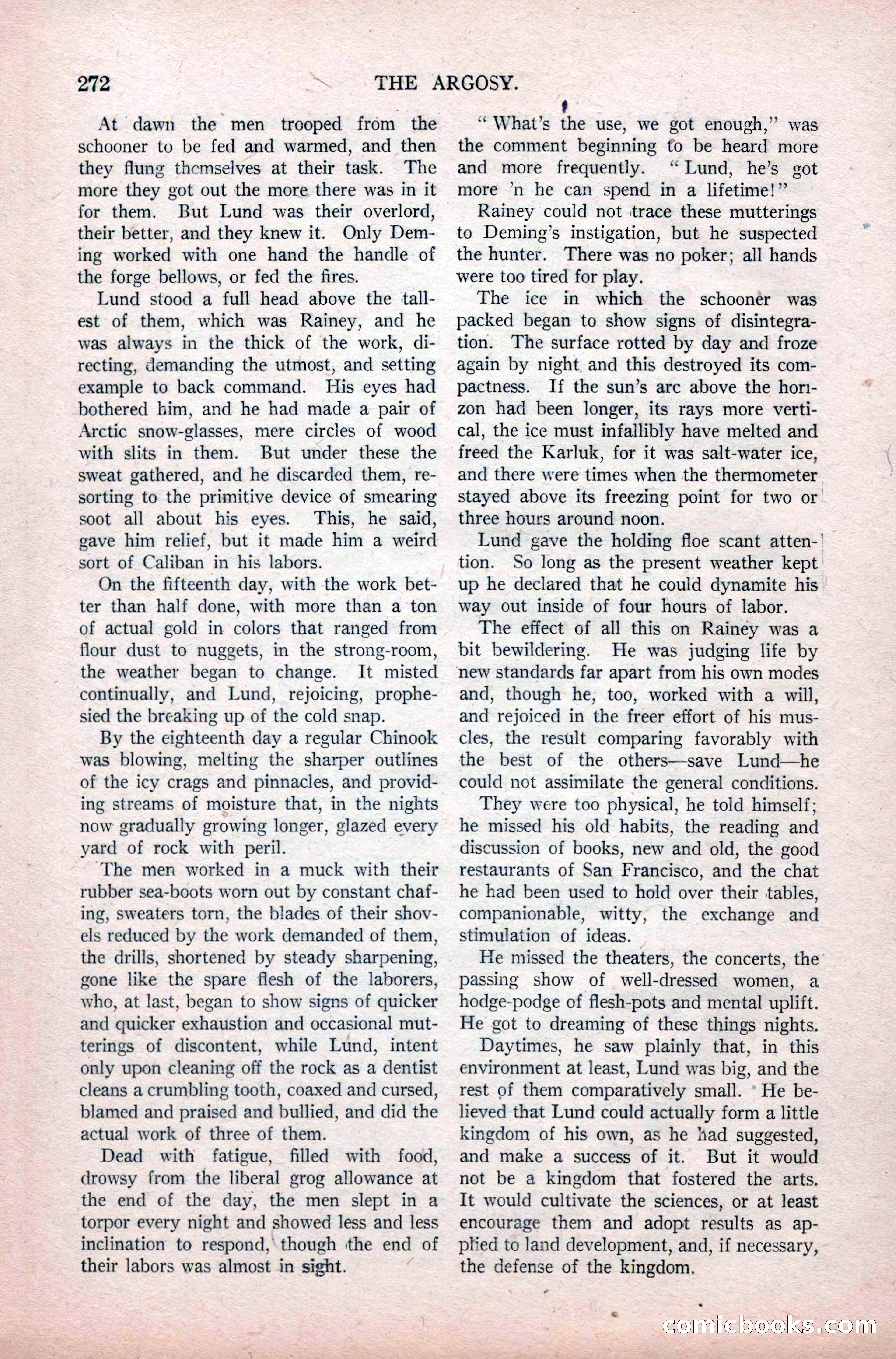
272 At dawn the men trooped from the schooner to be fed and warmed, and then they flung themselves at their task. The more they got out the more there was in it for them. But Lund was their overlord, their better, and they knew it. Only Dem- ing worked with one hand the handle of the forge bellows, or fed the fires. Lund stood a full head above the tall- est of them, which was Rainey, and he was always in the thick of the work, di- recting, demanding the utmost, and setting example to back command. His eyes had bothered him, and he had made a pair of Arctic snow-glasses, mere circles of wood with slits in them. But under these the sweat gathered, and he discarded them, re- sorting to the primitive device of smearing soot all about his eyes. This, he said, gave him relief, but it made him a weird sort of Caliban in his labors. On the fifteenth day, with the work bet- ter than half done, with more than a ton of actual gold in colors that ranged from flour dust to nuggets, in the strong-room, the weather began to change. It misted continually, and Lund, rejoicing, prophe- sied the breaking up of the cold snap. By the eighteenth day a regular Chinook was blowing, melting the sharper outlines of the icy crags and pinnacles, and provid- ing streams of moisture that, in the nights now gradually growing longer, glazed every yard of rock with peril. ‘The men worked in a muck with their rubber sea-boots worn out by constant chaf- ing, sweaters torn, the blades of their shov- els reduced by the work demanded of them, the drills, shortened by steady sharpening, gone like the spare flesh of the laborers, who, at last, began to show signs of quicker and quicker exhaustion and occasional mut- terings of discontent, while Lund, intent only upon cleaning off the rock as a dentist cleans a crumbling tooth, coaxed and cursed, blamed and praised and bullied, and did the actual work of three of them. Dead with fatigue, filled with food, drowsy from the liberal grog allowance at the end of the day, the men slept in a torpor every night and showed less and less inclination to respond, though the end of their labors was almost in sight. THE ARGOSY. $ ‘““What’s the use, we got enough,” was the comment beginning fo be heard more and more frequently. ‘Lund, he’s got more ’n he can spend in a lifetime!” Rainey could not trace these mutterings to Deming’s instigation, but he suspected the hunter. There was no poker; all hands were too tired for play. The ice in which the schooner was packed began to show signs of disintegra- tion. The surface rotted by day and froze again by night. and this destroyed its com- pactness. If the sun’s arc above the hori- zon had been longer, its rays more verti- cal, the ice must infallibly have melted and freed the Karluk, for it was salt-water ice, and there were times when the thermometer stayed above its freezing point for two or three hours around noon. Lund gave the holding floe scant atten-' tion. So long as the present weather kept up he declared that he could dynamite his way out inside of four hours of labor. The effect of all this on Rainey was a bit bewildering. He was judging life by new standards far apart from his own modes and, though he; too, worked with a will, and rejoiced in the freer effort of his mus- cles, the result comparing favorably with the best of the others—save Lund—he could not assimilate the general conditions. They were too physical, he told himself; he missed his old habits, the reading and discussion of books, new and old, the good restaurants of San Francisco, and the chat he had been used to hold over their tables, companionable, witty, the exchange and stimulation of ideas. He missed the theaters, the concerts, the passing show of well-dressed women, a hodge-podge of flesh-pots and mental uplift. He got to dreaming of these things nights. Daytimes, he saw plainly that, in this environment at least, Lund was big, and the rest of them comparatively small. * He be- lieved that Lund could actually form a little kingdom of his own, as he had suggested, and make a success of it. But it would not be a kingdom that fostered the arts. It would cultivate the sciences, or at least encourage them and adopt results as ap- plied to land development, and, if necessary, the defense of the kingdom. oe s Gomichbooks (E@)