
Pulp Fiction, 1920 · page 104 of 180
Argosy, Vol. 118, No. 2 — page 104: what you’re looking at
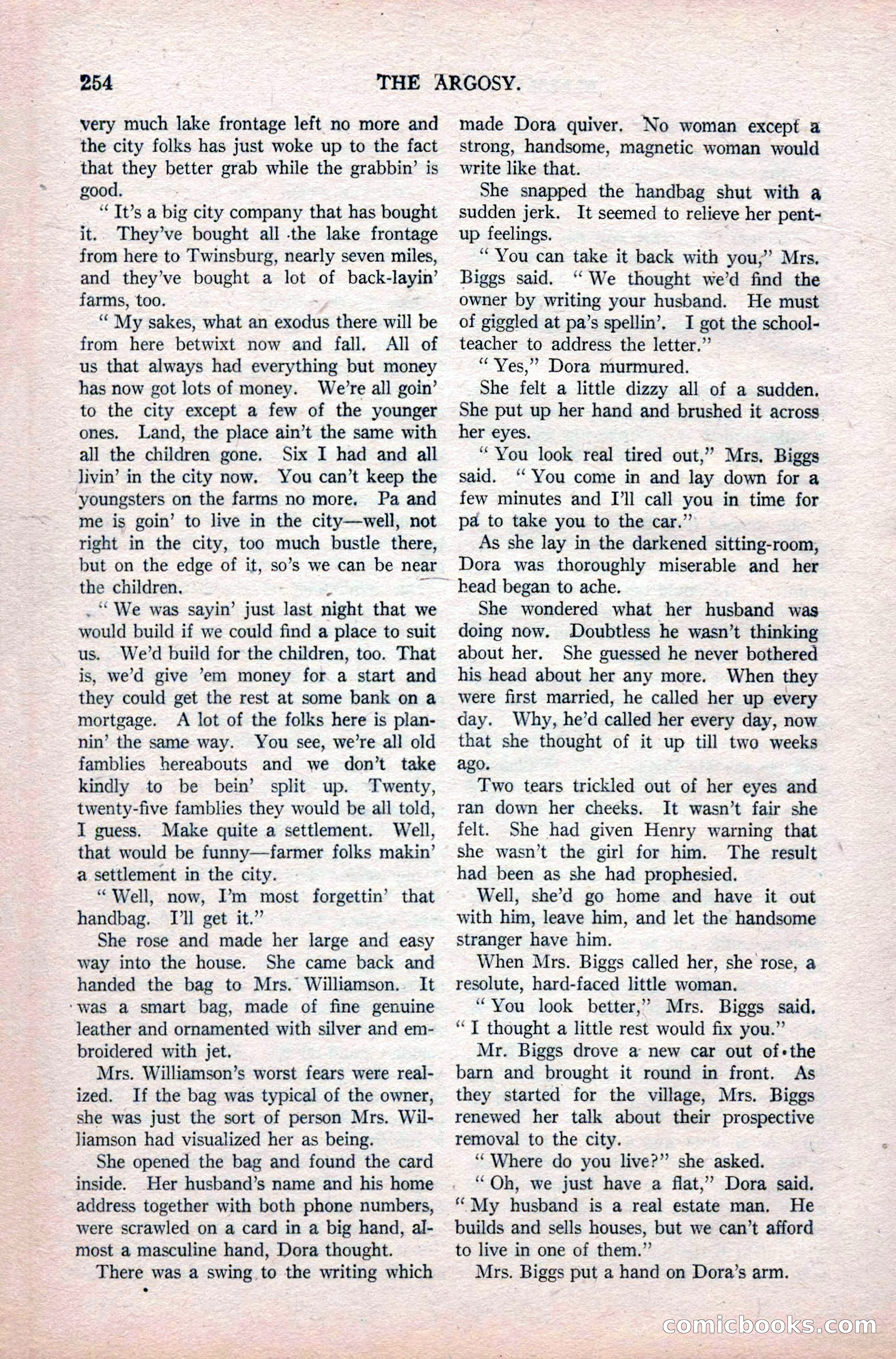
A restored page from Pulp Fiction, 1920. Page through the whole issue in the reader above.
📄 Transcribed text from this page (OCR, searchable)
Machine-transcribed from the original scan — historical spelling and the odd misread are preserved.
204 very much lake frontage left no more and the city folks has just woke up to the fact _ that they better grab while the grabbin’ is good. ‘Tt’s a big city company that has bought it. They’ve bought all the lake frontage from here to Twinsburg, nearly seven miles, and they’ve bought a lot of back-layin’ farms, too. ‘My sakes, what an exodus there will be from here betwixt now and fall. All of us that always had everything but money has now got lots of money. We’re all goin’ to the city except a few of the younger ones. Land, the place ain’t the same with all the children gone. Six I had and all livin’ in the city now. You can’t keep the youngsters on the farms no more. Pa and me is goin’ to live in the city—vwell, not right in the city, too much bustle there, but on the edge of it, so’s we can be near the children. : . ‘“ We was sayin’ just last night that we would build if we could find a place to suit us. We’d build for the children, too. That is, we’d give ’em money for a start and they could get the rest at some bank on a mortgage. A lot of the folks here is plan- nin’ the same way. You see, we’re all old famblies hereabouts and we don’t take kindly to be bein’ split up. Twenty, twenty-five famblies they would be all told, I guess. Make quite a settlement. Well, that would be funny—farmer folks makin’ a settlement in the city. “Well, now, I’m most forgettin’ that © handbag. I'll get it.” She rose and made her large and easy way into the house. She came back and handed the bag to Mrs. Williamson. It ‘was a smart bag, made of fine genuine leather and ornamented with silver and em- broidered with jet. Mrs. Williamson’s worst fears were real- ized. If the bag was typical of the owner, she was just the sort of person Mrs. Wil- - Jiamson had visualized her as being. She opened the bag and found the card inside. Her husband’s name and his home address together with both phone numbers, were scrawled on a card in a big hand, al- most a masculine hand, Dora thought. There was a swing to the writing which THE ARGOSY. made Dora quiver. No woman except a strong, handsome, magnetic woman would write like that. She snapped the handbag shut with a sudden jerk. It seemed to relieve her pent- up feelings. | “You can take it back with you,’ Mrs. Biggs said. ‘“ We thought we’d find the owner by writing your husband. He must of giggled at pa’s spellin’, I got the school- teacher to address the letter.” “Yes,” Dora murmured. She felt a little dizzy all of a sudden. She put up her hand and brushed it across her eyes. ‘You look real tired out,” Mrs, Biggs said. ‘‘ You come in and lay down for a few minutes and I'll call you in time for pa to take you to the car.” As she lay in the darkened sitting-room, Dora was thoroughly miserable and her - head began to ache. She wondered what her husband was doing now. Doubtless he wasn’t thinking about her. She guessed he never bothered his head about her any more. When they were first married, he called her up every day. Why, he’d called her every day, now that she thought of it up till two weeks ago. Two tears trickled out of her eyes and ran down her cheeks. It wasn’t fair she felt. She had given Henry warning that she wasn’t the girl for him. The result had been as she had prophesied. Well, she’d go home and have it out with him, leave him, and let the handsome stranger have him. When Mrs. Biggs called her, she rose, a resolute, hard-faced little woman. “You look better,” Mrs. Biggs said. “I thought a little rest would fix you.” Mr. Biggs drove a new car out of+the barn and brought it round in front. As they started for the village, Mrs. Biggs renewed her talk about their prospective removal to the city. “Where do you live?” she asked. “Oh, we just have a flat,’ Dora said. “My husband is a real estate man, He builds and sells houses, but we can’t afford to live in one of them.” Mrs. Biggs put a hand on Dora’s arm. EOPNICLOOLX< (E@)