
Pulp Fiction, 1920 · page 88 of 188
Argosy, Vol. 117, No. 3 — page 88: what you’re looking at
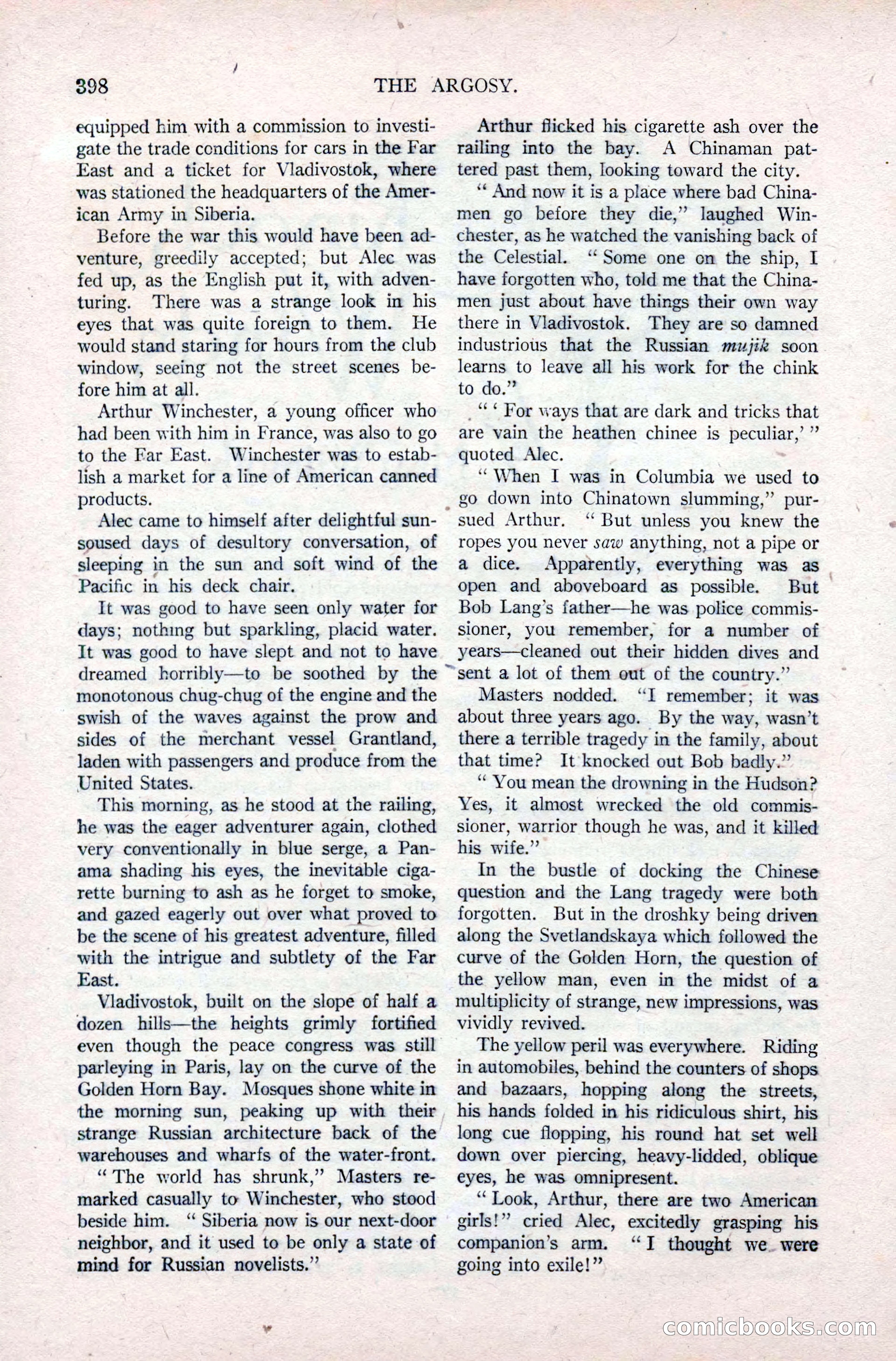
A restored page from Pulp Fiction, 1920. Page through the whole issue in the reader above.
📄 Transcribed text from this page (OCR, searchable)
Machine-transcribed from the original scan — historical spelling and the odd misread are preserved.
398 THE equipped him with a commission to investi- gate the trade conditions for cars in the Far East and a ticket for Vladivostok, where was stationed the headquarters of the Amer- ican Army in Siberia. Before the war this would have been ad- venture, greedily accepted; but Alec was fed up, as the English put it, with adven- turing. There was a strange look in his eyes that was quite foreign to them. He would stand staring for hours from the club window, seeing not the street scenes be- fore him at all. Arthur Winchester, a young officer who had been with him in France, was also to go to the Far East. Winchester was to estab- lish a market for a line of American canned products. Alec came to himself after delightful sun- soused days of desultory conversation, of sleeping in the sun and soft wind of the Pacific in his deck chair. It was good to have seen only water for days; nothing but sparkling, placid water. It was good to have slept and not to have dreamed horribly—to be soothed by the monotonous chug-chug of the engine and the swish of the waves against the prow and sides of the merchant vessel Grantland, laden with passengers and produce from the United States. This morning, as he stood at the railing, he was the eager adventurer again, clothed very conventionally in blue serge, a Pan- ama shading his eyes, the inevitable ciga- rette burning to ash as he forget to smoke, and gazed eagerly out over what proved to be the scene of his greatest adventure, filled with the intrigue and subtlety of the Far East. Vladivostok, built on the slope of half a dozen hills—the heights grimly fortified even though the peace congress was still parleying in Paris, lay on the curve of the Golden Horn Bay. Mosques shone white in the morning sun, peaking up with their strange Russian architecture back of the warehouses and wharfs of the water-front. “The world has shrunk,” Masters re- marked casually to Winchester, who stood beside him. “ Siberia now is our next-door neighbor, and it used to be only a state of mind for Russian novelists.” ARGOSY. Arthur flicked his cigarette ash over the railing into the bay. A Chinaman pat- tered past them, looking toward the city. ‘* And now it is a place where bad China- men go before they die,” laughed Win- chester, as he watched the vanishing back of the Celestial. ‘Some one eon the ship, I have forgotten who, told me that the China- men just about have things their own way there in Vladivostok. They are so damned industrious that the Russian mujik soon learns to leave all his work for the chink to do.” _‘** For ways that are dark and tricks that are vain the heathen chinee is peculiar,’ ” quoted Alec. ‘When I was in Columbia we used to go down into Chinatown slumming,” pur- sued Arthur. ‘‘ But unless you knew the ropes you never saw anything, not a pipe or a dice. Apparently, everything was as open and aboveboard as possible. Bob Lang’s father—he was police commis- sioner, you remember, for a number of years—cleaned out their hidden dives and ‘sent a lot of them out of the country.” Masters nodded. “I remember; it was about three years ago. By the way, wasn’t there a terrible tragedy in the family, about that time? It knocked out Bob badly.” ‘You mean the drowning in the Hudson? Yes, it almost wrecked the old commis- sioner, warrior though he was, and it killed his wife.” In the bustle of docking the Chinese question and the Lang tragedy were both forgotten. But in the droshky being driven along the Svetlandskaya which followed the curve of the Golden Horn, the question of the yellow man, even in the midst of a multiplicity of strange, new impressions, was vividly revived. The yellow peril was everywhere. Riding in automobiles, behind the counters of shops and bazaars, hopping along the streets, his hands folded in his ridiculous shirt, his long cue flopping, his round hat set well down over piercing, heavy-lidded, oblique eyes, he was omnipresent. “Look, Arthur, there are two American girls!”” cried Alec, excitedly grasping his companion’s arm. “I thought we. were going into exile!” (EO) OOK But (C@)