
Pulp Fiction, 1920 · page 80 of 188
Argosy, Vol. 117, No. 3 — page 80: what you’re looking at
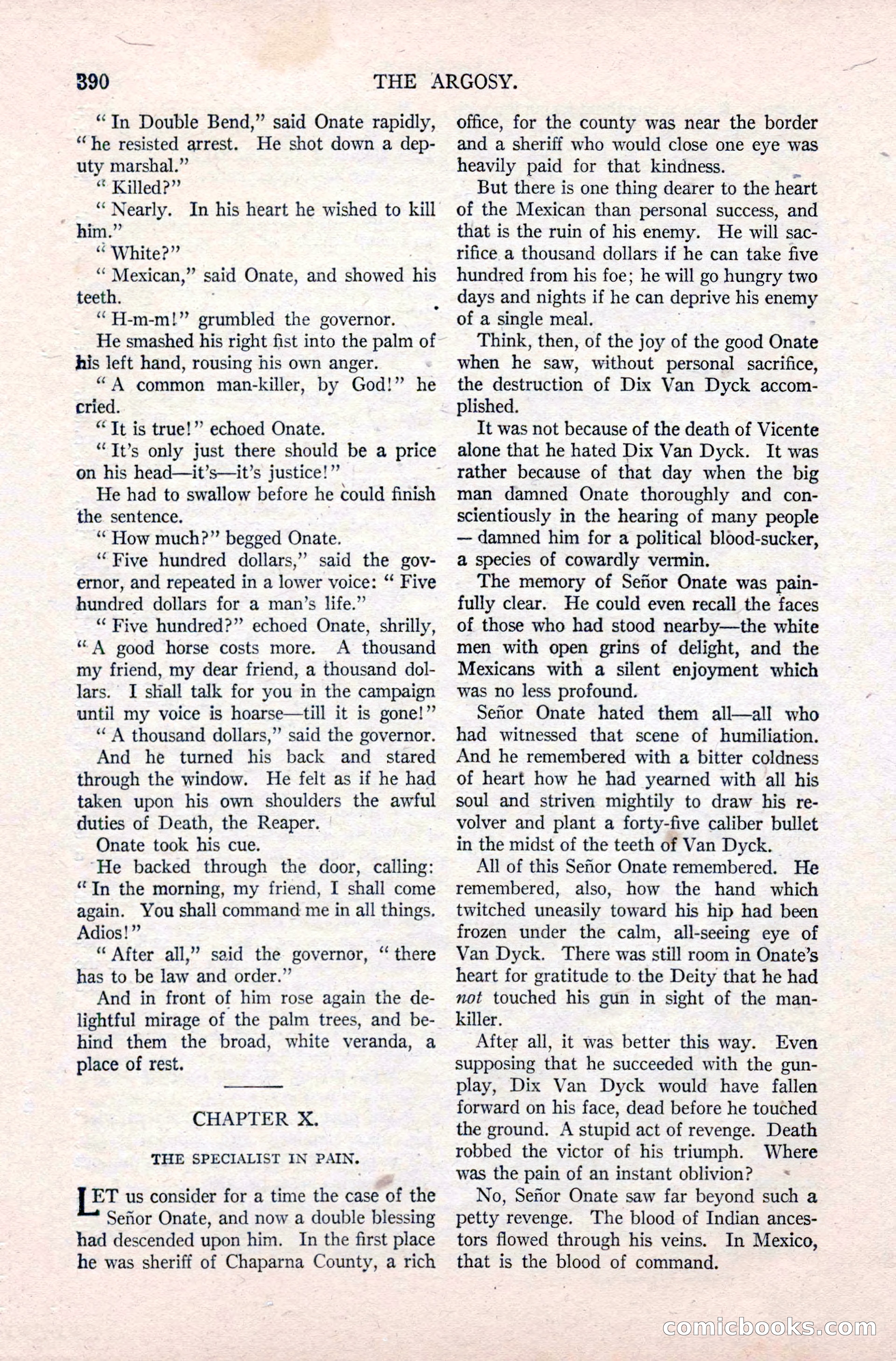
A restored page from Pulp Fiction, 1920. Page through the whole issue in the reader above.
📄 Transcribed text from this page (OCR, searchable)
Machine-transcribed from the original scan — historical spelling and the odd misread are preserved.
390 “In Double Bend,” said Onate rapidly, “he resisted arrest. He shot down a dep- uty marshal.” “ Killed?” “Nearly. In his heart he wished to kill ~ him.” “ White?” ““ Mexican,” said Onate, and showed his teeth. ; ‘““H-m-m!”’ grumbled the governor. He smashed his right fist into the palm of his left hand, rousing his own anger. “A common man-killer, by God!” he cried. “Tt is true!” echoed Onate. “It’s only just there should be a price on his head—it’s—it’s justice!” He had to swallow before he could finish the sentence. | “How much?” begged Onate. “Five hundred dollars,” said the gov- ernor, and repeated in a lower voice: “ Five hundred dollars for a man’s life.” “Five hundred?” echoed Onate, shrilly, * A good horse costs more. A thousand my friend, my dear friend, a thousand dol- lars. I shall talk for you in the campaign until my voice is hoarse—till it is gone!” ‘‘ A thousand dollars,” said the governor. And he turned his back and _ stared through the window. He felt as if he had taken upon his own shoulders the awful duties of Death, the Reaper. Onate took his cue. “He backed through the door, calling: “In the morning, my friend, I shall come again. You shall command me in all things. Adios!” “ After all,” said the governor, “ there has to be law and order.” And in front of him rose again the de- lightful mirage of the palm trees, and be- hind them the broad, white veranda, a place of rest. CHAPTER X., THE SPECIALIST IN PAIN. ET us consider for a time the case of the Senor Onate, and now a double blessing had descended upon him. In the first place he was sheriff of Chaparna County, a rich THE ARGOSY. office, for the county was near the border and a sheriff who would close one eye was heavily paid for that kindness. a But there is one thing dearer to the heart of the Mexican than personal success, and that is the ruin of his enemy. He will sac- rifice a thousand dollars if he can take five hundred from his foe; he will go hungry two days and nights if he can deprive his enemy of a single meal. | Think, then, of the joy of the good Onate when he saw, without personal sacrifice, the destruction of Dix Van Dyck accom- plished. It was not because of the death of Vicente alone that he hated Dix Van Dyck. It was - rather because of that day when the big man damned Onate thoroughly and con- scientiously in the hearing of many people — damned him for a political blood-sucker, a species of cowardly vermin. The memory of Sefior Onate was pain- fully clear. He could even recall the faces of those who had stood nearby—the white men with open grins of delight, and the Mexicans with a silent enjoyment which was no less profound. Senor Onate hated them all—all who had witnessed that scene of humiliation. And he remembered with a bitter coldness of heart how he had yearned with all his soul and striven mightily to draw his re- volver and plant a forty-five caliber bullet in the midst of the teeth of Van Dyck. All of this Senor Onate remembered. He remembered, also, how the hand which twitched uneasily toward his hip had been frozen under the calm, all-seeing eye of Van Dyck. There was still room in Onate’s heart for gratitude to the Deity that he had not touched his gun in sight of the man- killer. After all, it was better this way. Even supposing that he succeeded with the gun- play, Dix Van Dyck would have fallen forward on his face, dead before he touched the ground. A stupid act of revenge. Death robbed the victor of his triumph. Where was the pain of an instant oblivion? ~ No, Senor Onate saw far beyond such a petty revenge. The blood of Indian ances- tors flowed through his veins. In Mexico, that is the blood of command. Go VOOKS ANUG (E@