
Pulp Fiction, 1920 · page 75 of 188
Argosy, Vol. 117, No. 3 — page 75: what you’re looking at
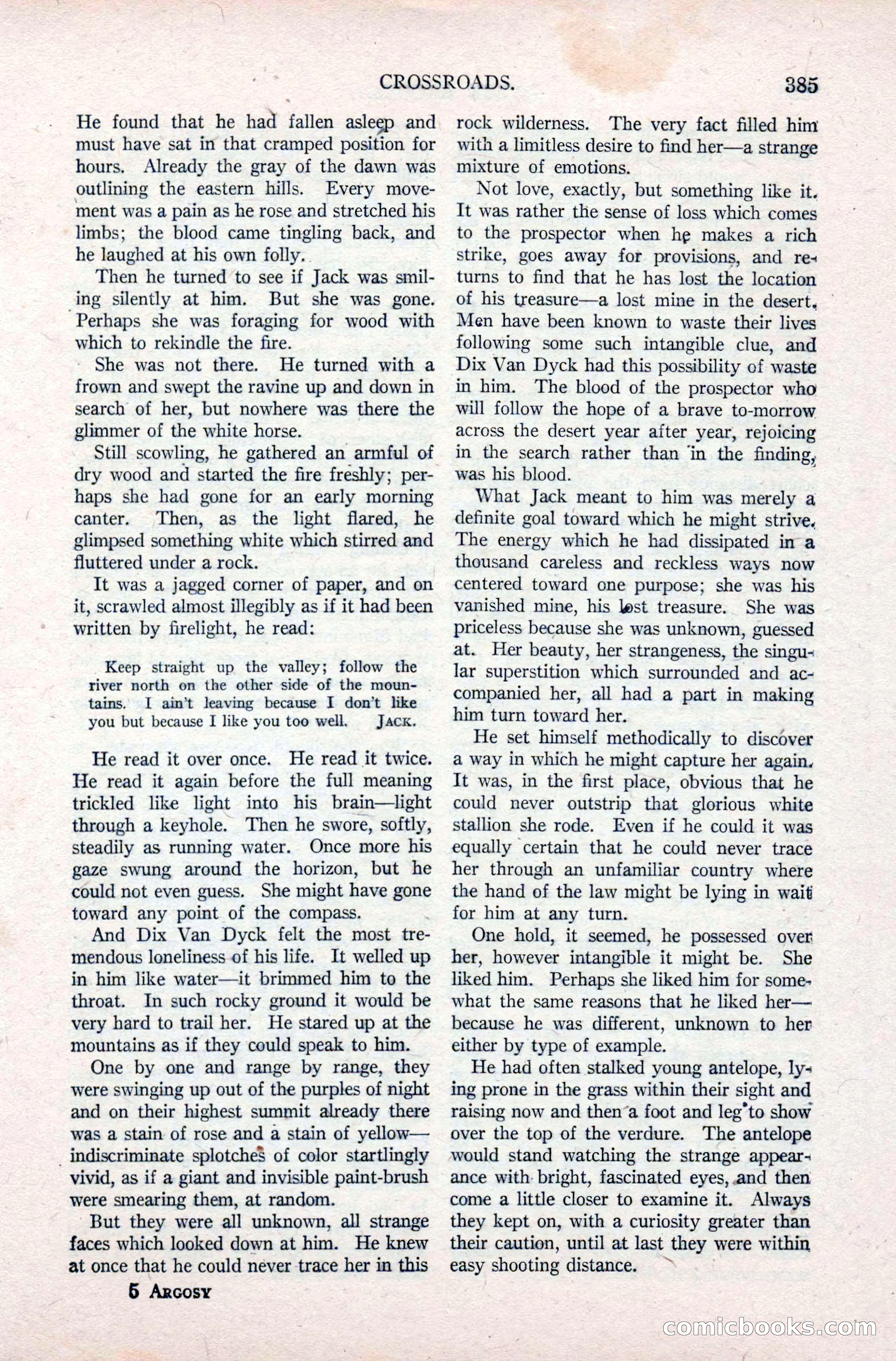
A restored page from Pulp Fiction, 1920. Page through the whole issue in the reader above.
📄 Transcribed text from this page (OCR, searchable)
Machine-transcribed from the original scan — historical spelling and the odd misread are preserved.
CROSSROADS. He found that he had fallen asleep and must have sat in that cramped position for hours, Already the gray of the dawn was outlining the eastern hills. Every move- ment was a pain as he rose and stretched his limbs; the blood came tingling back, and he laughed at his own folly. Then he turned to see if Jack was smil- ing silently at him. But she was gone. Perhaps she was foraging for wood with which to rekindle the fire. - She was not there. He turned with a frown and swept the ravine up and down in search of her, but nowhere was there the glimmer of the white horse. Still scowling, he gathered an armful of dry wood and started the fire freshly; per- haps she had gone for an early morning canter. Then, as the light flared, he glimpsed something white which stirred and fluttered under a rock. It was a jagged corner of paper, and on it, scrawled almost illegibly as if it had been written by firelight, he read: Keep straight up the valley; follow the river north on the other side of the moun- . tains. I ain’t leaving because I don’t like you but because I like you too well. JAck. He read it over once. He read it twice. He read it again before the full meaning trickled like light into his brain—light through a keyhole. Then he swore, softly, steadily as running water. Once more his gaze swung around the horizon, but he could not even guess. She might have gone toward any point of the compass. And Dix Van Dyck felt the most tre- mendous loneliness of his life. It welled up in him like water—it brimmed him to the throat. In such rocky ground it would be very hard to trail her. He stared up at the mountains as if they could speak to him. One by one and range by range, they were swinging up out of the purples of night and on their highest summit already there was a stain of rose and a stain of yellow— indiscriminate splotche$ of color startlingly vivid, as if a giant and invisible paint-brush were smearing them, at random. But they were all unknown, all strange faces which looked down at him. He knew at once that he could never trace her in this 6 Arcosy 38d rock wilderness. The very fact filled him with a limitless desire to find her—a strange mixture of emotions. Not love, exactly, but something like it. It was rather the sense of loss which comes to the prospector when he makes a rich strike, goes away for provisions, and re- turns to find that he has lost the location of his treasure—a lost mine in the desert, | Men have been known to waste their lives following some such intangible clue, and Dix Van Dyck had this possibility of waste in him. The blood of the prospector who will follow the hope of a brave to-morrow across the desert year after year, rejoicing in the search rather than ‘in the finding, was his blood. What Jack meant to him was merely a definite goal toward which he might strive. The energy which he had dissipated in a thousand careless and reckless ways now centered toward one purpose; she was his vanished mine, his lest treasure. She was priceless because she was unknown, guessed at. Her beauty, her strangeness, the singu- lar superstition which surrounded and ac- companied her, all had a part in making him turn toward her. He set himself methodically to discover a way in which he might capture her again, It was, in the first place, obvious that he could never outstrip that glorious white stallion she rode. Even if he could it was equally certain that he could never trace her through an unfamiliar country where the hand of the law might be lying in wait for him at any turn. One hold, it seemed, he possessed over her, however intangible it might be. She liked him. Perhaps she liked him for some- what the same reasons that he liked her— because he was different, unknown to her either by type of example. He had often stalked young antelope, ly- ing prone in the grass within their sight and raising now and then‘a foot and leg*to show over the top of the verdure. The antelope would stand watching the strange appear- ance with bright, fascinated eyes, and then come a little closer to examine it. Always they kept on, with a curiosity greater than their caution, until at last they were within easy shooting distance. —~ CoOmiclooolK< Eo}