
Pulp Fiction, 1920 · page 16 of 188
Argosy, Vol. 117, No. 3 — page 16: what you’re looking at
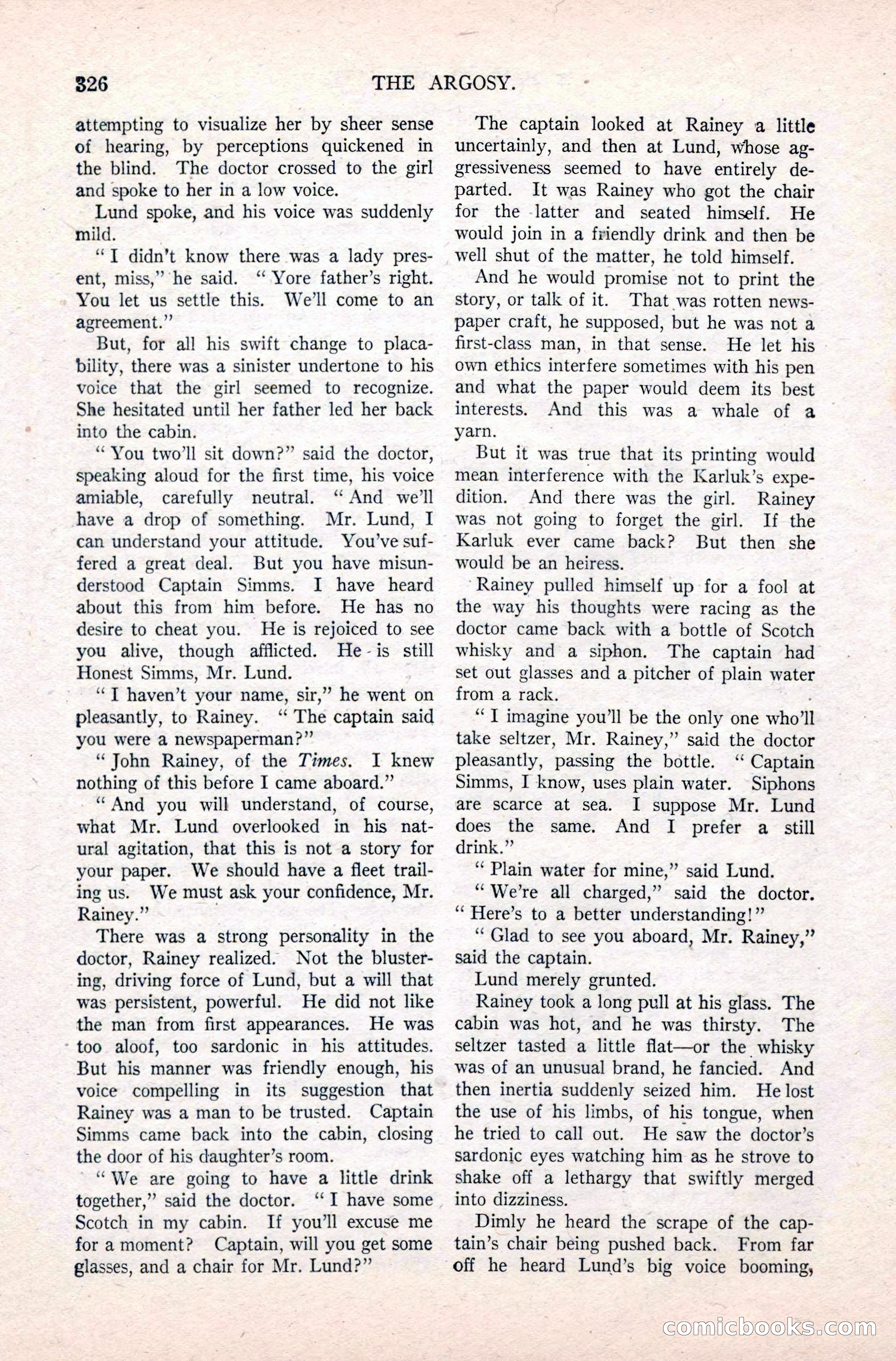
A restored page from Pulp Fiction, 1920. Page through the whole issue in the reader above.
📄 Transcribed text from this page (OCR, searchable)
Machine-transcribed from the original scan — historical spelling and the odd misread are preserved.
326 attempting to visualize her by sheer sense of hearing, by perceptions quickened in the blind. The doctor crossed to the girl and spoke to her in a low voice. Lund spoke, and his voice was suddenly mild. ‘““T didn’t know there was a lady pres- ent, miss,” he said. ‘‘ Yore father’s right. You let us settle this. We'll come to an agreement.” But, for all his swift change to placa- bility, there was a sinister undertone to his voice that the girl seemed to recognize. She hesitated until her father led her back into the cabin. “You two’ll sit down?” said the doctor, speaking aloud for the first time, his voice amiable, carefully neutral. ‘“ And we'll have a drop of something. Mr. Lund, I can understand your attitude. You’ve suf- fered a great deal. But you have misun- derstood Captain Simms. I have heard about this from him before. He has no desire to cheat you. He is rejoiced to see you alive, though afflicted. He-is still Honest Simms, Mr. Lund. ‘““T haven’t your name, sir,’”’ he went on pleasantly, to Rainey. ‘‘ The captain said you were a newspaperman?”’ “John Rainey, of the Times. I knew nothing of this before I came aboard.” “And you will understand, of course, what Mr. Lund overlooked in his nat- ural agitation, that this is not a story for your paper. We should have a fleet trail- ing us. We must ask your confidence, Mr. Rainey.” There was a strong personality in the doctor, Rainey realized. Not the bluster- ing, driving force of Lund, but a will that was persistent, powerful. He did not like the man from first appearances. He was ‘too aloof, too sardonic in his attitudes. But his manner was friendly enough, his voice compelling in its suggestion that Rainey was a man to be trusted. Captain Simms came back into the cabin, closing the door of his daughter’s room. “We are going to have a little drink together,” said the doctor. ‘“‘I have some Scotch in my cabin. If you'll excuse me fora moment? Captain, will you get some glasses, and a chair for Mr. Lund?” THE ARGOSY. The captain looked at Rainey a little uncertainly, and then at Lund, whose ag- gressiveness seemed to have entirely de- parted. It was Rainey who got the chair for the -latter and seated himself. He would join in a friendly drink and then be well shut of the matter, he told himself. And he would promise not to print the story, or talk of it. That was rotten news- paper craft, he supposed, but he was not a first-class man, in that sense. He let his own ethics interfere sometimes with his pen and what the paper would deem its best interests. And this was a whale of a yarn. But it was true that its printing would mean interference with the Karluk’s expe- dition. And there was the girl. Rainey was not going to forget the girl. If the Karluk ever came back? But then she would be an heiress. ‘Rainey pulled himself up for a fool at the way his thoughts were racing as the doctor came back with a bottle of Scotch whisky and a siphon. The captain had set out glasses and a pitcher of plain water from a rack. : “J imagine you'll be the only one who’ll take seltzer, Mr. Rainey,” said the doctor pleasantly, passing the bottle. ‘“ Captain Simms, I know, uses plain water. Siphons are scarce at sea. I suppose Mr. Lund does the same. And I prefer a still drink.” ‘Plain water for mine,” said Lund. “We're all charged,” said the doctor. ‘“ Here’s to a better understanding!” ‘Glad to see you aboard, Mr. Rainey,” said the captain. Lund merely grunted. Rainey took a long pull at his glass. The cabin was hot, and he was thirsty. The seltzer tasted a little flat—or the whisky was of an unusual brand, he fancied. And then inertia suddenly seized him. He lost the use of his limbs, of his tongue, when he tried to call out. He saw the doctor’s sardonic eyes watching him as he strove to shake off a lethargy that swiftly merged into dizziness. Dimly he heard the scrape of the cap- tain’s chair being pushed back. From far off he heard Lund’s big voice booming, CORICLOO© S (C@