
Pulp Fiction, 1920 · page 99 of 176
Argosy, Vol. 117, No. 2 — page 99: what you’re looking at
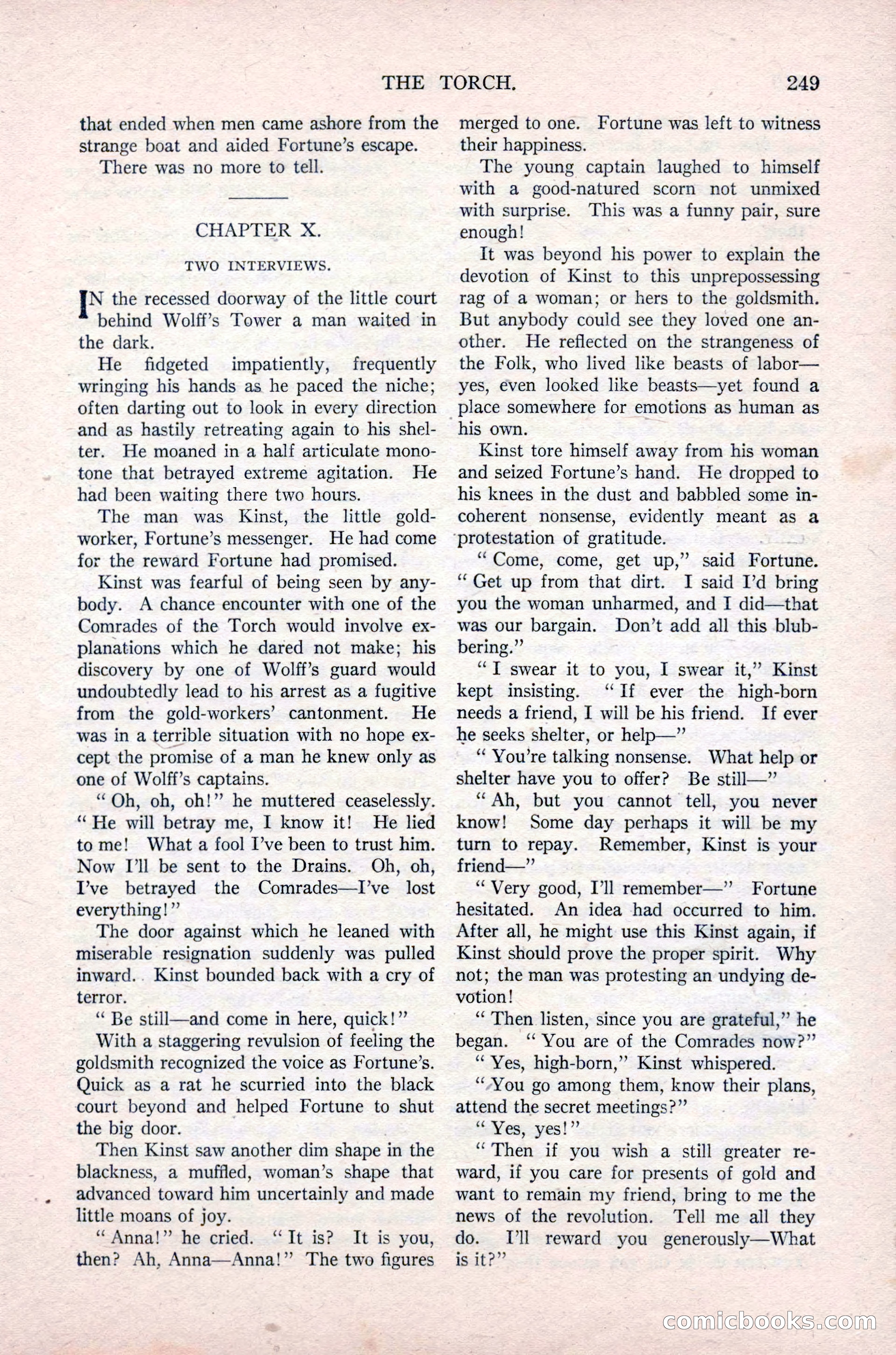
A restored page from Pulp Fiction, 1920. Page through the whole issue in the reader above.
📄 Transcribed text from this page (OCR, searchable)
Machine-transcribed from the original scan — historical spelling and the odd misread are preserved.
THE TORCH. that ended when men came ashore from the strange boat and aided Fortune’s escape. There was no more to tell. CHAPTER X. TWO INTERVIEWS. [N the recessed doorway of the little court behind Wolff’s Tower a man waited in the dark. He fidgeted impatiently, frequently wringing his hands as he paced the niche; often darting out to look in every direction and as hastily retreating again to his shel- ter. He moaned in a half articulate mono- tone that betrayed extreme agitation. He had been waiting there two hours. The man was Kinst, the little gold- worker, Fortune’s messenger. He had come for the reward Fortune had promised. Kinst was fearful of being seen by any- body. A chance encounter with one of the Comrades of the Torch would involve ex- planations which he dared not make; his discovery by one of Wolff’s guard would undoubtedly lead to his arrest as a fugitive from the gold-workers’ cantonment. He was in a terrible situation with no hope ex- cept the promise of a man he knew only as one of Wolff’s captains. “Oh, oh, oh!” he muttered ceaselessly. “ He will betray me, I know it! He lied to me! What a fool I’ve been to trust him. Now I'll be sent to the Drains. Oh, oh, lve betrayed the Comrades—lI’ve lost everything!” The door against which he leaned with miserable resignation suddenly was pulled inward.. Kinst bounded back with a cry of terror. ‘ Be still—and come in here, quick!” With a staggering revulsion of feeling the goldsmith recognized the voice as Fortune’s. Quick as a rat he scurried into the black court beyond and helped Fortune to shut the big door. Then Kinst saw another dim shape in the blackness, a muffled, woman’s shape that advanced toward him uncertainly and made little moans of joy. “Anna!” he cried. ‘It is? It is you, then? Ah, Anna—Anna!” The two figures 249 merged to one. Fortune was left to witness their happiness. The young captain laughed to himself with a good-natured scorn not unmixed with surprise. This was a funny pair, sure enough! It was beyond his power to explain the devotion of Kinst to this unprepossessing rag of a woman; or hers to the goldsmith. But anybody could see they loved one an- other. He reflected on the strangeness of the Folk, who lived like beasts of labor— yes, éven looked like beasts—yet found a place somewhere for emotions as human as his own. Kinst tore himself away from his woman and seized Fortune’s hand. He dropped to his knees in the dust and babbled some in- coherent nonsense, evidently meant as a ‘protestation of gratitude. “Come, come, get up,” said Fortune. ‘Get up from that dirt. I said I’d bring you the woman unharmed, and I did—that was our bargain. Don’t add all this blub- bering.”’ ““T swear it to you, I swear it,” Kinst kept insisting. ‘If ever the high-born needs a friend, I will be his friend. If ever he seeks shelter, or help—”’ “You’re talking nonsense. What help or shelter have you to offer? Be still—” “Ah, but you cannot tell, you never know! Some day perhaps it will be my turn to repay. Remember, Kinst is your friend—”’ “Very good, I’ll remember—” Fortune hesitated. An idea had occurred to him. After all, he might use this Kinst again, if Kinst should prove the proper spirit. Why not; the man was protesting an undying de- votion! ‘‘ Then listen, since you are grateful,” he began. ‘‘ You are of the Comrades now?” ‘Yes, high-born,” Kinst whispered. “You go among them, know their plans, attend the secret meetings?” | “Yes, yes!” “Then if you wish a still greater re- ward, if you care for presents of gold and want to remain my friend, bring to me the news of the revolution. Tell me all they do. [ll reward you generously—What is it?” Gomichbook (C@