
Pulp Fiction, 1920 · page 92 of 176
Argosy, Vol. 117, No. 2 — page 92: what you’re looking at
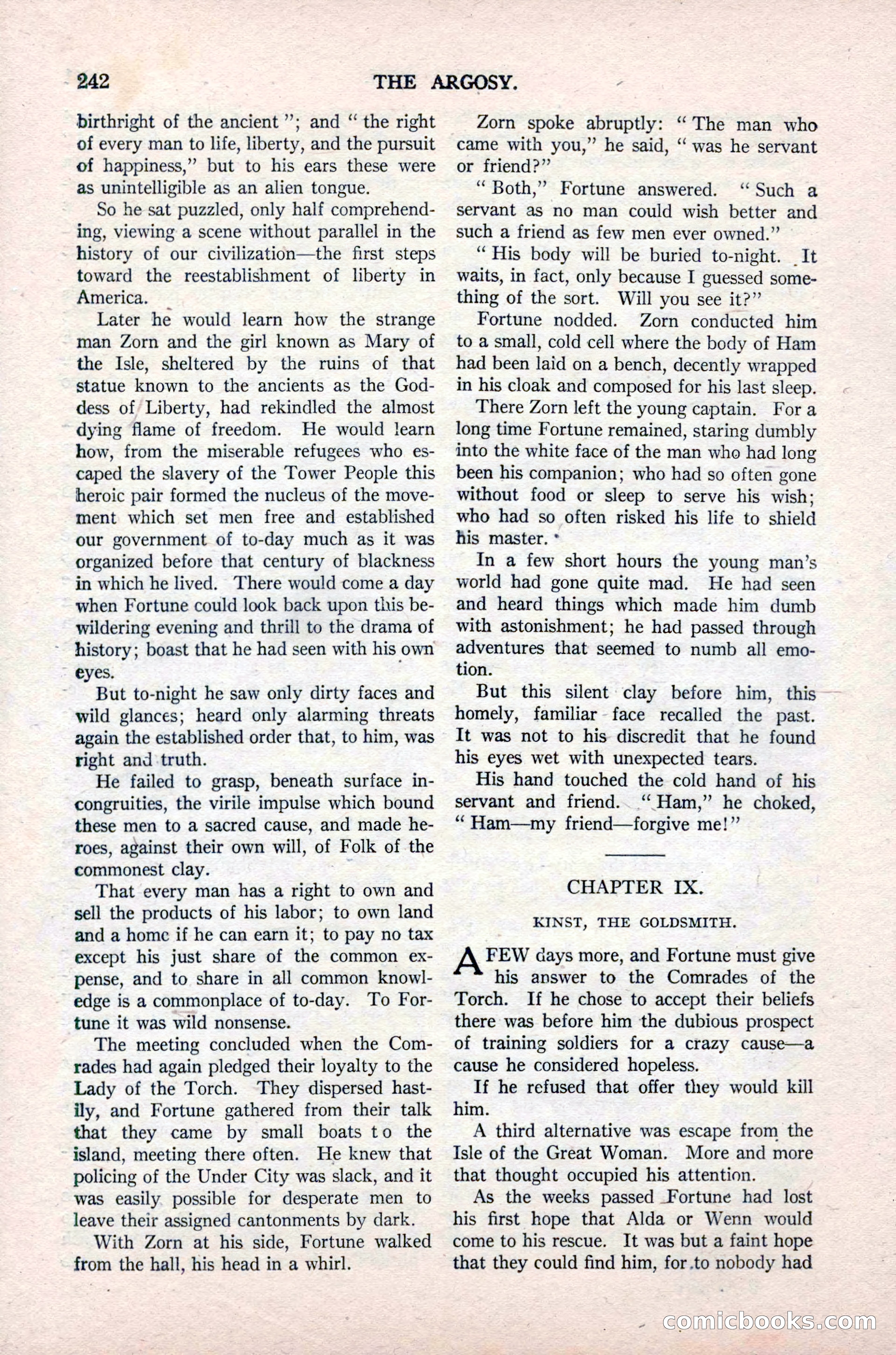
A restored page from Pulp Fiction, 1920. Page through the whole issue in the reader above.
📄 Transcribed text from this page (OCR, searchable)
Machine-transcribed from the original scan — historical spelling and the odd misread are preserved.
242 birthright of the ancient ”’; and “ the right of every man to life, liberty, and the pursuit of happiness,” but to his ears these were as unintelligible as an alien tongue. So he sat puzzled, only half comprehend- ing, viewing a scene without parallel in the history of our civilization—the first steps toward the reestablishment of liberty in America. _ Later he would learn how the strange man Zorn and the girl known as Mary of the Isle, sheltered by the ruins of that statue known to the ancients as the God- dess of Liberty, had rekindled the almost dying flame of freedom. He would learn how, from the miserable refugees who es- caped the slavery of the Tower People this heroic pair formed the nucleus of the move- ment which set men free and established our government of to-day much as it was organized before that century of blackness in which he lived. There would come a day when Fortune could look back upon this be- wildering evening and thrill to the drama of ~ history; boast that he had seen with his own eyes. But to-night he saw only dirty faces and wild glances; heard only alarming threats again the established order that, to him, was right and truth. He failed to grasp, beneath surface in- congruities, the virile impulse which bound these men to a sacred cause, and made he- roes, against their own will, of Folk of the commonest clay. That every man has a right to own and sell the products of his labor; to own land and a home if he can earn it; to pay no tax except his just share of the common ex- pense, and to share in all common knowl- edge is a commonplace of to-day. To For- tune it was wild nonsense. The meeting concluded when the Com- rades had again pledged their loyalty to the Lady of the Torch. They dispersed hast- ily, and Fortune gathered from their talk that they came by small boats to the island, meeting there often. He knew that policing of the Under City was slack, and it was easily possible for desperate men to leave their assigned cantonments by dark. With Zorn at his side, Fortune walked from the hall, his head in a whirl. THE ARGOSY. Zorn spoke abruptly: “The man who came with you,” he said, “ was he servant or friend?” “Both,” Fortune answered. ‘Such a servant as no man could wish better and such a friend as few men ever owned.” “His body will be buried to-night. It waits, in fact, only because I guessed some- thing of the sort. Will you see it?” Fortune nodded. Zorn conducted him to a small, cold cell where the body of Ham had been laid on a bench, decently wrapped in his cloak and composed for his last sleep. There Zorn left the young captain. Fora long time Fortune remained, staring dumbly into the white face of the man who had long been his companion; who had so often gone without food or sleep to serve his wish; who had so often risked his life to shield his master. * In a few short hours the young man’s world had gone quite mad. He had seen and heard things which made him dumb with astonishment; he had passed through adventures that seemed to numb all emo- tion. But this silent clay before him, this homely, familiar face recalled the past. It was not to his discredit that he found his eyes wet with unexpected tears. His hand touched the cold hand of his servant and friend. “Ham,” he choked, ““Ham—my friend—forgive me!”’ CHAPTER IX. KINST, THE GOLDSMITH. A FEW cays more, and Fortune must give his answer to the Comrades of the Torch. If he chose to accept their beliefs there was before him the dubious prospect of training soldiers for a crazy cause—a cause he considered hopeless. If he refused that offer they would kill him. A third alternative was escape from the Isle of the Great Woman. More and more that thought occupied his attention. As the weeks passed Fortune had lost his first hope that Alda or Wenn would come to his rescue. It was but a faint hope that they could find him, for.to nobody had - CONE OOOKXS (C@