
Pulp Fiction, 1920 · page 79 of 176
Argosy, Vol. 117, No. 2 — page 79: what you’re looking at
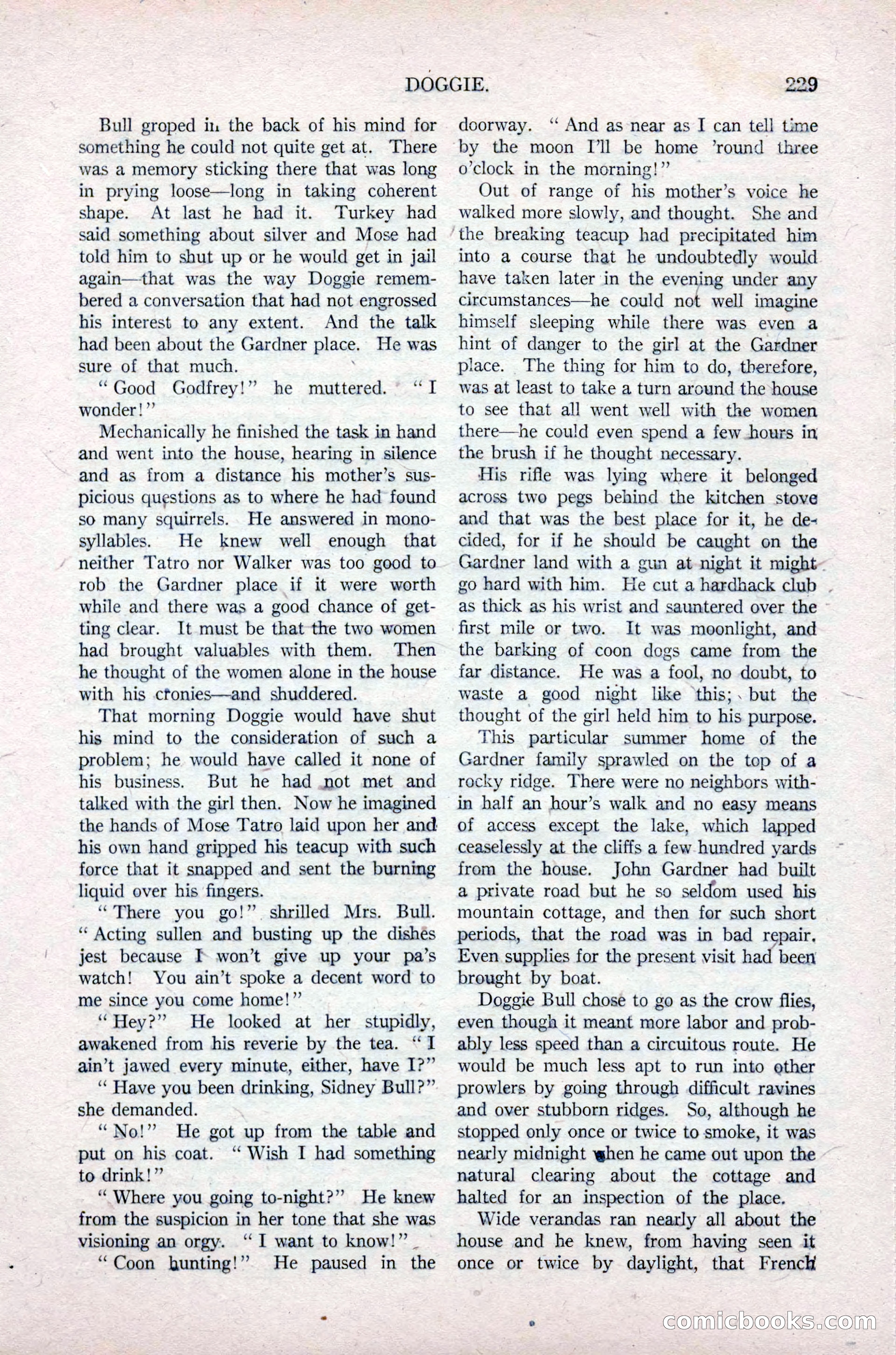
A restored page from Pulp Fiction, 1920. Page through the whole issue in the reader above.
📄 Transcribed text from this page (OCR, searchable)
Machine-transcribed from the original scan — historical spelling and the odd misread are preserved.
DOGGIE. Bull groped in the back of his mind for something he could not quite get at. There was a memory sticking there that was long in prying loose—long in taking coherent shape. At last he had it. Turkey had said something about silver and Mose had told him to shut up or he would get in jail again—that was the way Doggie remem- bered a conversation that had not engrossed his interest to any extent. And the talk had been about the Gardner place. He was sure of that much. “Good Godfrey!” he muttered. “I wonder!” Mechanically he finished the task in hand and went into the house, hearing in silence and as from a distance his mother’s sus- picious questions as to where he had found sO many squirrels. He answered in mono- syllables. He knew well enough that neither Tatro nor Walker was too good to rob the Gardner place if it were worth while and there was a good chance of get- ting clear. It must be that the two women had brought valuables with them. Then he thought of the women alone in the house with his cfonies—and shuddered. That morning Doggie would have shut his mind to the consideration of such a problem; he would have called it none of his business. But he had not met and talked with the girl then. Now he imagined the hands of Mose Tatro laid upon her and his own hand gripped his teacup with such force that it snapped and sent the burning liquid over his fingers. “There you go!” shrilled Mrs. Bull. “Acting sullen and busting up the dishés jest because I won’t give up your pa’s watch! You ain’t spoke a decent word to me since you come home!”’ “Hey?” He looked at her stupidly, awakened from his reverie by the tea. “I ain’t jawed every minute, either, have I?” ‘“‘ Have you been drinking, Sidney Bull?” she demanded. “No!” He got up from the table and put on his coat. “ Wish I had something to drink!” ‘Where you going to-night?” He knew from the suspicion in her tone that she was visioning an orgy. ‘‘ I want to know!” _ “Coon hunting!” He paused in the 229 doorway. ‘‘ And as near as I can tell time by the moon I'll be home ’round three o’clock in the morning!”’ Out of range of his mother’s voice he walked more slowly, and thought. She and ‘the breaking teacup had precipitated him into a course that he undoubtedly would have taken later in the evening under any circumstances—he could not well imagine himself sleeping while there was even a hint of danger to the girl at the Gardner piace. The thing for him to do, therefore, was at least to take a turn around the house to see that all went well with the women there—he could even spend a few hours in the brush if he thought necessary. His rifle was lying where it belonged across two pegs behind the kitchen stove and that was the best place for it, he de- cided, for if he should be caught on the Gardner land with a gun at night it might- go hard with him. He cut a hardhack club . as thick as his wrist and sauntered over the first mile or two. It was moonlight, and the barking of coon dogs came from the far distance. He was a fool, no doubt, to waste a good night like ‘this;. but the thought of the girl held him to his purpose. This particular summer home of the Gardner family sprawled on the top of a rocky ridge. There were no neighbors with- in half an hour’s walk and no easy means of access except the lake, which lapped ceaselessly at the cliffs a few hundred yards from the house. John Gardner had built a private road but he so seldom used his mountain cottage, and then for such short periods, that the road was in bad repair. Even supplies for the present visit had been brought by boat. Doggie Bull chose to go as the crow flies, even though it meant more labor and prob- ably less speed than a circuitous route. He would be much less apt to run into ether prowlers by going through difficult ravines and over stubborn ridges. So, although he stopped only once or twice to smoke, it was nearly midnight when he came out upon the natural clearing about the cottage and halted for an inspection of the place. Wide verandas ran nearly all about the house and he knew, from having seen it once or twice by daylight, that French ° CONMGEOOOKS (C@