
Pulp Fiction, 1920 · page 42 of 176
Argosy, Vol. 117, No. 2 — page 42: what you’re looking at
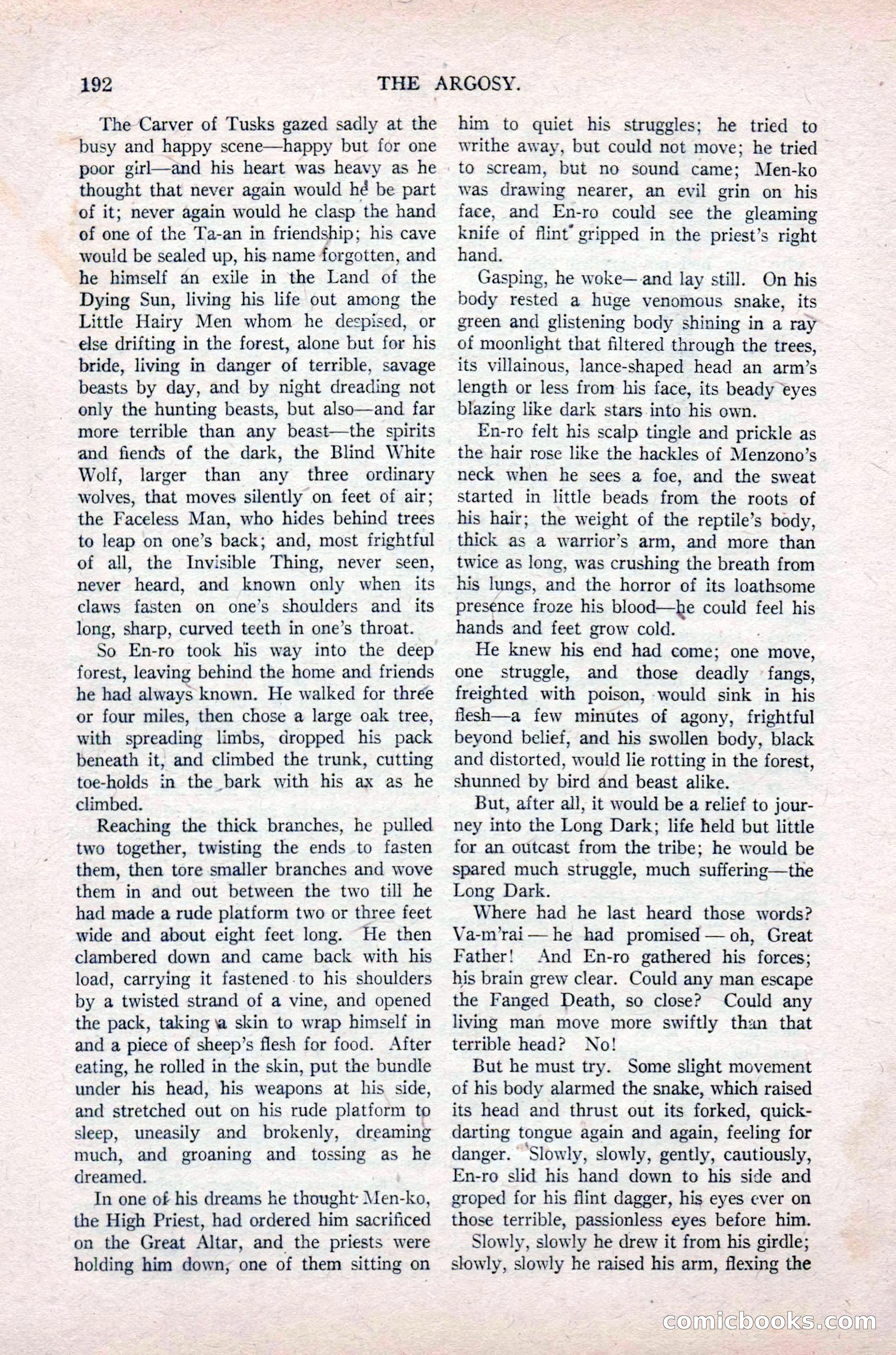
A restored page from Pulp Fiction, 1920. Page through the whole issue in the reader above.
📄 Transcribed text from this page (OCR, searchable)
Machine-transcribed from the original scan — historical spelling and the odd misread are preserved.
192 The Carver of Tusks gazed sadly at the busy and happy scene—happy but for one poor girl—and his heart was heavy as he thought that never again would hé be part of it; never again would he clasp the hand of one of the Ta-an in friendship; his cave would be sealed up, his name forgotten, and he himself an exile in the Land of the Dying Sun, living his life out among the Little Hairy Men whom he despised, or else drifting in the forest, alone but for his bride, living in danger of terrible, savage beasts by day, and by night dreading not only the hunting beasts, but also—and far more terrible than any beast—the spirits and fiends of the dark, the Blind White Wolf, larger than any three ordinary wolves, that moves silently on feet of air; the Faceless Man, who hides behind trees to leap on one’s back; and, most frightful of all, the Invisible Thing, never seen, never heard, and known only when its claws fasten on one’s shoulders and its long, sharp, curved teeth in one’s throat. So En-ro took his way into the deep forest, leaving behind the home and friends he had always known. He walked for three or four miles, then chose a large oak tree, with spreading limbs, dropped his pack beneath it, and climbed the trunk, cutting toe-holds in the bark with his ax as he climbed. Reaching the thick branches, he pulled two together, twisting the ends to fasten them, then tore smaller branches and wove them in and out between the two till he had made a rude platform two or three feet wide and about eight feet long. He then clambered down and came back with his load, carrying it fastened.to his shoulders by a twisted strand of a vine, and opened the pack, taking \a skin to wrap himself in and a piece of sheep’s flesh for food. After eating, he rolled in the skin, put the bundle under his head, his weapons at his side, and stretched out on his rude platform to sleep, uneasily and brokenly, dreaming much, and groaning and tossing as he dreamed. In one of his dreams he thought Men-ko, the High Priest, had ordered him sacrificed on the Great Altar, and the priests were holding him down, one of them sitting on THE ARGOSY. him to quiet his struggles; he tried to writhe away, but could not move; he tried to scream, but no sound came; Men-ko was drawing nearer, an evil grin on his face, and En-ro could see the gleaming knife of flint’ gripped in the priest’s right hand. Gasping, he woke— and lay still. On his body rested a huge venomous snake, its green and glistening body shining in a ray of moonlight that filtered through the trees, its villainous, lance-shaped head an arm’s length or less from his face, its beady eyes blazing like dark stars into his own. En-ro felt his scalp tingle and prickle as the hair rose like the hackles of Menzono’s neck when he sees a foe, and the sweat started in little beads from the roots of his hair; the weight of the reptile’s body, thick as a warrior’s arm, and more than twice as long, was crushing the breath from his lungs, and the horror of its loathsome presence froze his blood—he could feel his hands and feet grow cold. He knew his end had come; one move, one struggle, and those deadly - fangs, freighted with poison, would sink in his flesh—a few minutes of agony, frightful beyond belief, and his swollen body, black and distorted, would lie rotting in the forest, shunned by bird and beast alike. But, after all, it would be a relief to jour- ney into the Long Dark; life held but little for an outcast from the tribe; he would be spared much struggle, much suffering—the Long Dark. Where had he last heard those words? Va-m’rai— he had promised — oh, Great Father! And En-ro gathered his forces; his brain grew clear. Could any man escape the Fanged Death, so close? Could any living man move more swiftly than that terrible head? No! But he must try. Some slight movement of his body alarmed the snake, which raised its head and thrust out its forked, quick- darting tongue again and again, feeling for danger. ‘Slowly, slowly, gently, cautiously, En-ro slid his hand down to his side and groped for his flint dagger, his eyes ever on those terrible, passionless eyes before him. Slowly, slowly he drew it from his girdle; slowly, slowly he raised his arm, flexing the COPMICLOOOKS (S@)