
Pulp Fiction, 1920 · page 36 of 176
Argosy, Vol. 117, No. 2 — page 36: what you’re looking at
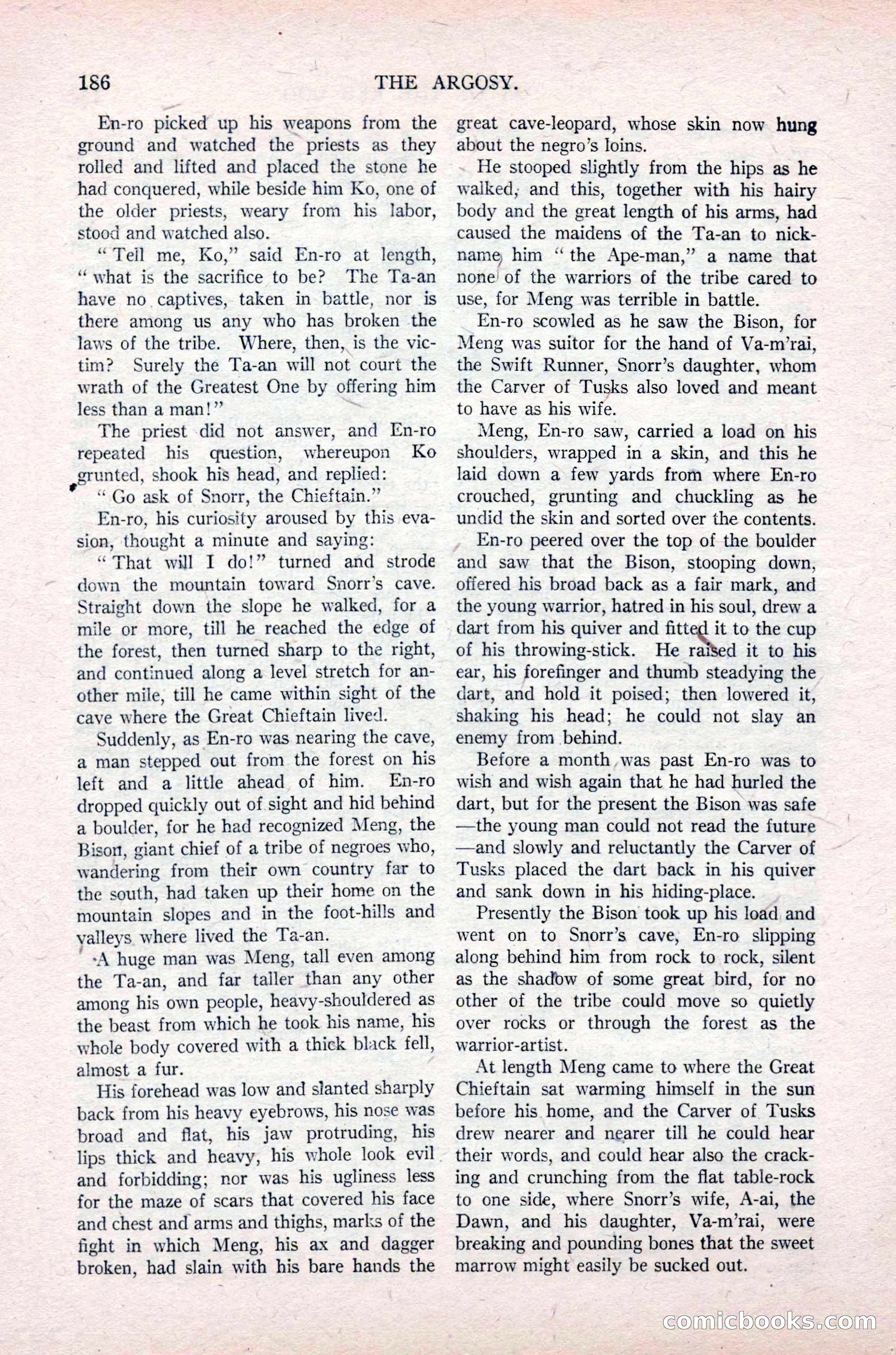
A restored page from Pulp Fiction, 1920. Page through the whole issue in the reader above.
📄 Transcribed text from this page (OCR, searchable)
Machine-transcribed from the original scan — historical spelling and the odd misread are preserved.
186 En-ro picked up his weapons from the ground and watched the priests as they rolled and lifted and placed the stone he had conquered, while beside him Ko, one of the older priests, weary from his labor, stood and watched also. “Tell me, Ko,” said En-ro at length, “what is the sacrifice to be? The Ta-an have no captives, taken in battle, nor is there among us any who has broken the laws of the tribe. Where, then, is the vic- tim? Surely the Ta-an will not court the wrath of the Greatest One by offering him less than a man!” 3 The priest did not answer, and [En-ro repeated his question, whereupon Ko erunted, shook his head, and replied: “ Go ask of Snorr, the Chieftain.” En-ro, his curiosity aroused by this eva- sion, thought a minute and saying: “That will I do!” turned and _ strode down the mountain toward Snorr’s cave. Straight down the slope he walked, for a mile or more, till he reached the edge of the forest, then turned sharp to the right, and continued along a level stretch for an- other mile, till he came within sight of the cave where the Great Chieftain lived. Suddenly, as En-ro was nearing the cave, a man stepped out from the forest on his left and a little ahead of him. En-ro dropped quickly out of sight and hid behind a boulder, for he had recognized Meng, the Bison, giant chief of a tribe of negroes who, wandering from their own country far to the south, had taken up their home on the mountain slopes and in the foot-hills and valleys. where lived the Ta-an. ' +A huge man was Meng, tall even among the Ta-an, and far taller than any other among his own people, heavy-shouldered as the beast from which he took his name, his whole body covered with a thick black fell, almost a fur. His forehead was low and slanted sharply back from his heavy eyebrows, his nose was broad and flat, his jaw protruding, his lips thick and heavy, his whole look evil and forbidding; nor was his ugliness less for the maze of scars that covered his face and chest and arms and thighs, marks of the fight in which Meng, his ax and dagger broken, had slain with his bare hands the THE ARGOSY. great cave-leopard, whose skin now hung about the negro’s loins. He stooped slightly from the hips as he walked; and this, together with his hairy body and the great length of his arms, had caused the maidens of the Ta-an to nick- name him ‘‘ the Ape-man,” a name that none! of the warriors of the tribe cared to use, for Meng was terrible in battle. En-ro scowled as he saw the Bison, for Meng was suitor for the hand of Va-m’rai, the Swift Runner, Snorr’s daughter, whom the Carver of Tusks also loved and meant to have as his wife. Meng, En-ro saw, carried a load on his shoulders, wrapped in a skin, and this he laid down a few yards from where En-ro crouched, grunting and chuckling as he undid the skin and sorted over the contents. En-ro peered over the top of the boulder and saw that the Bison, stooping down, ofiered his broad back as a fair mark, and the young warrior, hatred in his soul, drew a dart from his quiver and fitted it to the cup of his throwing-stick. He raised it to his ear, his forefinger and thumb steadying the dart, and hold it poised; then lowered it, shaking his head; he could not slay an enemy from behind. Before a month,was past En-ro was to wish and wish again that he had hurled the dart, but for the present the Bison was safe —the young man could not read the future —and slowly and reluctantly the Carver of Tusks placed the dart back in his quiver and sank down in his hiding-place. Presently the Bison took up his load and went on to Snorr’s cave, En-ro slipping along behind him from rock to rock, silent as the shadow of some great bird, for no other of the tribe could move so quietly over rocks or through the forest as the watrrior-artist. At length Meng came to where the Great Chieftain sat warming himself in the sun before his home, and the Carver of Tusks drew nearer and nearer till he could hear their words, and could hear also the crack- ing and crunching from the flat table-rock to one side, where Snorr’s wife, A-ai, the Dawn, and his daughter, Va-m’rai, were breaking and pounding bones that the sweet marrow might easily be sucked out. CORICGLOOOLK (E@