
Pulp Fiction, 1920 · page 34 of 176
Argosy, Vol. 117, No. 2 — page 34: what you’re looking at
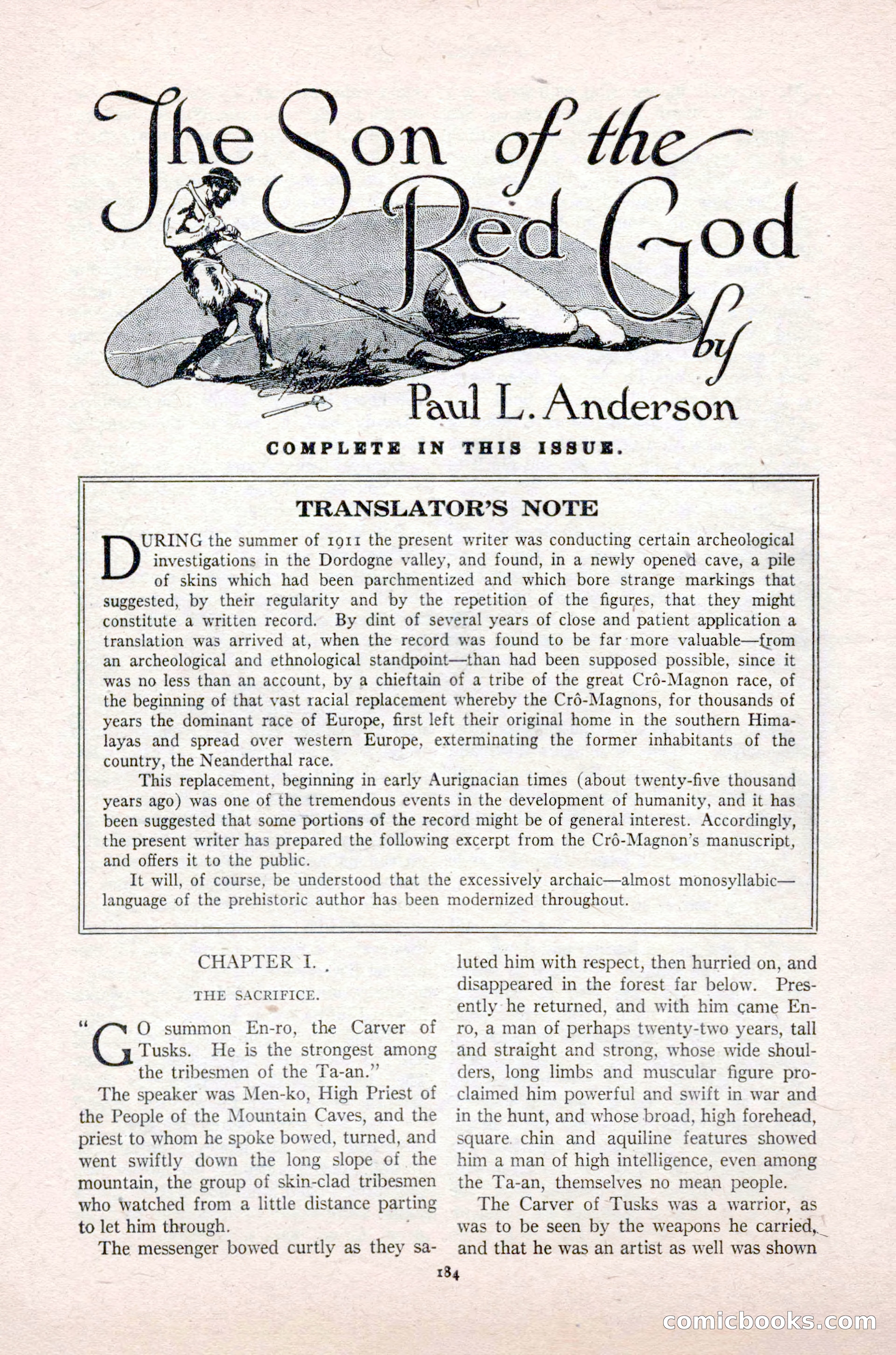
A restored page from Pulp Fiction, 1920. Page through the whole issue in the reader above.
📄 Transcribed text from this page (OCR, searchable)
Machine-transcribed from the original scan — historical spelling and the odd misread are preserved.
he Non of the— © Paul L. Anderson COMPLETE IN THIS ISSUE. TRANSLATOR’S NOTE URING the summer of 1o11 the present writer was conducting certain archeological D investigations in the Dordogne valley, and found, in a newly opened cave, a pile of skins which had been parchmentized and which bore strange markings that suggested, by their regularity and by the repetition of the figures, that they might constitute a written record. By dint of several years of close and patient application a translation was arrived at, when the record was found to be far more valuable—from an archeological and ethnological standpoint—than had been supposed possible, since it was no less than an account, by a chieftain of a tribe of the great Cro-Magnon race, of the beginning of that vast racial replacement whereby the Cr6-Magnons, for thousands of years the dominant race of Europe, first left their original home in the southern Hima- layas and spread over western Europe, exterminating the former inhabitants of the country, the Neanderthal race. This replacement, beginning in early Aurignacian times (about twenty-five thousand years ago) was one of the tremendous events in the development of humanity, and it has been suggested that sore portions of the record might be of general interest. Accordingly, the present writer has prepared the following excerpt from the Cro-Magnon’s manuscript, and offers it to the public. It will, of course, be understood that the excessively archaic—almost monosyllabic— language of the prehistoric author has been modernized throughout. CHAPTER ‘T. THE SACRIFICE. " O summon En-ro, the Carver of Tusks. He is the strongest among the tribesmen of the Ta-an.” The speaker was Men-ko, High Priest of the People of the Mountain Caves, and the priest to whom he spoke bowed, turned, and went swiftly down the long slope of the mountain, the group of skin-clad tribesmen who watched from a little distance parting to let him through. The messenger bowed curtly as they sa- luted him with respect, then hurried on, and disappeared in the forest far below. Pres- ently he returned, and with him came En- ro, a man of perhaps twenty-two years, tall and straight and strong, whose wide shoul- ders, long limbs and muscular figure pro- claimed him powerful and swift in war and in the hunt, and whose broad, high forehead, square. chin and aquiline features showed him a man of high intelligence, even among the Ta-an, themselves no mean people. The Carver of Tusks was a warrior, as was to be seen by the weapons he carried,_ and that he was an artist as well was shown 134 ECORICLOOO© (F@)