
Pulp Fiction, 1920 · page 18 of 176
Argosy, Vol. 117, No. 2 — page 18: what you’re looking at
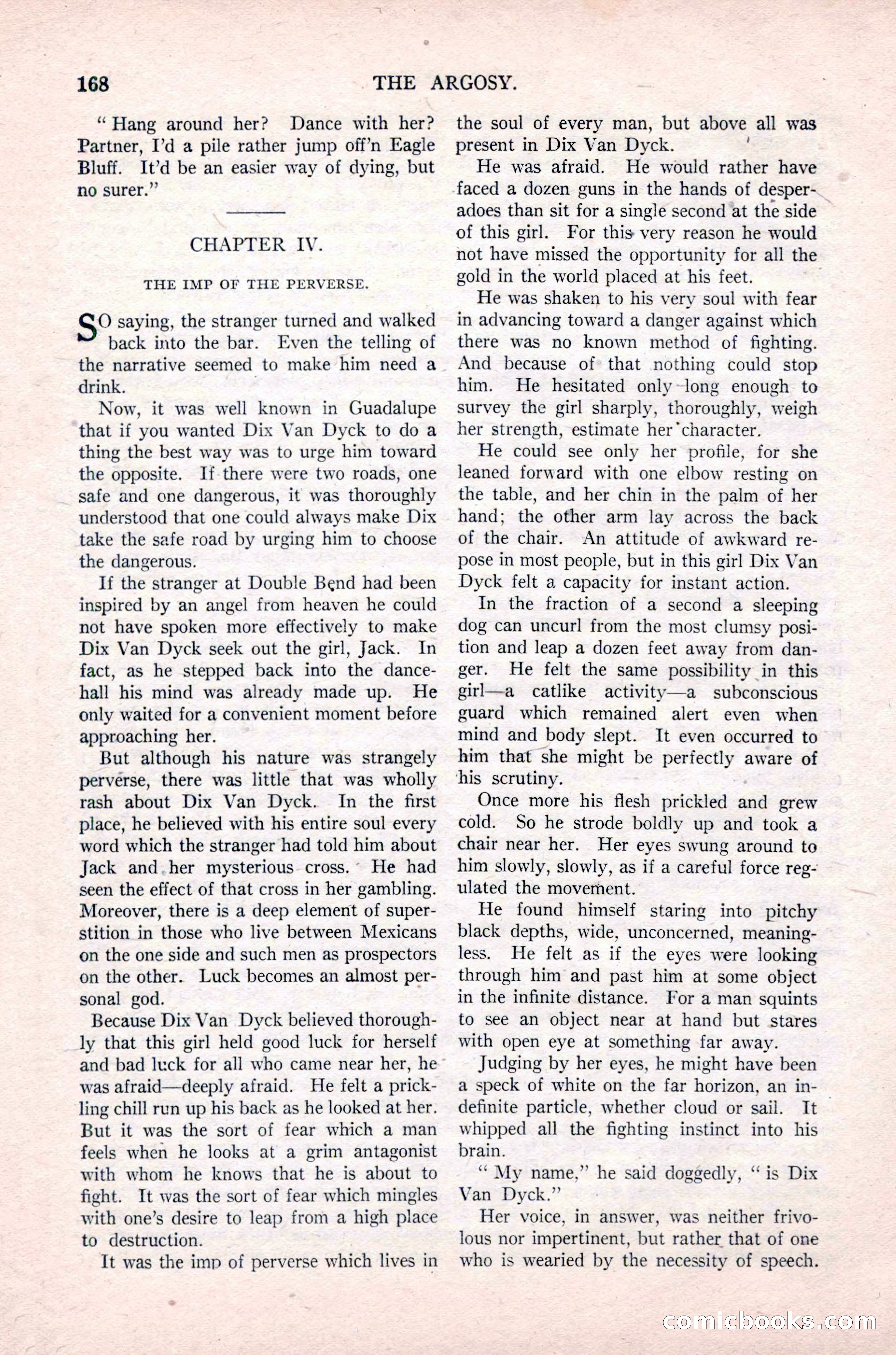
A restored page from Pulp Fiction, 1920. Page through the whole issue in the reader above.
📄 Transcribed text from this page (OCR, searchable)
Machine-transcribed from the original scan — historical spelling and the odd misread are preserved.
168 “ Hang around her? Dance with her? Partner, I’d a pile rather jump off’n Eagle Bluff. It'd be an easier way of dying, but no surer.”’ CHAPTER IV. THE IMP OF THE PERVERSE. S° saying, the stranger turned and walked back into the bar. Even the telling of the narrative seemed to make him need a drink. Now, it was well known in Guadalupe that if you wanted Dix Van Dyck to do a thing the best way was to urge him toward the opposite. If there were two roads, one safe and one dangerous, it was thoroughly understood that one could always make Dix take the safe road by urging him to choose the dangerous. If the stranger at Double Bend had been inspired by an angel from heaven he could not have spoken more effectively to make Dix Van Dyck seek out the girl, Jack. In fact, as he stepped back into the dance- hall his mind was already made up. He only waited for a convenient moment before approaching her. But although his nature was strangely perverse, there was little that was wholly rash about Dix Van Dyck. In the first place, he believed with his entire soul every word which the stranger had told him about Jack and her mysterious cross.° He had seen the effect of that cross in her gambling. Moreover, there is a deep element of super- stition in those who live between Mexicans on the one side and such men as prospectors on the other. Luck becomes an almost per- sonal god. Because Dix Van Dyck believed thorough- ly that this girl held good luck for herself and bad luck for all who came near her, he was afraid—deeply afraid. He felt a prick- ling chill run up his back as he looked at her. But it was the sort of fear which a man feels when he looks at a grim antagonist with whom he knows that he is about to fight. It was the sort of fear which mingles with one’s desire to leap from a high place to destruction. It was the imp of perverse which lives in THE ARGOSY. the soul of every man, but above all was present in Dix Van Dyck. He was afraid. He would rather have faced a dozen guns in the hands of desper- adoes than sit for a single second at the side of this girl. For this very reason he would not have missed the opportunity for all the gold in the world placed at his feet. He was shaken to his very soul with fear in advancing toward a danger against which there was no known method of fighting. And because of that nothing could stop him. He hesitated only-long enough to survey the girl sharply, thoroughly, weigh her strength, estimate her character. He could see only her profile, for she leaned forward with one elbow resting on the table, and her chin in the palm of her hand; the other arm lay across the back of the chair. An attitude of awkward re- pose in most people, but in this girl Dix Van Dyck felt a capacity for instant action. In the fraction of a second a sleeping dog can uncurl from the most clumsy posi- tion and leap a dozen feet away from dan- ger. He felt the same possibility in this girl—a_ catlike activity—a subconscious guard which remained alert even when mind and body slept. It even occurred to him that she might be perfectly aware of his scrutiny. Once more his flesh prickled and grew cold. So he strode boldly up and took a chair near her. Her eyes swung around to him slowly, slowly, as if a careful force reg- ulated the movement. He found himself staring into pitchy black depths, wide, unconcerned, meaning- less. He felt as if the eyes were looking through him and past him at some object in the infinite distance. For a man squints to see an object near at hand but stares with open eye at something far away. Judging by her eyes, he might have been a speck of white on the far horizon, an in- definite particle, whether cloud or sail. whipped all the fighting instinct into his brain. ‘“My name,” he said doggedly, “ is Dix Van Dyck.” Her voice, in answer, was neither frivo- lous nor impertinent, but rather that of one who is wearied by the necessity of speech. (EO) DOO AMUG S e=. (C@