
Pulp Fiction, 1920 · page 126 of 176
Argosy, Vol. 117, No. 2 — page 126: what you’re looking at
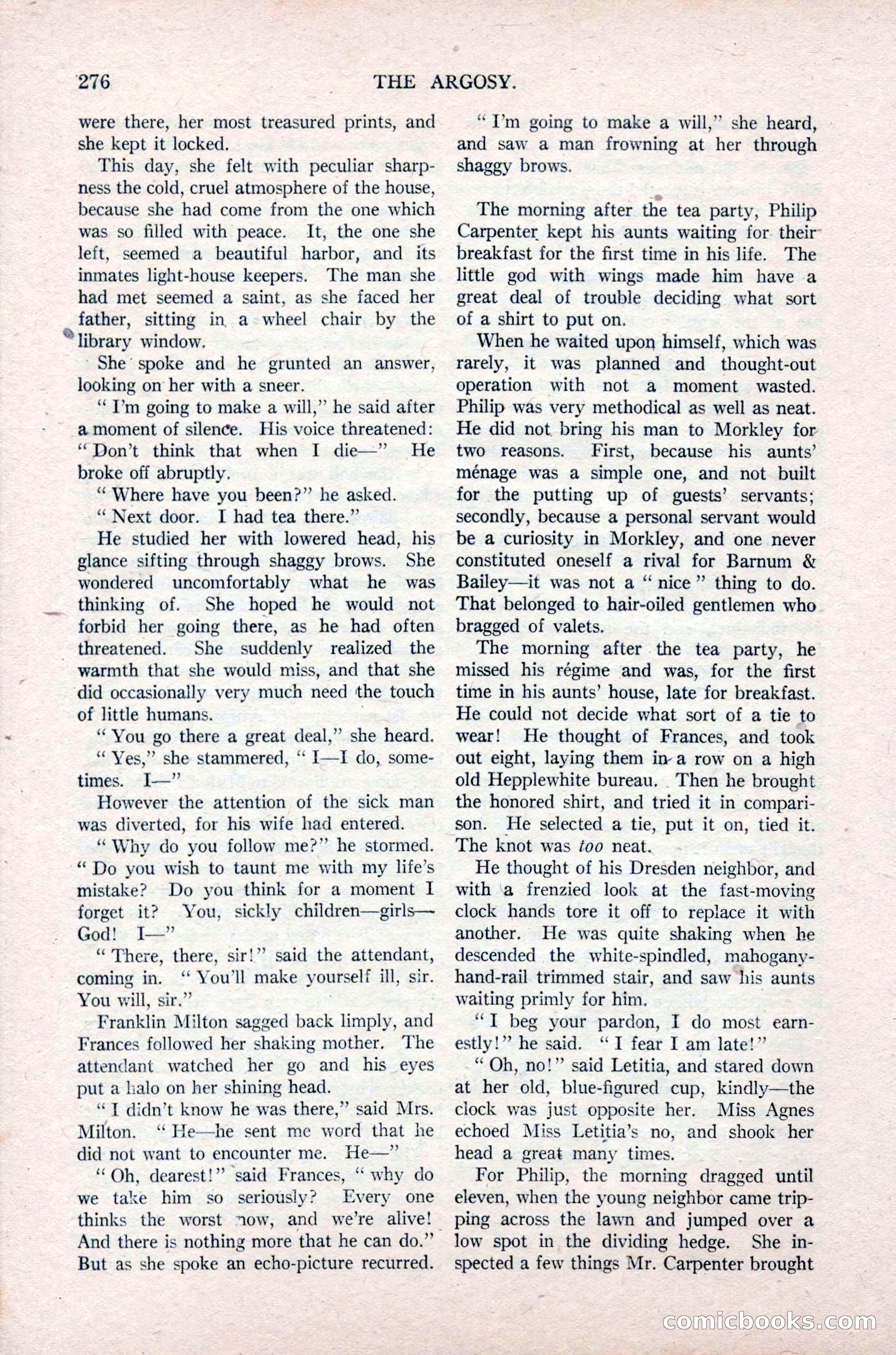
A restored page from Pulp Fiction, 1920. Page through the whole issue in the reader above.
📄 Transcribed text from this page (OCR, searchable)
Machine-transcribed from the original scan — historical spelling and the odd misread are preserved.
276 were there, her most treasured prints, and she kept it locked. This day, she felt with peculiar sharp- ness the cold, cruel atmosphere of the house, because she had come from the one which was so filled with peace. It, the one she left, seemed a beautiful harbor, and its inmates light-house keepers. The man she had met seemed a saint, as she faced her father, sitting in. a wheel chair by the “library window. She spoke and he grunted an answer, looking on her with a sneer. ‘Tm going to make a will,” he said after a moment of silence. His voice threatened: ‘Don’t think that when I die—” He broke off abruptly. “Where have you been?” he asked. ‘““Next door. I had tea there.”’ He studied her with lowered head, his glance sifting through shaggy brows. She wondered uncomfortably what he was thinking of. She hoped he would not forbid her going there, as he had often threatened. She suddenly realized the warmth that she would miss, and that she did occasionally very much need the touch of little humans. : ‘You go there a great deal,” she heard. “Yes,” she stammered, “ I—I do, some- times. J—” However the attention of the sick man was diverted, for his wife had entered. “Why do you follow me?” he stormed. “ Do you wish to taunt me with my life’s mistake? Do you think for a moment I forget it? You, sickly children—girls— God! I—” “ There, there, sir!”’ said the attendant, coming in. ‘ You'll make yourself ill, sir. You will, sir.” 3 Franklin Milton sagged back limply, and Frances followed her shaking mother. The attendant watched her go and his eyes put a halo on her shining head. “ T didn’t know he was there,” said Mrs. Milton. ‘‘ He—he sent me word that he did not want to encounter me. He—” “Oh, dearest!”’ said Frances, “ why do we take him so seriously? Every one thinks the worst now, and we’re alive! And there is nothing more that he can do.” But as she spoke an echo-picture recurred. THE ARGOSY. “I’m going to make a will,” she heard, and saw a man frowning at her through shaggy brows. The morning after the tea party, Philip Carpenter kept his aunts waiting for their breakfast for the first time in his life. The little god with wings made him have a great deal of trouble deciding what sort of a shirt to put on. When he waited upon himself, which was rarely, it was planned and _ thought-out operation with not a moment wasted. Philip was very methodical as well as neat. He did not bring his man to Morkley for two reasons. First, because his aunts’ meénage was a simple one, and not built for the putting up of guests’ servants; secondly, because a personal servant would be a curiosity in Morkley, and one never constituted oneself a rival for Barnum & Bailey—it was not a “nice” thing to do. That belonged to hair-oiled gentlemen who bragged of valets. The morning after the tea party, he missed his régime and was, for the first time in his aunts’ house, late for breakfast. He could not decide what sort of a tie to wear! He thought of Frances, and took out eight, laying them ina row on a high old Hepplewhite bureau. . Then he brought the honored shirt, and tried it in compari- son. He selected a tie, put it on, tied it. The knot was too neat. He thought of his Dresden neighbor, and with a frenzied look at the fast-moving clock hands tore it off to replace it with another. He was quite shaking when he descended the white-spindled, mahogany- hand-rail trimmed stair, and saw his aunts waiting primly for him. ‘“T beg your pardon, I do most earn- estly!” he said. ‘I fear I am late!” “Oh, no!” said Letitia, and stared down at her old, blue-figured cup, kindly—the clock was just opposite her. Miss Agnes echoed Miss Letitia’s no, and shook her head a great many times. For Philip, the morning dragged until eleven, when the young neighbor came trip- ping across the lawn and jumped over a low spot in the dividing hedge. She in- spected a few things Mr. Carpenter brought S Gomichboo (C@