
Pulp Fiction, 1920 · page 123 of 176
Argosy, Vol. 117, No. 2 — page 123: what you’re looking at
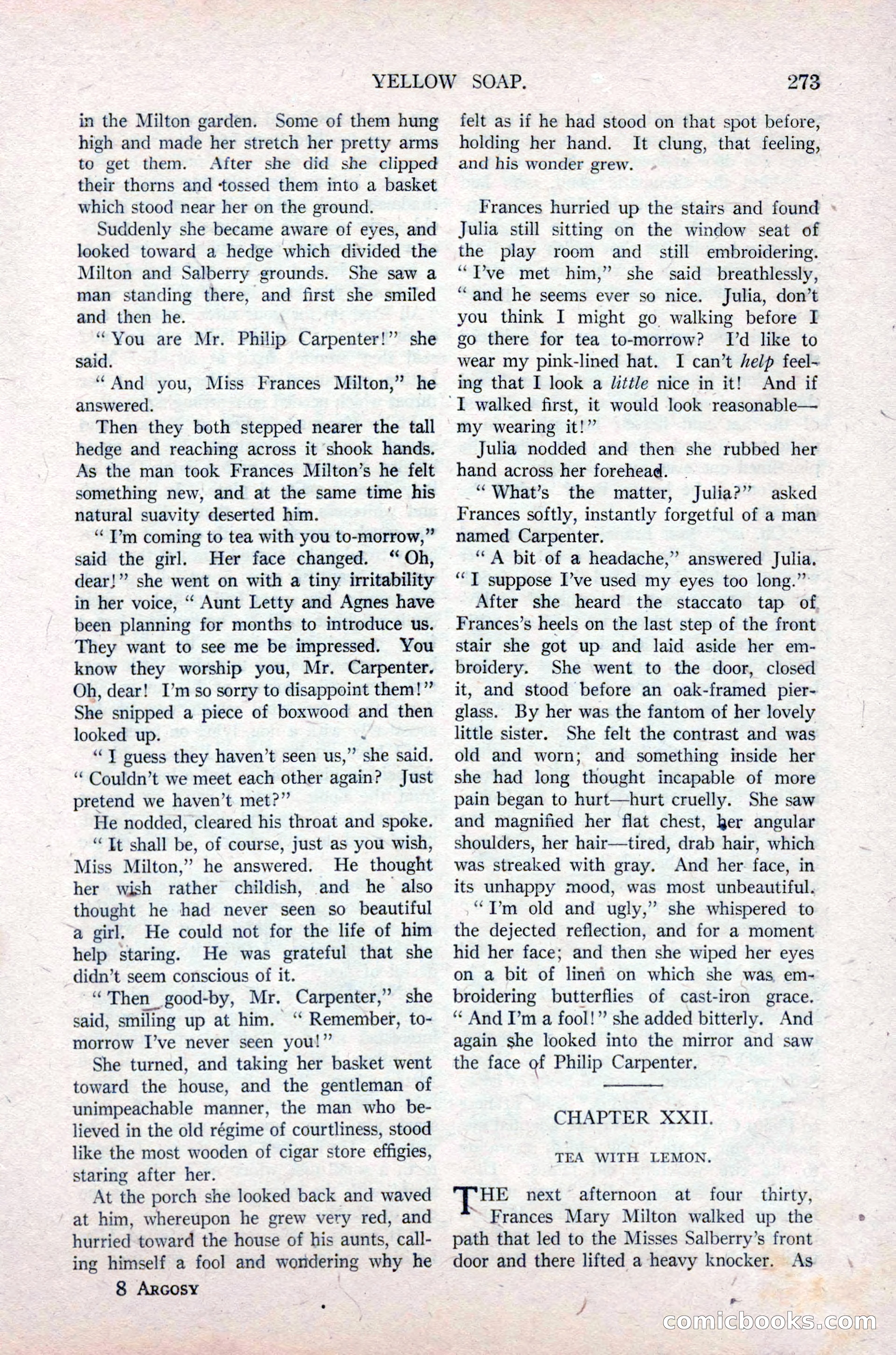
A restored page from Pulp Fiction, 1920. Page through the whole issue in the reader above.
📄 Transcribed text from this page (OCR, searchable)
Machine-transcribed from the original scan — historical spelling and the odd misread are preserved.
YELLOW SOAP. in the Milton garden. Some of them hung high and made her stretch her pretty arms to get them. After she did she clipped their thorns and ‘tossed them into a basket which stood near her on the ground. Suddenly she became aware of eyes, and looked toward a hedge which divided the Milton and Salberry grounds. She saw a man standing there, and first she smiled and then he. “You are Mr. Philip Carpenter!” she said. ‘““And you, Miss Frances Milton,” he answered. Then they both stepped nearer the tall hedge and reaching across it shook hands. As the man took Frances Milton’s he felt something new, and at the same time his natural suavity deserted him. “ T’m coming to tea with you to-morrow,” said the girl. Her face changed. “Oh, dear!” she went on with a tiny irritability in her voice, “ Aunt Letty and Agnes have been planning for months to introduce us. They want to see me be impressed. You know they worship you, Mr. Carpenter. Oh, dear! I’m so sorry to disappoint them!” She snipped a piece of boxwood and then looked up. ‘ ‘““T guess they haven’t seen us,” she said. ‘‘Couldn’t we meet each other again? Just pretend we haven’t met?” He nodded, cleared his throat and spoke. ‘Tt shall be, of course, just as you wish, Miss Milton,” he answered. He thought her wish rather childish, and he also thought he had never seen so beautiful a girl, He could not for the life of him help staring. He was grateful that she didn’t seem conscious of it. “'Then_good-by, Mr. Carpenter,” she said, smiling up at him. ‘“‘ Remember, to- morrow I’ve never seen you!” She turned, and taking her basket went toward the house, and the gentleman of unimpeachable manner, the man who be- lieved in the old régime of courtliness, stood like the most wooden of cigar store effigies, staring after her. At the porch she looked back and waved at him, whereupon he grew very red, and hurried toward the house of his aunts, call- ing himself a fool and wondering why he 8 ArGcosy 273 felt as if he had stood on that spot before, holding her hand. It clung, that feeling, and his wonder grew. Frances hurried up the stairs and found » Julia still sitting on the window seat of the play room and _ still embroidering. “ve met him,” she said breathlessly, “and he seems ever so nice. Julia, don’t you think I might go walking before I go there for tea to-morrow? I’d like to wear my pink-lined hat. I can’t help feel- ing that I look a little nice in it! And if I walked first, it would look reasonable— my wearing it!” Julia nodded and then she rubbed her hand across her forehead. | “What’s the matter, Julia?” asked Frances softly, instantly forgetful of a man named Carpenter. “A bit of a headache,” answered Julia. ““T suppose I’ve used my eyes too long.”’ After she heard the staccato tap of Frances’s heels on the last step of the front stair she got up and laid aside her em- broidery. She went to the door, closed it, and stood before an oak-framed pier- glass. By her was the fantom of her lovely little sister. She felt the contrast and was old and worn; and something inside her she had long thought incapable of more pain began to hurt—hurt cruelly. She saw and magnified her flat chest, ker angular shoulders, her hair—tired, drab hair, which was streaked with gray. And her. face, in its unhappy mood, was most unbeautiful. “Tm old and ugly,” she whispered to the dejected reflection, and for a moment hid her face; and then she wiped her eyes on a bit of linefi on which she was em- broidering butterflies of cast-iron grace. ** And I’m a fool!’ she added bitterly. And again she looked into the mirror and saw the face of Philip Carpenter, CHAPTER XXII. TEA WITH LEMON. HE next afternoon at four thirty, ™ Frances Mary Milton walked up the path that led to the Misses Salberry’s front door and there lifted a heavy knocker. As coe J s Gomichbooks (C@