
Pulp Fiction, 1920 · page 121 of 176
Argosy, Vol. 117, No. 2 — page 121: what you’re looking at
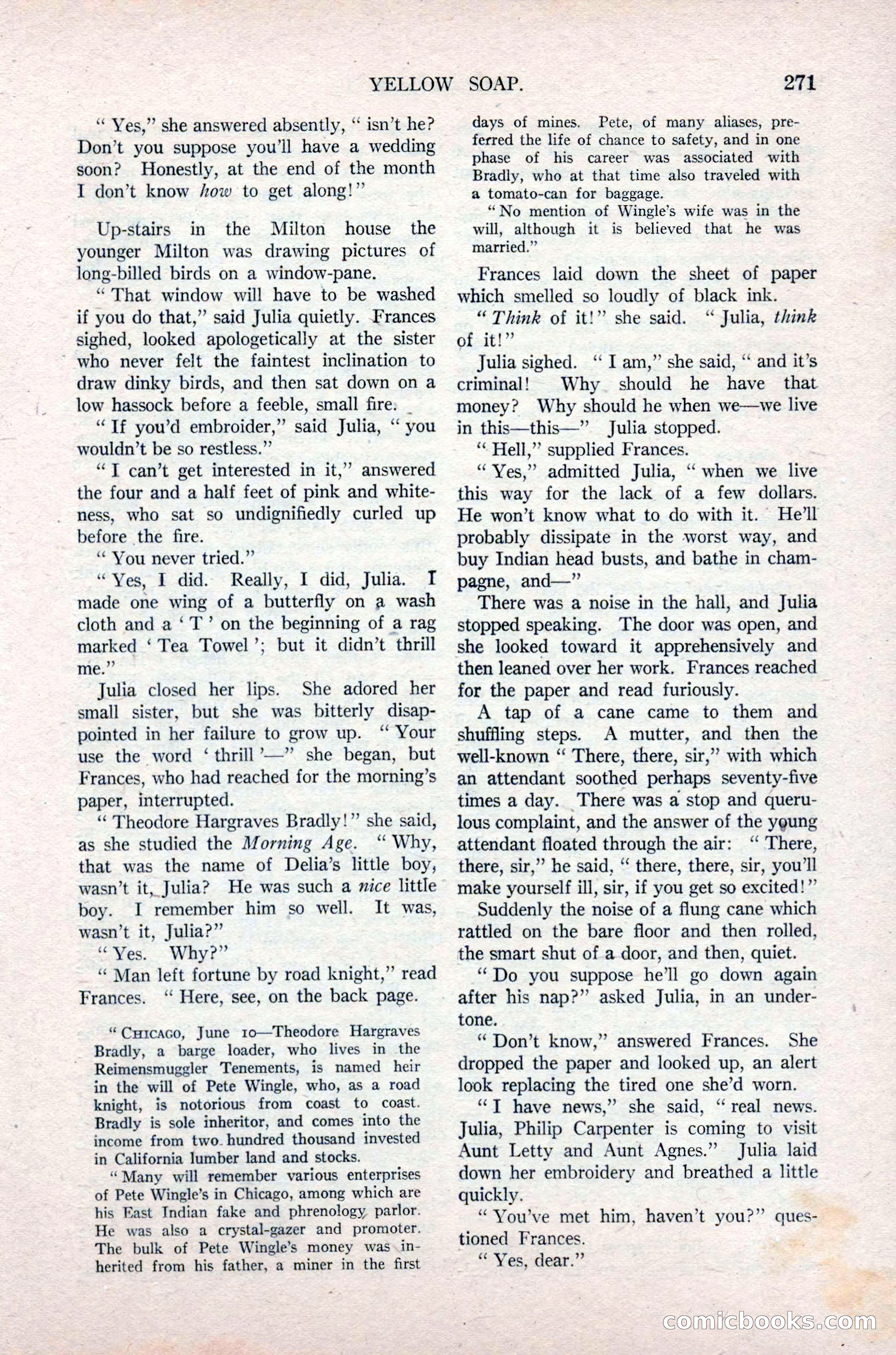
A restored page from Pulp Fiction, 1920. Page through the whole issue in the reader above.
📄 Transcribed text from this page (OCR, searchable)
Machine-transcribed from the original scan — historical spelling and the odd misread are preserved.
YELLOW SOAP. “Yes,” she answered absently, “‘ isn’t he? Don’t you suppose you'll have a wedding soon? Honestly, at the end of the month I don’t know /ow to get along!”’ Up-stairs in the Milton house the younger Milton was drawing pictures of long-billed birds on a window-pane. “That window will have to be washed if you do that,” said Julia quietly. I‘rances sighed, looked apologetically at the sister ' who never felt the faintest inclination to draw dinky birds, and then sat down on a low hassock before a feeble, small fire: _ “Tf you’d embroider,” said Julia, “‘ you wouldn’t be so restless.” “T can’t get interested in it,’ answered the four and a half feet of pink and white- ness, who sat so undignifiedly curled up before the fire. “You never tried.” “Ves, I did. Really, I did, Julia. I made one wing of a butterfly on a wash cloth and a ‘ T’ on the beginning of a rag marked ‘Tea Towel’; but it didn’t thrill me.”’ Julia closed her lips. She adored her small sister, but she was bitterly disap- pointed in her failure to grow up. “ Your use the word ‘thrill ’—” she began, but Frances, who had reached for the morning’s paper, interrupted. ‘“‘ Theodore Hargraves Bradly!” she said, as she studied the Morning Age. ‘“ Why, that was the name of Delia’s little boy, wasn’t it, Julia? He was such a nice little boy. I remember him so well. It was, wasn’t it, Julia?” “Ves. Why?” “Man left fortune by road knight,” read Frances. ‘ Here, see, on the back page. “Curcaco, June 1o—Theodore Hargraves Bradly, a barge loader, who lives in the Reimensmuggler Tenements, is named heir in the will of Pete Wingle, who, as a road knight, is notorious from coast to coast. Bradly is sole inheritor, and comes into the income from two. hundred thousand invested in California lumber land and stocks. “Many will remember various enterprises of Pete Wingle’s in Chicago, among which are his East Indian fake and phrenology, parlor. He was also a crystal-gazer and promoter. The bulk of Pete Wingle’s money was. in- herited from his father, a miner in the first 271 days of mines. Pete, of many aliases, pre- ferred the life of chance to safety, and in one phase of his career was associated with Bradly, who at that time also traveled with a tomato-can for baggage. “No mention of Wingle’s wife was in the will, although it is believed that he was married.” Frances laid down the sheet of paper which smelled so loudly of black ink. “Think of it!” she said. “ Julia, think of it!” Julia sighed. ‘ I am,” she said, “ and it’s criminal! Why should he have that money? Why should he when we—we live in this—this—” Julia stopped. “* Hell,” supplied Frances. “Yes,” admitted Julia, ‘““ when we live this way for the lack of a few dollars. He won’t know what to do with it. He'll probably dissipate in the worst way, and buy Indian head busts, and bathe in cham- pagne, and—”’ There was a noise in the hall, and Julia stopped speaking. The door was open, and she looked toward it apprehensively and then leaned over her work. Frances reached for the paper and read furiously. A tap of a cane came to them and shuffling steps. A mutter, and then the well-known ‘‘ There, there, sir,”’ with which an attendant soothed perhaps seventy-five times a day. There was a stop and queru- lous complaint, and the answer of the young attendant floated through the air: ‘“ There, there, sir,’”’ he said, ‘‘ there, there, sir, you'll make yourself ill, sir, if you get so excited!” Suddenly the noise of a flung cane which rattled on the bare floor and then rolled, the smart shut of a door, and then, quiet. “Do you suppose he'll go down again after his nap?” asked Julia, in an under- tone. “ Don’t know,” answered Frances. She dropped the paper and looked up, an alert look replacing the tired one she’d worn. “TI have news,” she said, “ real news. Julia, Philip Carpenter is coming to visit Aunt Letty and Aunt Agnes.” Julia laid down her embroidery and breathed a little quickly. “You’ve met him, haven’t you?” ques- tioned Frances. “Yes, dear.” (EO) NOOK (C@