
Pulp Fiction, 1920 · page 119 of 176
Argosy, Vol. 117, No. 2 — page 119: what you’re looking at
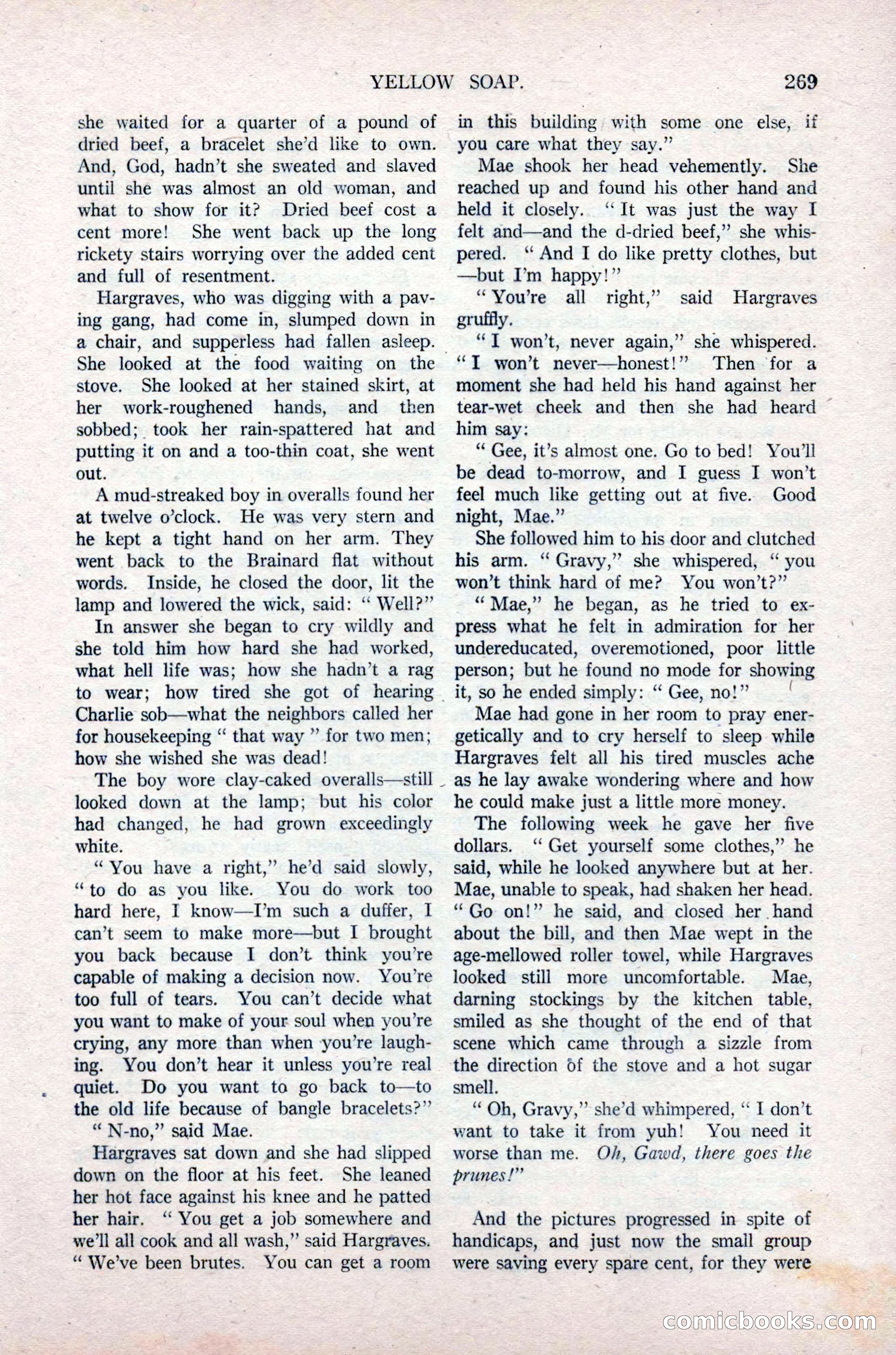
A restored page from Pulp Fiction, 1920. Page through the whole issue in the reader above.
📄 Transcribed text from this page (OCR, searchable)
Machine-transcribed from the original scan — historical spelling and the odd misread are preserved.
YELLOW SOAP. she waited for a quarter of a pound of dried beef, a bracelet she’d like to own. And, God, hadn’t she sweated and slaved until she was almost an old woman, and what to show for it? Dried beef cost a cent more! She went back up the long rickety stairs worrying over the added cent and full of resentment. Hargraves, who was digging with a pav- ing gang, had come in, slumped down in a chair, and supperless had fallen asleep. She looked at the food waiting on the stove. She looked at her stained skirt, at her work-roughened hands, and _ then sobbed; took her rain-spattered hat and putting it on and a too-thin coat, she went out. A mud-streaked boy in overalls found her at twelve o’clock. He was very stern and he kept a tight hand on her arm. They went back to the Brainard flat without words. Inside, he closed the door, lit the lamp and lowered the wick, said: ‘“‘ Well?”’ In answer she began to cry wildly and she told him how hard she had worked, what hell life was; how she hadn’t a rag to wear; how tired she got of hearing ~ Charlie sob—what the neighbors called her for housekeeping “ that way ” for two men; how she wished she was dead! The boy wore clay-caked overalls—still _ looked down at the lamp; but his color had changed, he had grown exceedingly white. “You have a right,” he’d said slowly, “to do as you like. You do work too hard here, I know—I’m such a duffer, I can’t seem to make more—but I brought you back because I don’t think you're capable of making a decision now. You're - too full of tears. You can’t decide what you want to make of your soul when you're crying, any more than when you're laugh- ing. You don’t hear it unless you’re real quiet. Do you want to go back to—to the old life because of bangle bracelets?” “ N-no,”’ said Mae. Hargraves sat down and she had slipped down on the floor at his feet. She leaned her hot face against his knee and he patted her hair. ‘“‘ You get a job somewhere and we'll all cook and all wash,” said Hargraves. “* We've been brutes. You can get a room 269 in this building with some one else, if you care what they say.” Mae shook her head vehemently. She reached up and found his other hand and held it closely. ‘‘ It was just the way I felt and—and the d-dried beef,” she whis- pered. ‘“ And I do like pretty clothes, but —but I’m happy!” “You're all right,” gruffly. “T won’t, never again,” she whispered. ““T won’t never—honest!” Then for a moment she had held his hand against her tear-wet cheek and then she had heard him say: “ Gee, it’s almost one. Go to bed! You'll be dead to-morrow, and I guess I won’t feel much like getting out at five. Good night, Mae.” She followed him to his door and clutched his arm. “ Gravy,” she whispered, “ you won’t think hard of me? You won’t?” “Mae,” he began, as he tried to ex- press what he felt in admiration for her undereducated, overemotioned, poor little person; but he found no mode for showing it, so he ended simply: “ Gee, no!” Mae had gone in her room to pray ener- getically and to cry herself to sleep while Hargraves felt all his tired muscles ache as he lay awake wondering where and how he could make just a little more money. The following week he gave her five dollars. ‘‘ Get yourself some clothes,” he said, while he looked anywhere but at her. Mae, unable to speak, had shaken her head. “Go on!” he said, and closed her hand about the bill, and then Mae wept in the age-mellowed roller towel, while Hargraves looked still more uncomfortable. Mae, darning stockings by the kitchen table, smiled as she thought of the end of that scene which came through a sizzle from the direction of the stove and a hot sugar smell. “Oh, Gravy,” she’d whimpered, “ I don’t want to take it from yuh! You need it worse than me. Of, Gawd, there goes the prunes!” said Hargraves And the pictures progressed in spite of handicaps, and just now the smail group were saving every spare cent, for they were GOmIicbooks (C@