
Pulp Fiction, 1920 · page 110 of 176
Argosy, Vol. 117, No. 2 — page 110: what you’re looking at
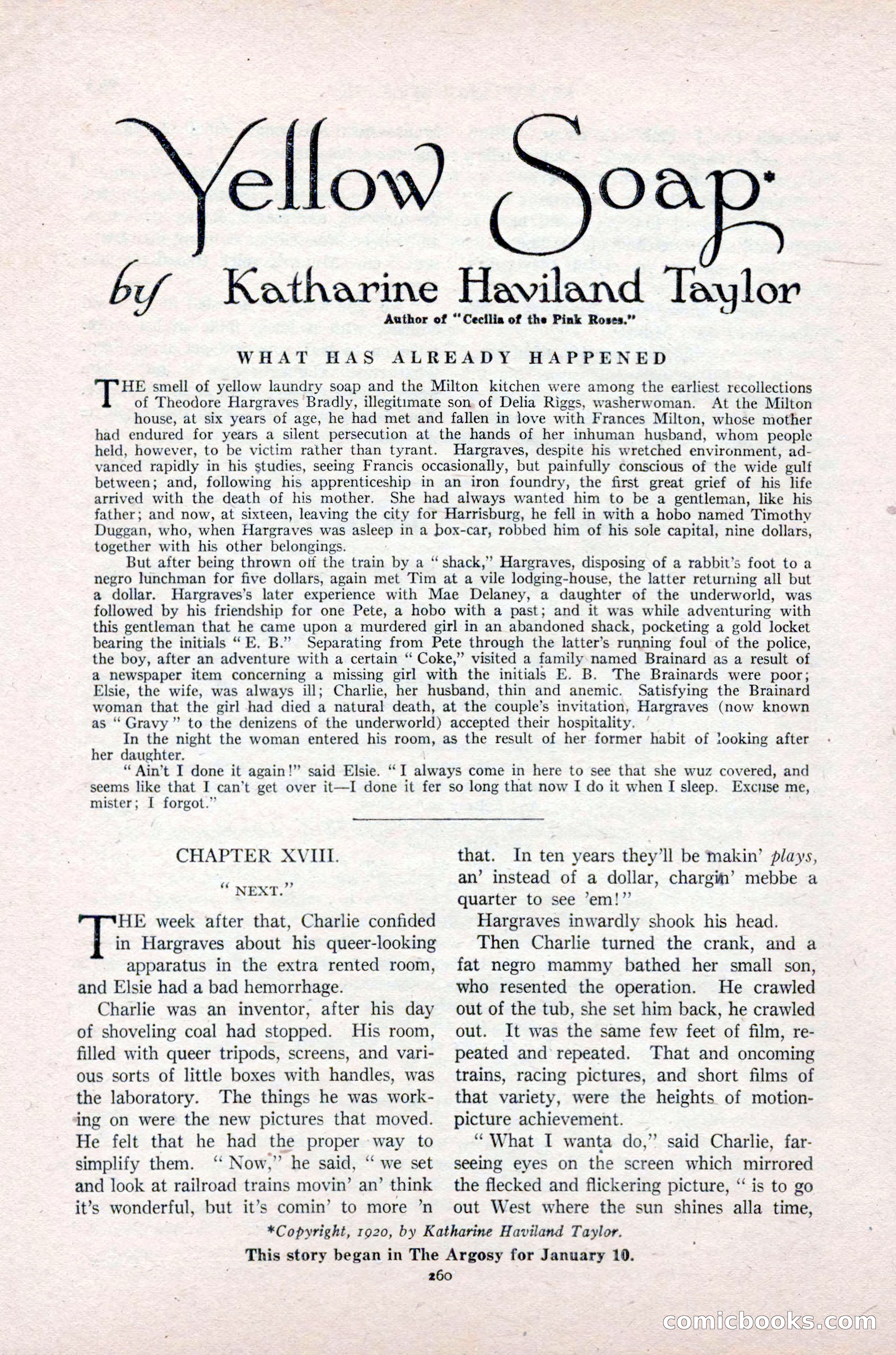
A restored page from Pulp Fiction, 1920. Page through the whole issue in the reader above.
📄 Transcribed text from this page (OCR, searchable)
Machine-transcribed from the original scan — historical spelling and the odd misread are preserved.
Yellow oar: by Katharine Haviland Taylor Author of “Cecilia of the Pink Roses.” WHAT HAS ALREADY HAPPENED HE smell of yellow laundry soap and the Milton kitchen were among the earliest recollections of Theodore Hargraves Bradly, illegitimate son of Delia Riggs, washerwoman. At the Milton house, at six years of age, he had met and fallen in love with Frances Milton, whose mother had endured for years a silent persecution at the hands of her inhuman husband, whom people held, however, to be victim rather than tyrant. Hargraves, despite his wretched environment, ad- vanced rapidly in his studies, seeing Francis occasionally, but painfully conscious of the wide gulf between; and, following his apprenticeship in an iron foundry, the first great grief of his life arrived with the death of his mother. She had always wanted him to be a gentleman, like his father; and now, at sixteen, leaving the city for Harrisburg, he fell in with a hobo named Timothy Duggan, who, when Hargraves was asleep in a box-car, robbed him of his sole capital, nine dollars, together with his other belongings. But after being thrown off the train by a “ shack,” Hargraves, disposing of a rabbit’s foot to a negro lunchman for five dollars, again met Tim at a vile lodging-house, the latter returning all but a dollar. Hargraves’s later experience with Mae Delaney, a daughter of the underworld, was followed by his friendship for one Pete, a hobo with a past; and it was while adventuring with this gentleman that he came upon a murdered girl in an abandoned shack, pocketing a gold locket bearing the initials “E, B.” Separating from Pete through the latter’s running foul of the police, the boy, after an adventure with a certain “ Coke,” visited a family named Brainard as a result of a newspaper item concerning a missing girl with the initials E. B. The Brainards were poor; Elsie, the wife, was always ill; Charlie, her husband, thin and anemic. Satisfying the Brainard woman that the girl had died a natural death, at the couple’s invitation, Hargraves (now known as “Gravy” to the denizens of the underworld) accepted their hospitality. ‘ In the night the woman entered his room, as the result of her former habit of looking after her daughter. “ Ain’t I done it again!” said Elsie. “I always come in here to see that she wuz covered, and seems like that I can’t get over it—I done it fer so long that now I do it when I sleep. Excuse me, mister; I forgot.” that. In ten years they’ll be makin’ plays, an’ instead of a dollar, chargin’ mebbe a quarter to see ’em!”’ Hargraves inwardly shook his head. Then Charlie turned the crank, and a fat negro mammy bathed her small son, who resented the operation. He crawled out of the tub, she set him back, he crawled out. It was the same few feet of film, re- peated and repeated. That and oncoming trains, racing pictures, and short films of that variety, were the heights of motion- picture achievement. CHAPTER XVIII. S NEXT. 2 HE week after that, Charlie confided in Hargraves about his queer-looking apparatus in the extra rented room, and Elsie had a bad hemorrhage. Charlie was an inventor, after his day of shoveling coal had stopped. His room, filled with queer tripods, screens, and vari- ous sorts of little boxes with handles, was the laboratory. The things he was work- ing on were the new pictures that moved. said Charlie, far- He felt that he had the proper way to simplify them. ‘ Now,” he said, “ we set and look at railroad trains movin’ an’ think it’s wonderful, but it’s comin’ to more ’n “What I wanta do,” seeing eyes on the screen which mirrored the flecked and flickering picture, “is to go out West where the sun shines alla time, *Copyright, 1920, by Katharine Haviland Taylor. This story began in The Argosy for January 10. 260 CORNICGLOOOLK< (C@