
Pulp Fiction, 1920 · page 105 of 176
Argosy, Vol. 117, No. 2 — page 105: what you’re looking at
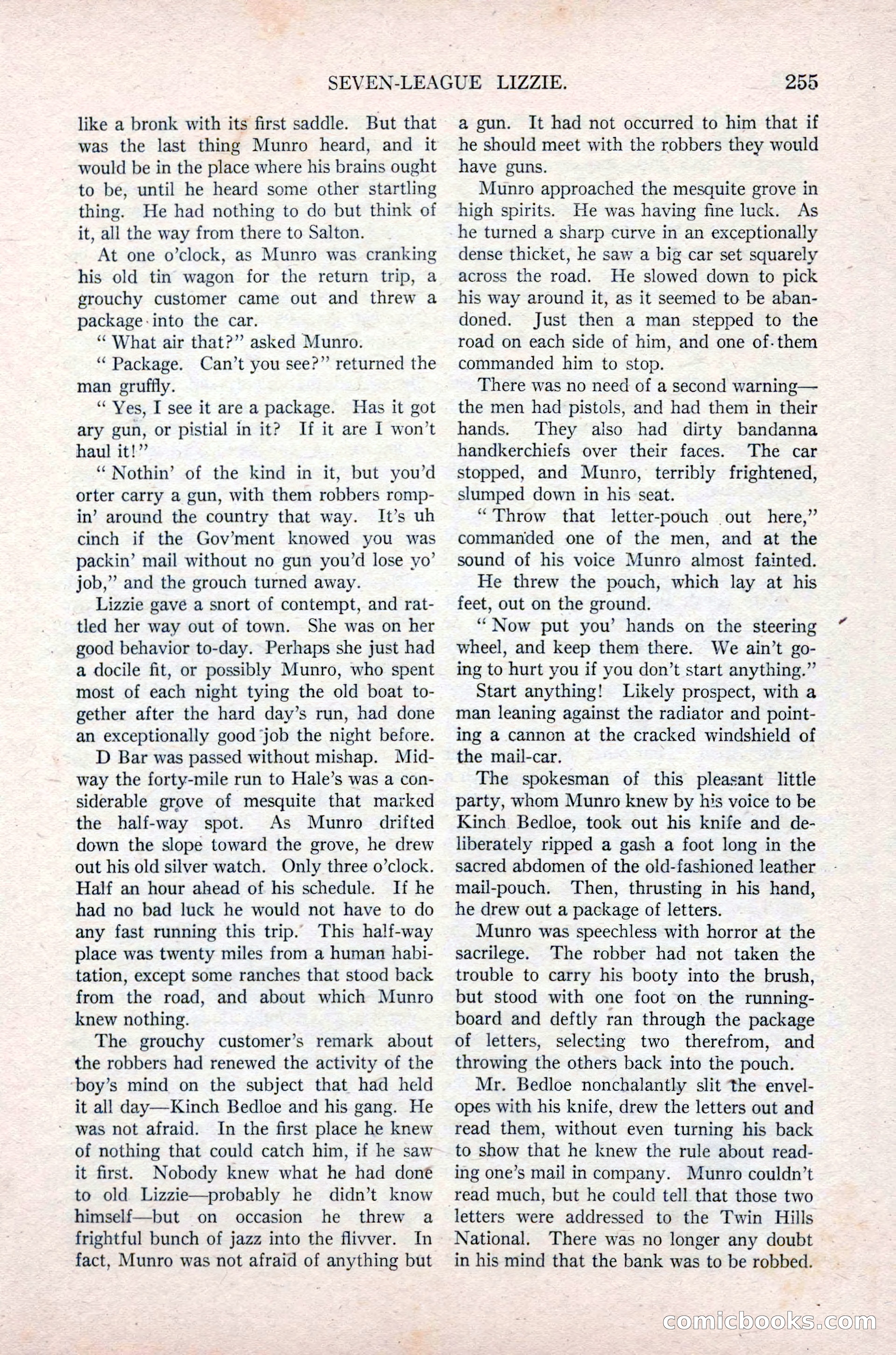
A restored page from Pulp Fiction, 1920. Page through the whole issue in the reader above.
📄 Transcribed text from this page (OCR, searchable)
Machine-transcribed from the original scan — historical spelling and the odd misread are preserved.
SEVEN-LEAGUE LIZZIE. like a bronk with its first saddle. But that was the last thing Munro heard, and it would be in the place where his brains ought to be, until he heard some other startling thing. He had nothing to do but think of it, all the way from there to Salton. At one o’clock, as Munro was cranking his old tin wagon for the return trip, a grouchy customer came out and threw a package-into the car. ‘“ What air that?” asked Munro. ‘“ Package. Can’t you see?” returned the man gruffly. “Yes, I see it are a package. Has it got ary gun, or pistial in it? If it are I won't haul it!” ‘Nothin’ of the kind in it, but you’d orter carry a gun, with them robbers romp- in’ around the country that way. It’s uh cinch if the Gov’ment knowed you was packin’ mail without no gun you’d lose yo’ job,” and the grouch turned away. Lizzie gave a snort of contempt, and rat- tled her way out of town. She was on her good behavior to-day. Perhaps she just had a docile fit, or possibly Munro, who spent most of each night tying the old boat to- gether after the hard day’s run, had done an exceptionally good job the night before. D Bar was passed without mishap. Mid- way the forty-mile run to Hale’s was a con- siderable grove of mesquite that marked the half-way spot. As Munro drifted down the slope toward the grove, he drew out his old silver watch. Only three o’clock. Half an hour ahead of his schedule. If he had no bad luck he would not have to do any fast running this trip. This half-way place was twenty miles from a human habi- tation, except some ranches that stood back from the road, and about which Munro knew nothing. The grouchy customer’s remark about the robbers had renewed the activity of the ‘boy’s mind on the subject that had held it all! day—Kinch Bedloe and his gang. He ‘ was not afraid. In the first place he knew of nothing that could catch him, if he saw it first. Nobody knew what he had done to old Lizzie—probably he didn’t know himself—but on occasion he threw a frightful bunch of jazz into the flivver. In fact, Munro was not afraid of anything but 250 a gun. It had not occurred to him that if he should meet with the robbers they would have guns. Munro approached the mesquite grove in high spirits. He was having fine luck. As he turned a sharp curve in an exceptionally dense thicket, he saw a big car set squarely across the road. He slowed down to pick his way around it, as it seemed to be aban- doned. Just then a man stepped to the road on each side of him, and one of- them commanded him to stop. There was no need of a second warning— the men had pistols, and had them in their hands. They also had dirty bandanna handkerchiefs over their faces. The car stopped, and Munro, terribly frightened, slumped down in his seat. “Throw that letter-pouch out here,”’ commanded one of the men, and at the sound of his voice Munro almost fainted. He threw the pouch, which lay at his feet, out on the ground. ‘Now put you’ hands on the steering wheel, and keep them there. We ain’t go- ing to hurt you if you don’t start anything.” Start anything! Likely prospect, with a man leaning against the radiator and point- ing a cannon at the cracked windshield of the mail-car, The spokesman of this pleasant little party, whom Munro knew by his voice to be Kinch Bedloe, took out his knife and de- liberately ripped a gash a foot long in the sacred abdomen of the old-fashioned leather mail-pouch. ‘Then, thrusting in his hand, he drew out a package of letters. Munro was speechless with horror at the sacrilege. The robber had not taken the trouble to carry his booty into the brush, but stood with one foot on the running- board and deftly ran through the package of letters, selecting two therefrom, and throwing the others back into the pouch. Mr. Bedloe nonchalantly slit the envel- opes with his knife, drew the letters out and read them, without even turning his back to show that he knew the rule about read- ing one’s mail in company. Munro couldn’t read much, but he could tell that those two letters were addressed to the Twin Hills National. There was no longer any doubt in his mind that the bank was to be robbed. EOMMIC DOO S (C©