
Pulp Fiction, 1920 · page 103 of 176
Argosy, Vol. 117, No. 2 — page 103: what you’re looking at
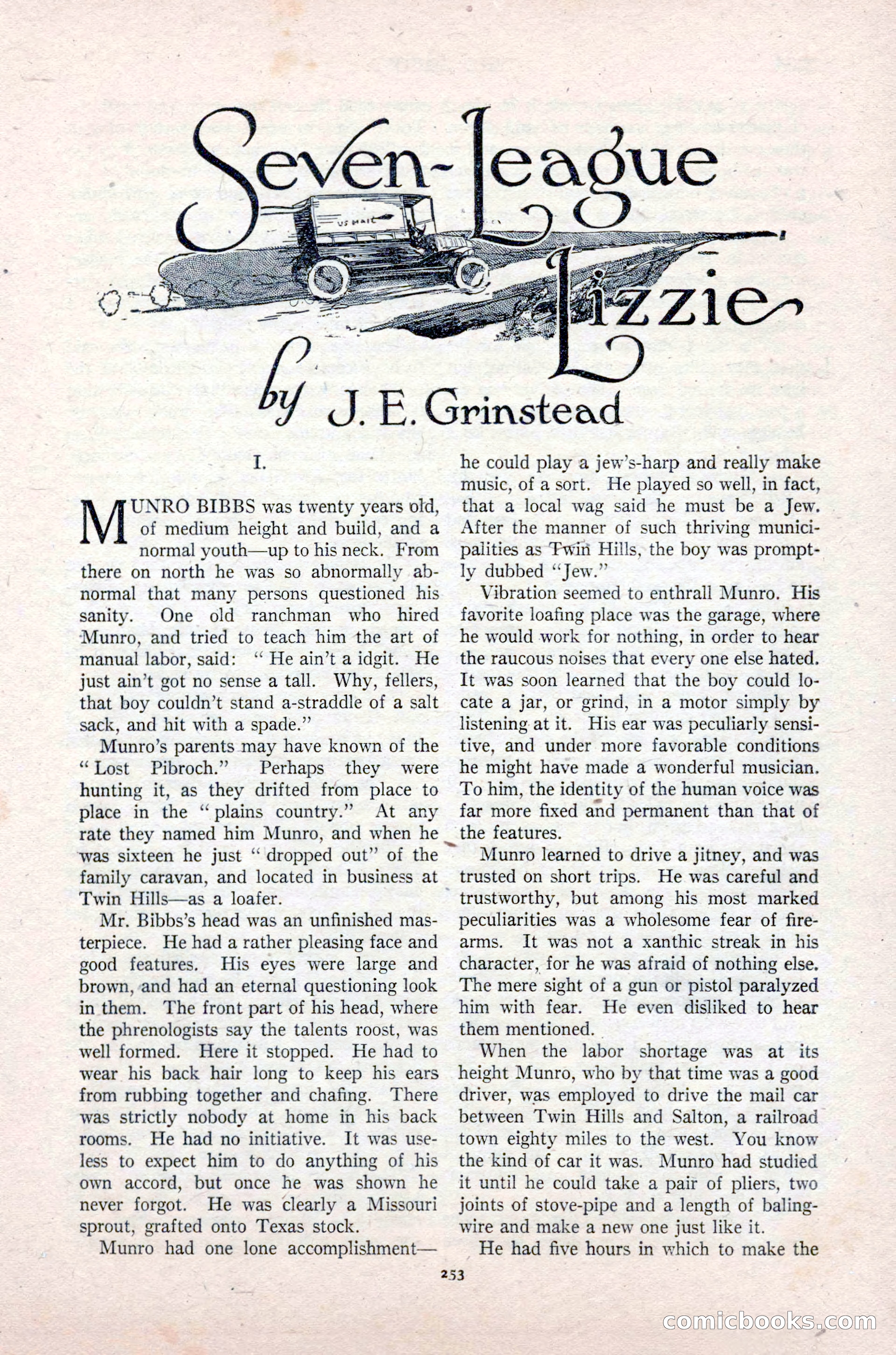
A restored page from Pulp Fiction, 1920. Page through the whole issue in the reader above.
📄 Transcribed text from this page (OCR, searchable)
Machine-transcribed from the original scan — historical spelling and the odd misread are preserved.
Vi J. E. Grinstead I. UNRO BIBBS was twenty years old, of medium height and build, and a normal youth—up to his neck. From there on north he was so abnormally ab- normal that many persons questioned his sanity. One old ranchman who hired ‘Munro, and tried to teach him the art of manual labor, said: ‘‘ He ain’t a idgit. He just ain’t got no sense a tall. Why, fellers, that boy couldn’t stand a-straddle of a salt sack, and hit with a spade.” Munro’s parents may have known of the “Lost Pibroch.” Perhaps they were hunting it, as they drifted from place to place in the “plains country.” At any rate they named him Munro, and when he ‘was sixteen he just “ dropped out”’ of the family caravan, and located in business at Twin Hills—as a loafer. Mr. Bibbs’s head was an unfinished mas- terpiece. He had a rather pleasing face and good features. His eyes were large and brown, and had an eternal questioning look in them. The front part of his head, where the phrenologists say the talents roost, was well formed. Here it stopped. He had to wear his back hair long to keep his ears from rubbing together and chafing. There was strictly nobody at home in his back rooms. He had no initiative. It was use- less to expect him to do anything of his own accord, but once he was shown he never forgot. He was clearly a Missouri sprout, grafted onto Texas stock. Munro had one lone accomplishment— he could play a jew’s-harp and really make music, of asort. He played so well, in fact, that a local wag said he must be a Jew. After the manner of such thriving munici- palities as Fwiri Hills, the boy was prompt- ly dubbed “Jew.” Vibration seemed to enthrall Munro. His favorite loafing place was the garage, where he would work for nothing, in order to hear the raucous noises that every one else hated. It was soon learned that the boy could lo- cate a jar, or grind, in a motor simply by listening at it. His ear was peculiarly sensi- tive, and under more favorable conditions he might have made a wonderful musician. To him, the identity of the human voice was far more fixed and permanent than that of the features. Munro learned to drive a jitney, and was trusted on short trips. He was careful and trustworthy, but among his most marked peculiarities was a wholesome fear of fire- arms. It was not a xanthic streak in his character, for he was afraid of nothing else. The mere sight of a gun or pistol paralyzed him with fear. He even disliked to hear them mentioned. When the labor shortage was at its height Munro, who by that time was a good driver, was employed to drive the mail car between Twin Hills and Salton, a railroad town eighty miles to the west. You know the kind of car it was. Munro had studied it until he could take a pair of pliers, two joints of stove-pipe and a length of baling- wire and make a new one just like it. He had five hours in which to make the 253 (E00) .DOOK {S@