
Pulp Fiction, 1919 · page 97 of 196
Argosy, Vol. 112, No. 2 — page 97: what you’re looking at
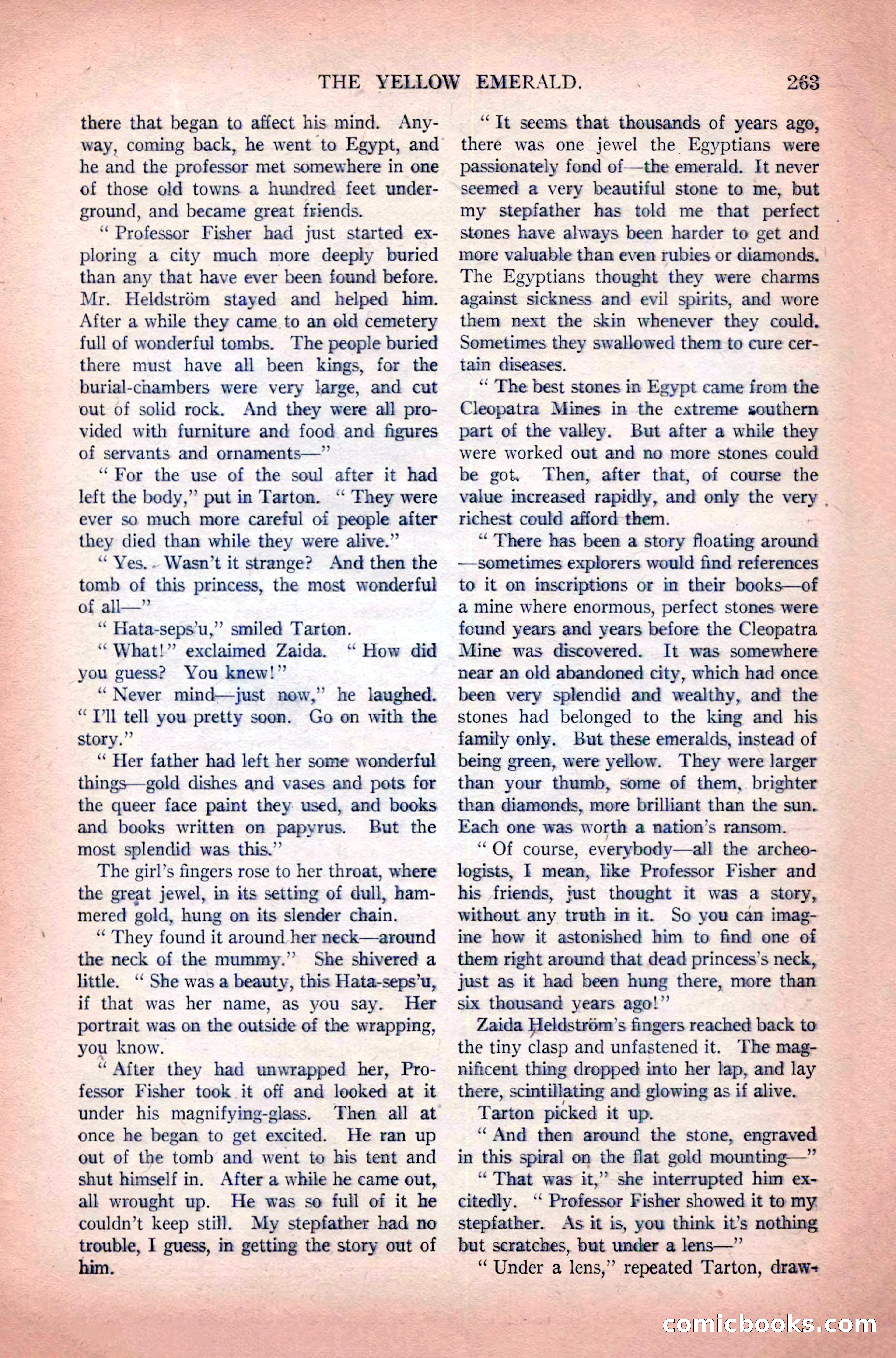
A restored page from Pulp Fiction, 1919. Page through the whole issue in the reader above.
📄 Transcribed text from this page (OCR, searchable)
Machine-transcribed from the original scan — historical spelling and the odd misread are preserved.
THE YELLOW EMERALD. there that began to affect his mind. Any- way, coming back, he went to Egypt, and he and the professor met somewhere in one of those old towns a hundred feet under- ground, and became great friends. “Professor Fisher had just started ex- ploring a city much more deeply buried than any that have ever been found before. Mr. Heldstré6m stayed and helped him. After a while they came to an old cemetery full of wonderful tombs. The people buried there must have all been kings, for the burial-chambers were very large, and cut out of solid rock. And they were all pro- vided with furniture and food and figures of servants and ornaments—” “For the use of the soul after it had left the body,” put in Tarton. “ They were ever so much more careful of people after they died than while they were alive.”’ “Yes... Wasn’t it strange? And then the tomb of this princess, the most wonderful of all—” ‘“ Hata-seps’u,” smiled Tarton. “What!” exclaimed Zaida. “ How did you guess? You knew!” “Never mind—just new,” he laughed. “Vl tell you pretty soon. Go on with the story.” ‘“‘ Her father had left her some wonderful things—gold dishes and vases and pots for the queer face paint they used, and books and books written on papyrus. But the most splendid was this.” The girl’s fingers rose to her throat, where the great jewel, in its setting of dull, ham- mered gold, hung on its slender chain. “They found it around her neck—around the neck of the mummy.” She shivered a little. ‘‘ She was a beauty, this Hata-seps’u, if that was her name, as you say. Her portrait was on the outside of the wrapping, you know. “ After they had unwrapped her, Pro- fessor Fisher took it off and leoked at it under his magnifying-glass. Then all at once he began to get excited. He ran up out of the tomb and went to his tent and shut himself in. After a while he came out, all wrought up. He was so full of it he couldn’t keep still. My stepfather had no trouble, I guess, in getting the story out of 263 “Tt seems that thousands of years ago, there was one jewel the Egyptians were passionately fond of—the emerald. It never seemed a very beautiful stone to me, but my stepfather has told me that perfect stones have always been harder to get and more valuable than even rubies or diamonds. The Egyptians thought they were charms against sickness and evil spirits, and wore them next the skin whenever they could. Sometimes they swallowed them to cure cer- tain diseases. ‘ The best stones in Egypt came from the Cleopatra Mines in the extreme southern part of the valley. But after a while they were worked out and no more stones could be got. Then, after that, of course the value imcreased rapidly, and only the very , richest could afford them. “There has been a story floating ana —sometimes explorers would find references to it on imscriptions or in their books—of a mine where enormous, perfect stones were found years and years before the Cleopatra Mine was discovered. It was somewhere near an old abandoned city, which had once been very splendid and wealthy, and the stones had belonged to the king and his family only. But these emeralds, instead of being green, were yellow. They were larger than your thumb, some of them, brighter than diamonds, more brilliant than the sun. Each one was worth a nation’s ransom. ‘“Of course, everybody—all the archeo- logists, | mean, like Professor Fisher and his friends, tust thought it was a story, without any truth in it. So you can imag- ine how it astonished him to find one of them right around that dead princess’s neck, just as it had been hung there, more than six thousand years ago!” Zaida Heldstrém’s fingers reached back to the tiny clasp and unfastened it. The mag- nificent thing dropped into her lap, and lay there, scintillating and glowing as if alive. Tarton picked it up. ‘And then around the stone, engraved in this spiral on the flat gold mounting— “ That was it,” she interrupted him ex- citedly. stepfather. As it is, you think it’s nothing but scratches, but under a lens—”’ ‘Under a lens,” repeated Tarton, draw+ ae ‘Professor Fisher showed it to my — “comicbook ‘S