
Pulp Fiction, 1919 · page 86 of 196
Argosy, Vol. 112, No. 2 — page 86: what you’re looking at
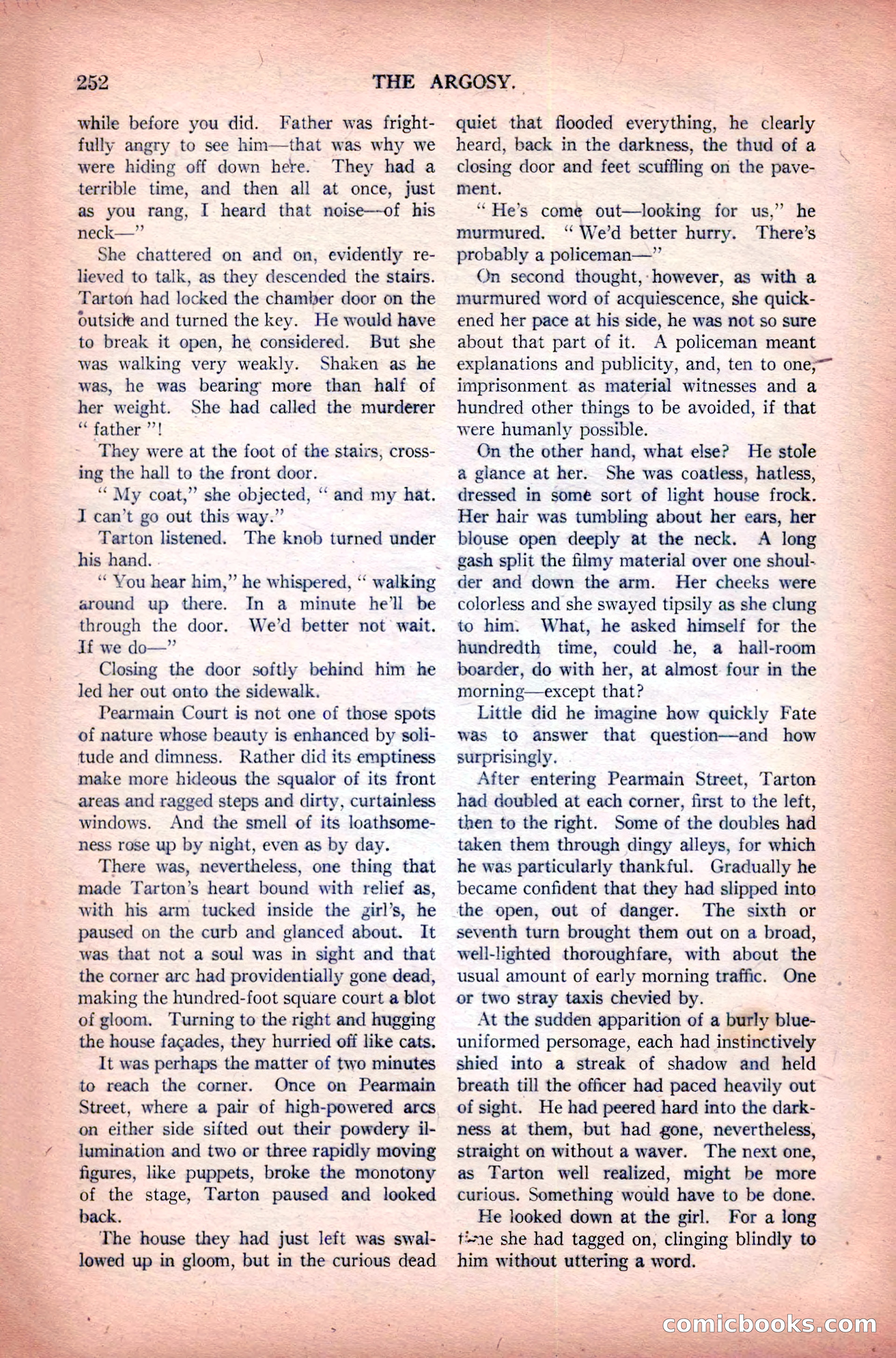
A restored page from Pulp Fiction, 1919. Page through the whole issue in the reader above.
📄 Transcribed text from this page (OCR, searchable)
Machine-transcribed from the original scan — historical spelling and the odd misread are preserved.
= while before you did. Father was fright- _ were hiding off down here. fully angry to see him—that was why we They had a terrible time, and then all at once, just as you rang, I heard that noise—of his neck—”’ She chattered on and on, evidently re- lieved to talk, as they descended the stairs. Tarton had locked the chamber door on the outside and turned the key. He would have to break it open, he considered. But she was walking very weakly. Shaken as he was, he was bearing more than half of her weight. She had called the murderer “father ”! They were at the foot of the stairs, cross- ing the hall to the front door. “ My coat,” she objected, “ and my hat. I can’t go out this way.” Tarton listened. The knob turned under his hand. ‘You hear him,” he w blenoied:@ around up there. In a minute he'll be through the door. We'd better not wait. If we do—”’ Closing the door softly behind him he led her out onto the sidewalk. Pearmain Court is not one of those spots of nature whose beauty is enhanced by soli- tude and dimness. Rather did its emptiness make more hideous the squalor of its front — areas and ragged steps and dirty, curtainless windows. And the smell of its loathsome- ness rose up by night, even as by day. There was, nevertheless, one thing that made Tarton’s heart bound with relief as, with his arm tucked inside the girl’s, he paused on the curb and glanced about. It was that not a soul was in sight and that the corner arc had providentially gone dead, making the hundred-foot square court a blot of gloom. Turning to the right and hugging the house facades, they hurried off like cats. It was perhaps the matter of two minutes to reach the corner. Once on Pearmain Street, where a pair of high-powered arcs on either side sifted out their powdery il- lumination and two or three rapidly moving figures, like puppets, broke the monotony of the stage, Tarton paused and looked back. The house they had just left was swal- lowed up in gloom, but in the curious dead ‘walking THE ARGOSY. quiet that flooded everything, he clearly heard, back in the darkness, the thud of a closing door and feet scuffling on the pave- ment. “ He’s come out—looking for us,” he murmured. ‘“ We’d better hurry. There’s probably a policeman—’’ On second thought,: however, as with a murmured word of acquiescence, she quick- ened her pace at his side, he was not so sure about that part of it. A policeman meant explanations and publicity, and, ten to one;~ imprisonment as material witnesses and a hundred other things to be avoided, if that were humanly possible. On the other hand, what else? He stole a glance at her. She was coatless, hatless, dressed in some sort of light house frock. Her hair was tumbling about her ears, her blouse open deeply at the neck. A long gash split the filmy material over one shoul- der and down the arm. Her cheeks were colorless and she swayed tipsily as she clung to him. What, he asked himself for the hundredth time, could -he, a_hall-room boarder, do with her, at almost rom in the morning—except that? Little did he imagine how quickly Fate was to answer that question—and how surprisingly. After entering Pearmain Street, Tarton had doubled at each corner, first to the left, then to the right. Some of the doubles had taken them through dingy alleys, for which he was particularly thankful. Gradually he became confident that they had slipped into the open, out of danger. The sixth or seventh turn brought them out on a broad, well-lighted thoroughfare, with about the usual amount of early morning traffic. One or two stray taxis chevied by. At the sudden apparition of a burly blue- uniformed personage, each had instinctively shied into a streak of shadow and held breath till the officer had paced heavily out — of sight. He had peered hard into the dark- ness at them, but had gone, nevertheless, straight on without a waver. The next one, as Tarton well realized, might be more curious. Something would have to be done. He looked down at the girl. For a long time she had tagged on, clinging blindly to him without uttering a word. | aMicbook bi be AD he L (a) @ OD ree pT ae | AY LOA vee, of pts y Of Ea 3 ih ; ih Der ae ie, uf rl PTR CO RONG. CV cra Ale MTA en at Wabi Sk a