
Pulp Fiction, 1919 · page 73 of 196
Argosy, Vol. 112, No. 2 — page 73: what you’re looking at
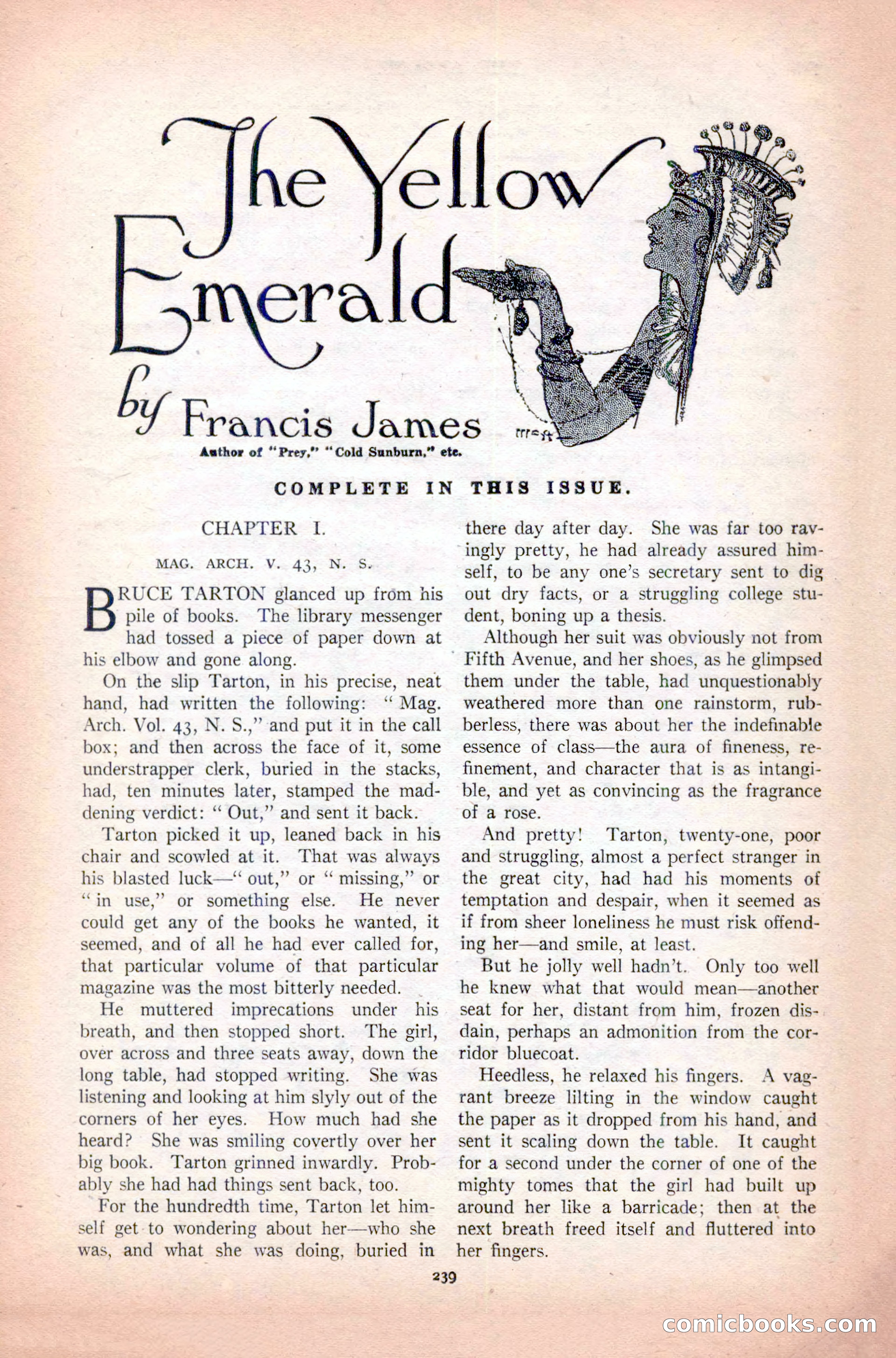
A restored page from Pulp Fiction, 1919. Page through the whole issue in the reader above.
📄 Transcribed text from this page (OCR, searchable)
Machine-transcribed from the original scan — historical spelling and the odd misread are preserved.
by Francis James Aathor of “Prey,”” “Cold Sunburn,” ete. — trreyy SEN COMPLETE IN THIS ISSUE. CHAPTER I. MAG. ARCH. V. 43, N. S. RUCE TARTON glanced up from his pile of books. The library messenger had tossed a piece of paper down at his elbow and gone along. On the slip Tarton, in his precise, neat hand, had written the following: ‘‘ Mag. Arch. Vol. 43, N. S.,” and put it in the call box; and then across the face of it, some understrapper clerk, buried in the stacks, had, ten minutes later, stamped the mad- dening verdict: ‘“‘ Out,” and sent it back. Tarton picked it up, leaned back in his chair and scowled at it. That was always his blasted luck—‘ out,” or ‘‘ missing,” or ‘in use,” or something else. He never could get any of the books he wanted, it seemed, and of all he had ever called for, that particular volume of that particular magazine was the most bitterly needed. He muttered imprecations under his breath, and then stopped short. The girl, over across and three seats away, down the long table, had stopped writing. She was listening and looking at him slyly out of the corners of her eyes. How much had she heard? She was smiling covertly over her big book. Tarton grinned inwardly. Prob- ably she had had things sent back, too. For the hundredth time, Tarton let him- self get-to wondering about her—who she was, and what she was doing, buried in there day after day. She was far too rav- ingly pretty, he had already assured him- self, to be any one’s secretary sent to dig — out dry facts, or a struggling college stu- dent, boning up a thesis. Although her suit was obviously not from - Fifth Avenue, and her shoes, as he glimpsed them under the table, had unquestionably weathered more than one rainstorm, rub- berless, there was about her the indefinable essence of class—the aura of fineness, re- finement, and character that is as intangi- ble, and yet as convincing as the fragrance of a rose. And pretty! Tarton, twenty-one, poor and struggling, almost a perfect stranger in the great city, had had his moments of temptation and despair, when it seemed as if from sheer loneliness he must risk offend- ing her—and smile, at least. But he jolly well hadn’t. Only too well he knew what that would mean—another seat for her, distant from him, frozen dis- dain, perhaps an admonition from the cor- ridor bluecoat. Heedless, he relaxed his fingers. A vag- rant breeze lilting in the window caught the paper as it dropped from his hand, and sent it scaling down the table. It caught for a second under the corner of one of the mighty tomes that the girl had built up around her like a barricade; then at the next breath freed itself and fluttered into her fingers. 239 COMEE .OOKS com