
Pulp Fiction, 1919 · page 65 of 196
Argosy, Vol. 112, No. 2 — page 65: what you’re looking at
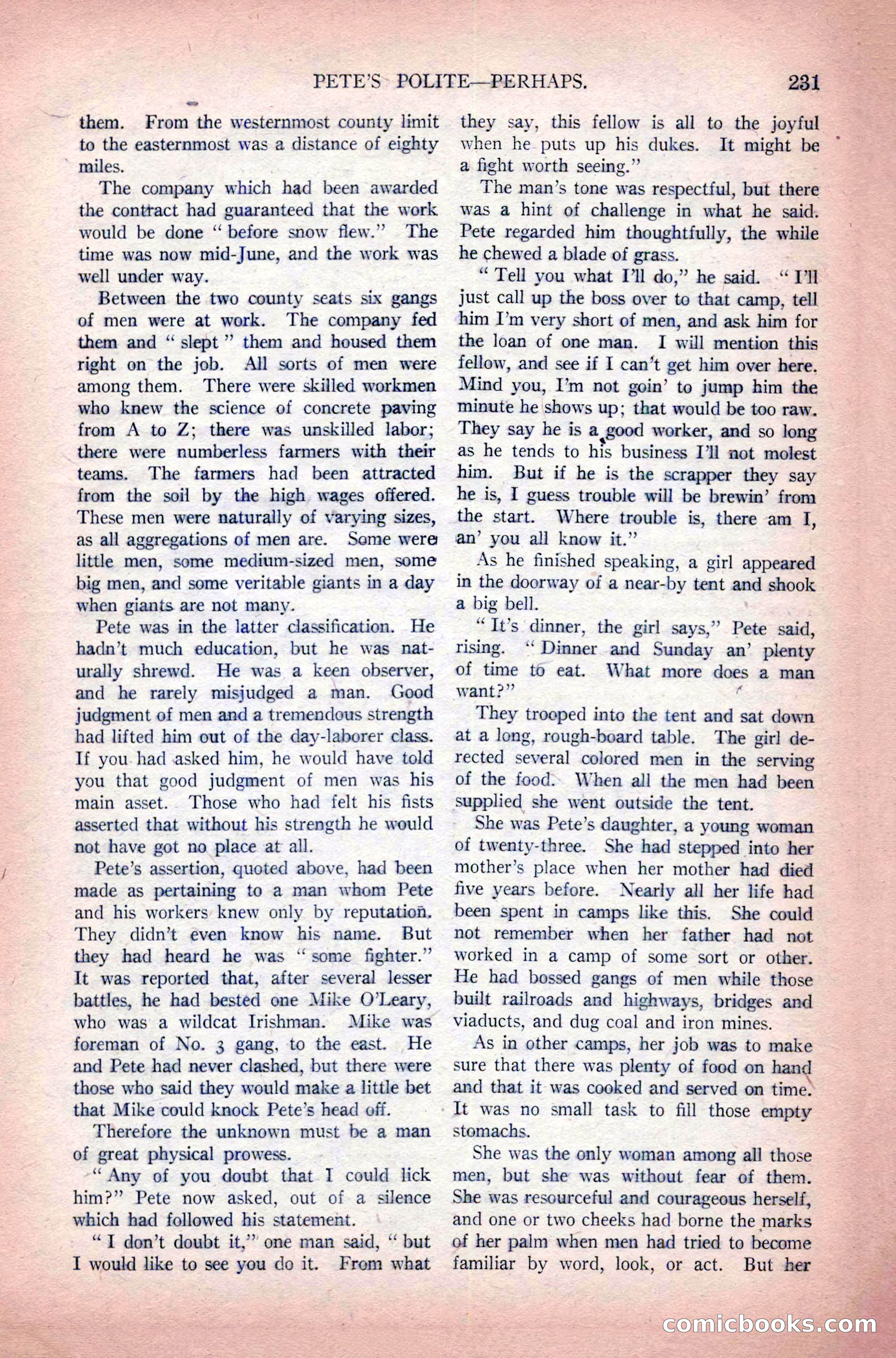
A restored page from Pulp Fiction, 1919. Page through the whole issue in the reader above.
📄 Transcribed text from this page (OCR, searchable)
Machine-transcribed from the original scan — historical spelling and the odd misread are preserved.
PETE’S» POLITE—PERHAPS. them. From the westernmost county limit to the easternmost was a distance of eighty ~ miles. The company which had been awarded the conttact had guaranteed that the work would be done ‘ before snow flew.” The time was now mid-June, and the work was well under way. Between the two county seats six gangs of men were at work. ‘The company fed them and “ slept’ them and housed them right on the job. All sorts of men were among them. There were skilled workmen who knew the science of concrete paving from A to Z; there was unskilled labor; there were numberless farmers with their teams. The farmers had been attracted from the soil by the high wages offered. These men were naturally of varying sizes, as all aggregations of men are. Some were little men, some medium-sized men, some big men, and some veritable giants in a day when giants are not many. Pete was in the latter classification. He hadn’t much education, but he was nat- urally shrewd. He was a keen observer, and he rarely misjudged a man. Good judgment of men and a tremendous strength had lifted him out of the day-laborer class. If you- had asked him, he would have told you that good judgment of men was his main asset. Those who had felt his fists asserted that without his strength he would not have got no place at all. Pete’s assertion, quoted above, had been made as pertaining to a man whom Pete and his workers knew only by reputation. They didn’t even know his name. But they had heard he was “ some fighter.” It was reported that, after several lesser battles, he had bested one Mike O’Leary, who was a wildcat Irishman. Mike was foreman of No. 3 gang, to the east. He and Pete had never clashed, but there were those who said they would make a little bet that Mike could knock Pete’s head off. Therefore the unknown must be a man of great physical prowess. “Any of you doubt that I could lick hime” Pete now asked, out of a silence which had followed his statement. “T don’t doubt it,” one man said, “ but I would like to see you do it. From what 231 they say, this fellow is all to the joyful when he puts up his dukes. a fight worth seeing.”’ The man’s tone was respectful, but diets was a hint of challenge in what he said. Pete regarded him thoughtfully, the while he chewed a blade of grass. “Tell you what I’ll do,” he said. “Ill just call up the boss over to that camp, tell him I’m very short of men, and ask him for the loan of one man. I will mention this fellow, and see if I can’t get him over here. Mind you, I’m not goin’ to jump him the minute he shows up; that would be too raw. They say he is a good worker, and so long as he tends to his business I’ll aot molest him. But if he is the scrapper they say he is, I guess trouble will be brewin’ from the start. Where trouble is, there am I, an’ you all know it.” As he finished speaking, a girl appeared in the doorway oi a near-by tent and shook a big bell. “It’s dinner, the girl says,” Pete said, rising. ‘‘ Dinner and Sunday an’ plenty of time to eat. What more eS a man want?” They trooped into the tent and sat down at a long, rough-board table. The girl de- rected several colored men in the serving of the food. When all the men had been supplied she went outside the tent. She was Pete’s daughter, a young woman of twenty-three. She had stepped into her mother’s place when her mother had died five years before. Nearly all her life had been spent in camps like this. She could not remember when her father had not worked in a camp of some sort or other. He had bossed gangs of men while those built railroads and highways, bridges and viaducts, and dug coal and iron mines. As in other camps, her job was to make sure that there was plenty of food on han and that it was cooked and served on time. It was no small task to fill those empty stomachs. She was the only woman among all those men, but she was without fear of them. She was resourceful and courageous herself, and one or two cheeks had borne the marks of her palm when men had tried to become familiar by word, look, or act. But her It might be ~ ~comicbooks.c