
Pulp Fiction, 1919 · page 37 of 196
Argosy, Vol. 112, No. 2 — page 37: what you’re looking at
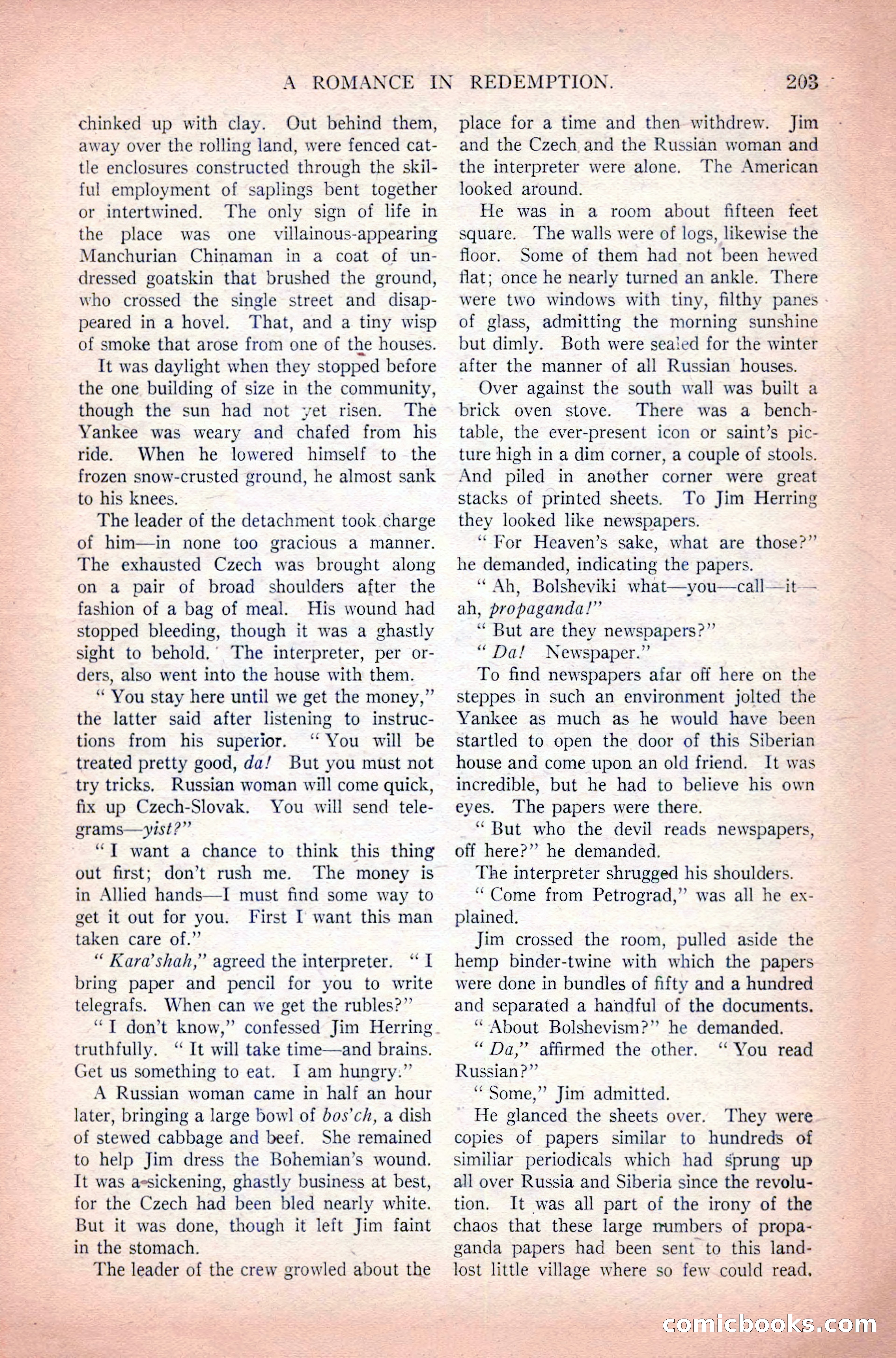
A restored page from Pulp Fiction, 1919. Page through the whole issue in the reader above.
📄 Transcribed text from this page (OCR, searchable)
Machine-transcribed from the original scan — historical spelling and the odd misread are preserved.
A ROMANCE IN REDEMPTION. chinked up with clay. Out behind them, away over the rolling land, were fenced cat- tle enclosures constructed through the skil- ful employment of saplings bent together or intertwined. The only sign of life in the place was one villainous-appearing Manchurian Chinaman in a coat of un- dressed goatskin that brushed the ground, who crossed the single street and disap- peared in a hovel. That, and a tiny wisp of smoke that arose from one of the houses. It was daylight when they stopped before the one building of size in the community, though the sun had not yet risen. The Yankee was weary and chafed from his ride. When he lowered himself to the frozen snow-crusted ground, he almost sank to his knees. The leader of the detachment took charge of him—in none too gracious a manner. The exhausted Czech was brought along on a pair of broad shoulders after the fashion of a bag of meal. His wound had stopped bleeding, though it was a ghastly sight to behold.’ The interpreter, per or- ders, also went into the house with them. “You stay here until we get the money,” the latter said after listening to instruc- tions from his superior. ‘‘ You will be _ treated pretty good, da/ But you must not try tricks. Russian woman will come quick, fix up Czech-Slovak. You will send tele- erams—yist?” “T want a chance to think this thing out first; don’t rush me. The money is in Allied hands—I must find some way to get it out for you. First I want this man taken care of.” “ Kara’ shah,” agreed the interpreter. “ I bring paper and pencil for you to write telegrafs. When can we get the rubles?” ‘“T don’t know,” confessed Jim Herring truthfully. ‘ It will take time—and brains. Get us something to eat. I am hungry.” A Russian woman came in half an hour later, bringing a large bowl of do0s’ch, a dish of stewed cabbage and beef. She remained to help Jim dress the Bohemian’s wound. It was aesickening, ghastly business at best, for the Czech had been bled nearly white. But it was done, though it left Jim faint in the stomach. | The leader of the crew growled about the 203 - place for a time and then withdrew. Jim and the Czech and the Russian woman and the interpreter were alone. The American looked around. He was in a room about fifteen feet square. The walls were of logs, likewise the floor. Some of them had not been hewed flat; once he nearly turned an ankle. There were two windows with tiny, filthy panes - of glass, admitting the morning sunshine but dimly. Both were seated for the winter after the manner of all Russian houses. Over against the south wall was built a brick oven stove. There was a_bench- table, the ever-present icon or saint’s pic- ture high in a dim corner, a couple of stools. And piled in another corner were great stacks of printed sheets. To Jim Herring they looked like newspapers. ‘For Heaven’s sake, what are those?” he demanded, indicating the papers. “Ah, Bolsheviki what—you—call—it— ah, propaganda!” “ But are they newspapers?” “Dal Newspaper.” To find newspapers afar off here on the steppes in such an environment jolted the Yankee as much as he would have been startled to open the door of this Siberian house and come upon an old friend. It was incredible, but he had to believe his own eyes. The papers were there. “But who the devil reads newspapers, off here?” he demanded. The interpreter shrugged his shoulders. ‘Come from Petrograd,” was all he ex- plained. Jim crossed the room, pulled aside the hemp binder-twine with which the papers were done in bundles of fifty and a hundred and separated a handful of the documents. ‘About Bolshevism?” he demanded. “Da,” affirmed the other. ‘“‘ You read Russian?” “Some,” Jim admitted. He glanced the sheets over. They were copies of papers similar to hundreds of similiar periodicals which had sprung up all over Russia and Siberia since the revolu- tion. It was all part of the irony of the chaos that these large mumbers of propa- ganda papers had been sent to this land- lost little village where so few could read. GEomichoo