
Pulp Fiction, 1919 · page 35 of 196
Argosy, Vol. 112, No. 2 — page 35: what you’re looking at
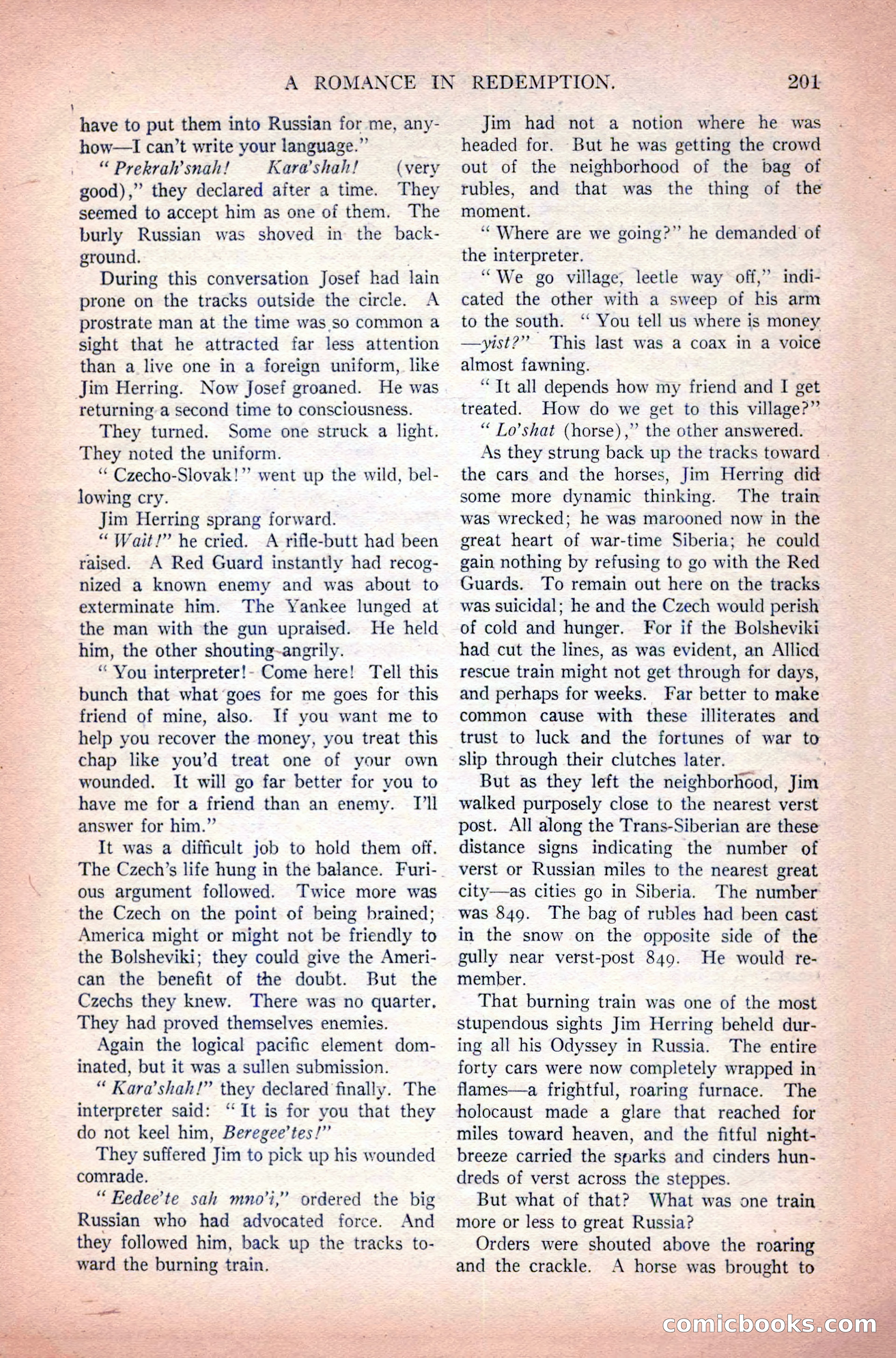
A restored page from Pulp Fiction, 1919. Page through the whole issue in the reader above.
📄 Transcribed text from this page (OCR, searchable)
Machine-transcribed from the original scan — historical spelling and the odd misread are preserved.
A ROMANCE IN have to put them into Russian for me, any- how—lI can’t write your language.” “ Prekrah’snah! Kara’shah! (very good),” they declared after a time. They seemed to accept him as one of them. The burly Russian was shoved in the back- ground. | During this conversation Josef had lain prone on the tracks outside the circle. A prostrate man at the time was.so common a sight that he attracted far less attention than a live one in a foreign uniform, like Jim Herring. Now Josef groaned. He was returning a second time to consciousness. They turned. Some one struck a light. They noted the uniform. ‘““ Czecho-Slovak!”’ went up the wild, bel- lowing cry. Jim Herring sprang forward. “ Wait!” he cried. A rifle-butt had been raised. A Red Guard instantly had recog- nized a known enemy and was about to exterminate him. The Yankee lunged at the man with the gun upraised. He held him, the other shouting-angrily. “You interpreter!- Come here! Tell this bunch that what goes for me goes for this friend of mine, also. If you want me to help you recover the money, you treat this chap like you’d treat one of your own wounded. It will go far better for vou to have me for a friend than an enemy. I'll answer for him.” It was a difficult job to hold them off. The Czech’s life hung in the balance. Furi-_ ous argument followed. Twice more was the Czech on the point of being brained; America might or might not be friendly to the Bolsheviki; they could give the Ameri- can the benefit of the doubt. But the Czechs they knew. There was no quarter, They had proved themselves enemies. Again the logical pacific element dom- inated, but it was a sullen submission. “ Kara’shah!” they declared finally. The interpreter said: “It is for you that they do not keel him, Beregee’tes!” They suffered Jim to pick up his wounded comrade. “ Fedee’te sah mno’i,” ordered the big Russian who had advocated force. And they followed him, back up the tracks to- ward the burning train. REDEMPTION, Jim had not a notion where he was headed for. But he was getting the crowd out of the neighborhood of the bag of rubles, and that was the thing of the moment. ‘“ Where are we going?”’ he demanded of the interpreter. “We go village, leetle way off,” indi- cated the other with a sweep of his arm to the south. ‘“ You tell us where is money —vyist?” This last was a coax in a voice almost fawning. “Tt all depends how my friend and I get treated. How do we get to this village?” “ Lo’shat (horse),” the other answered. As they strung back up the tracks toward . the cars and the horses, Jim Herring did some more dynamic thinking. The train was wrecked; he was marooned now in the great heart of war-time Siberia; he could gain nothing by refusing to go with the Red Guards. To remain out here on the tracks was suicidal; he and the Czech would perish of cold and hunger. For if the Bolsheviki had cut the lines, as was evident, an Allicd rescue train might not get through for days, and perhaps for weeks. Far better to make common cause with these illiterates and trust to luck and the fortunes of war to slip through their clutches later. But as they left the neighborhood, Jim walked purposely close to the nearest verst post. All along the Trans-Siberian are these distance signs indicating the number of verst or Russian miles to the nearest great city—as cities go in Siberia. was 849. The bag of rubles had been cast in the snow on the opposite side of the gully near verst-post 849. He would re- member. That burning train was one of the most stupendous sights Jim Herring beheld dur- ing all his Odyssey in Russia. The entire forty cars were now completely wrapped in flames—a frightful, roaring furnace. The holocaust made a glare that reached for miles toward heaven, and the fitful night- breeze carried the sparks and cinders hun- dreds of verst across the steppes. But what of that? more or less to great Russia? : Orders were shouted above the roaring and the crackle. A horse was brought to 201 The number What was one train Ces! —— cComicbooks.com —