
Pulp Fiction, 1919 · page 20 of 196
Argosy, Vol. 112, No. 2 — page 20: what you’re looking at
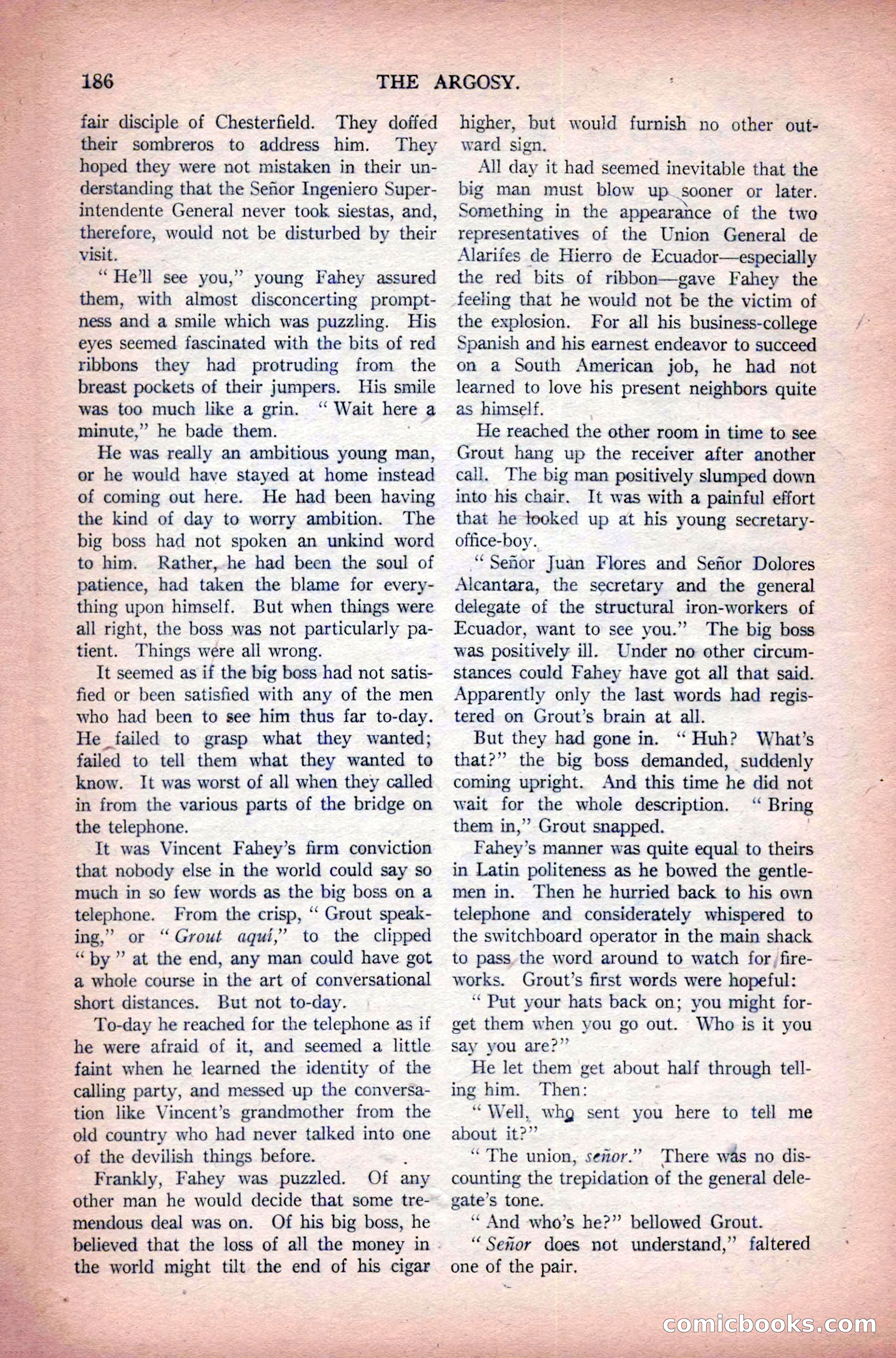
A restored page from Pulp Fiction, 1919. Page through the whole issue in the reader above.
📄 Transcribed text from this page (OCR, searchable)
Machine-transcribed from the original scan — historical spelling and the odd misread are preserved.
fair disciple of Chesterfield. They doifed their sombreros to address him. They hoped they were not mistaken in their un- derstanding that the Senor Ingeniero Super- intendente General never took siestas, and, therefore, would not be disturbed by their Visit. “He'll see you,” young Fahey assured them, with almost disconcerting prompt- ness and a smile which was puzzling. His eyes seemed fascinated with the bits of red ribbons they had protruding from the breast pockets of their jumpers. His smile was too much like a grin. ‘‘ Wait here a minute,” he bade them. : He was really an ambitious young man, or he would have stayed at home instead of coming out here. He had been having the kind of day to worry ambition. The big boss had not spoken an unkind word to him. Rather, he had been the soul of patience, had taken the blame for every- thing upon himself. But when things were all right, the boss was not particularly pa- tient. Things were all wrong. It seemed as if the big boss had not satis- fied or been satisfied with any of the men who had been to see him thus far to-day. He failed to grasp what they wanted; failed to tell them what they wanted to _ know. It was worst of all when they called in from the various parts of the bridge on the telephone. It was Vincent Fahey’s firm conviction that nobody else in the world could say so much in so few words as the big boss on a telephone. From the crisp, “‘ Grout speak- ing,’ or “Grout aqui,’ to the clipped “by ” at the end, any man could have got a whole course in the art of conversational short distances. But not to-day. To-day he reached for the telephone as if he were afraid of it, and seemed a little faint when he learned the identity of the calling party, and messed up the conversa- tion like Vincent’s grandmother from the old country who had never talked into one of the devilish things before. Frankly, Fahey was puzzled. Of any other man he would decide that some tre- mendous deal was on. Of his big boss, he believed that the loss of all the money in - the world might tilt the end of his cigar Se SS eg Es So ae oS eh ee RO» rend THE ARGOSY. higher, but would furnish no other out- ward sign. All day it had seemed inevitable that the big man must blow up_ sooner or later. Something in the appearance of the two representatives of the Union General de Alarifes de Hierro de Ecuador—especially the red bits of ribbon—gave Fahey the feeling that he would not be the victim of the explosion. For all his business-college Spanish and his earnest endeavor to succeed on a South American job, he had not learned to love his present neighbors quite as himself. He reached the other room in time to see Grout hang up the receiver after another call. The big man positively slumped down into his chair. It was with a painful effort that he tooked up at his young secretary- office-boy. “*Senor Juan Flores and Senor Dolores Alcantara, the secretary and the general delegate of the structural iron-workers of Ecuador, want to see you.” The big boss was positively ill. Under no other circum- stances could Fahey have got all that said. Apparently only the Jast words had regis- tered on Grout’s brain at all. But they had gone in. “ Huh? What’s that?” the big boss demanded, suddenly coming upright. And this time he did not wait for the whole description. “ Bring them in,’ Grout snapped. | Fahey’s manner was quite equal to theirs in Latin politeness as he bowed the gentle- men in. Then he hurried back to his own telephone and considerately whispered to the switchboard operator in the main shack to pass, the word around to watch for, fire- works. Grout’s first words were hopeful: ‘Put your hats back on; you might for- get them when you go out. Who is it you say you are?” He let them get about half through tell- ing him. Then: “Well, whg sent you here to tell me about it?” ‘The union, senor.’ There was no dis- counting the trepidation of the general dele- gate’s tone. ‘And who’s he?” bellowed Grout. “Senor does not understand,” faltered one of = pair.