
Pulp Fiction, 1919 · page 165 of 196
Argosy, Vol. 112, No. 2 — page 165: what you’re looking at
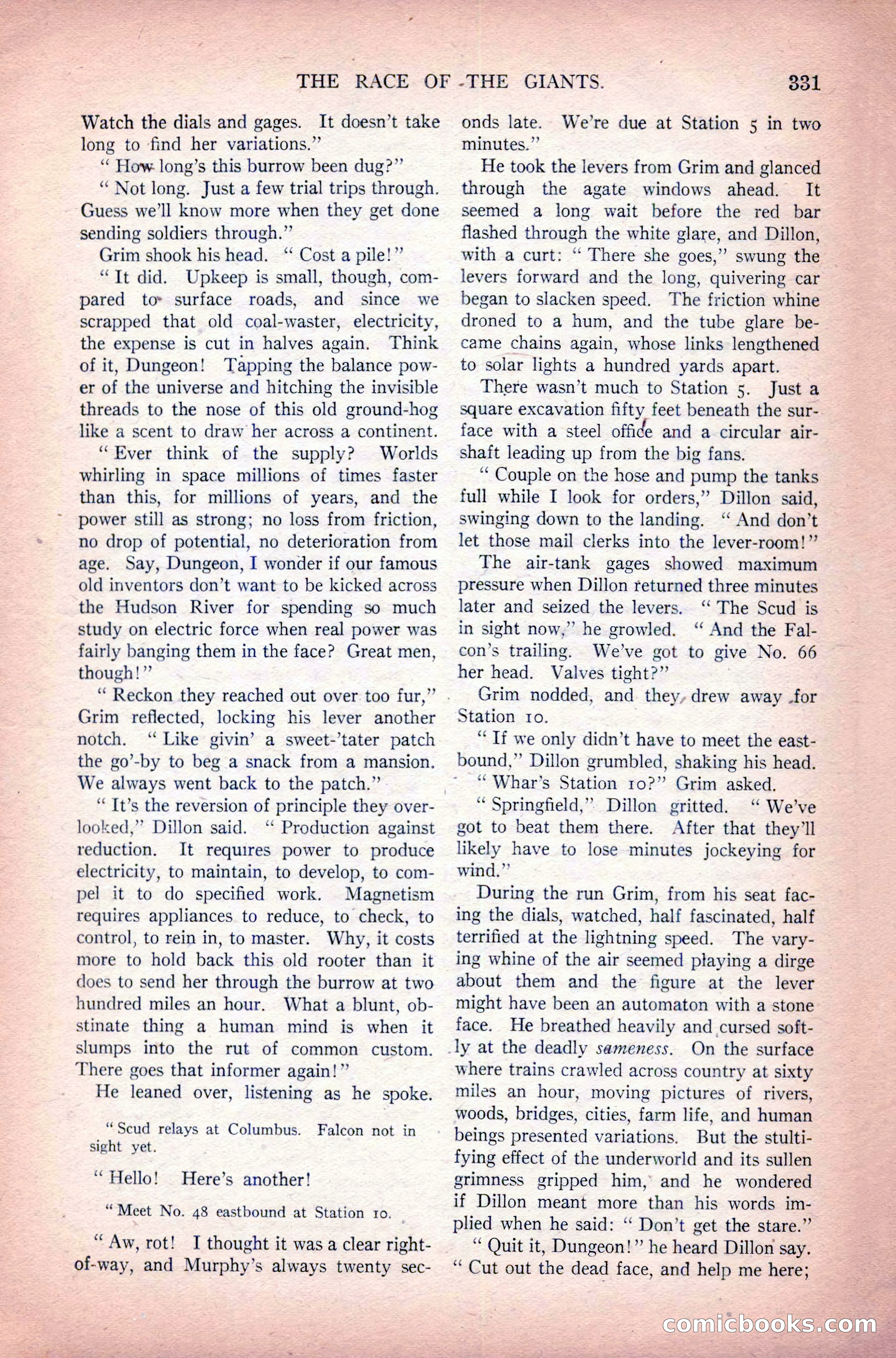
A restored page from Pulp Fiction, 1919. Page through the whole issue in the reader above.
📄 Transcribed text from this page (OCR, searchable)
Machine-transcribed from the original scan — historical spelling and the odd misread are preserved.
THE RACE OF -THE GIANTS. Watch the dials and gages. It doesn’t take long to find her variations.” ‘““ How long’s this burrow been dug?”’ “ Not long. Just a few trial trips through. Guess we'll know more when they get done sending soldiers through.” Grim shook his head. “ Cost a pile!”’ “Tt did. Upkeep is small, though, com- pared to» surface roads, and since we scrapped that old coal-waster, electricity, the expense is cut in halves again. Think of it, Dungeon! Tapping the balance pow- er of the universe and hitching the invisible threads to the nose of this old ground-hog like a scent to draw her across a continent. “Ever think of the supply? Worlds whirling in space millions of times faster than this, for millions of years, and the power still as strong; no loss from friction, no drop of potential, no deterioration from age. Say, Dungeon, I wonder if our famous old inventors don’t want to be kicked across the Hudson River for spending so much study on electric force when real power was fairly banging them in the face? Great men, though!” ‘“ Reckon they reached out over too fur,” . Grim reflected, locking his lever another notch. “ Like givin’ a sweet-’tater patch the go’-by to beg a snack from a mansion. We always went back to the patch.” ‘“ It’s the reversion of principle they over- looked,” Dillon said. “ Production against reduction. It requires power to produce electricity, to maintain, to develop, to com- pel it to do specified work. Magnetism requires appliances to reduce, to check, to control, to rein in, to master. Why, it costs more to hold back this old rooter than it does to send her through the burrow at two hundred miles an hour. What a blunt, ob- stinate thing a human mind is when it slumps into the rut of common custom. There goes that informer again!”’ He leaned over, listening as he spoke. “Scud relays at Columbus. Falcon not in sight yet. ‘* Hello! “Meet No. 48 eastbound at Station ro. Here’s another! ‘“ Aw, rot! I thought it was a clear right- of-way, and Murphy’s always twenty sec- _ly at the deadly sameness. onds late. We’re due at Station 5 in two minutes.” He took the levers from Grim and glanced through the agate windows ahead. It seemed a long wait before the red bar flashed through the white glare, and Dillon, with a curt: “ There she goes,” swung the levers forward and the long, quivering car began to slacken speed. The friction whine droned to a hum, and the tube glare be- came chains again, whose links lengthened to solar lights a hundred yards apart. There wasn’t much to Station 5. Just a square excavation fifty feet beneath the sur- face with a steel office and a circular air- shaft leading up from the big fans. ‘“ Couple on the hose and pump the tanks full while I look for orders,” Dillon said, swinging down to the landing. ‘ And don’t let those mail clerks into the lever-room!”’ The air-tank gages showed maximum pressure when Dillon returned three minutes later and seized the levers. ‘‘ The Scud is in sight now,” he growled. ‘ And the Fal- con’s trailing. We've got to give No. 66 her head. Valves tight?” Grim nodded, and they, drew away -for Station 10. ‘‘ If we only didn’t have to meet the east- bound,” Dillon grumbled, shaking his head. ‘ Whar’s Station ro?” Grim asked. ‘ Springfield,” Dillon gritted. ‘“ We’ve got to beat them there. After that they'll likely have to lose minutes jockeying for wind.”’ During the run Grim, from his seat fac- ing the dials, watched, half fascinated, half terrified at the lightning speed. The vary- ing whine of the air seemed playing a dirge about them and the figure at the lever might have been an automaton with a stone face. He breathed heavily and cursed soft- On the surface where trains crawled across country at sixty miles an hour, moving pictures of rivers, woods, bridges, cities, farm life, and human beings presented variations. But the stulti- fying effect of the underworld and its sullen grimness gripped him, and he wondered if Dillon meant more than his words im- plied when he said: “ Don’t get the stare.” Quit it, Dungeon!” he heard Dillon say. ‘Cut out the dead face, and help me here; Eomicbooks ~ ool |