
Pulp Fiction, 1919 · page 156 of 196
Argosy, Vol. 112, No. 2 — page 156: what you’re looking at
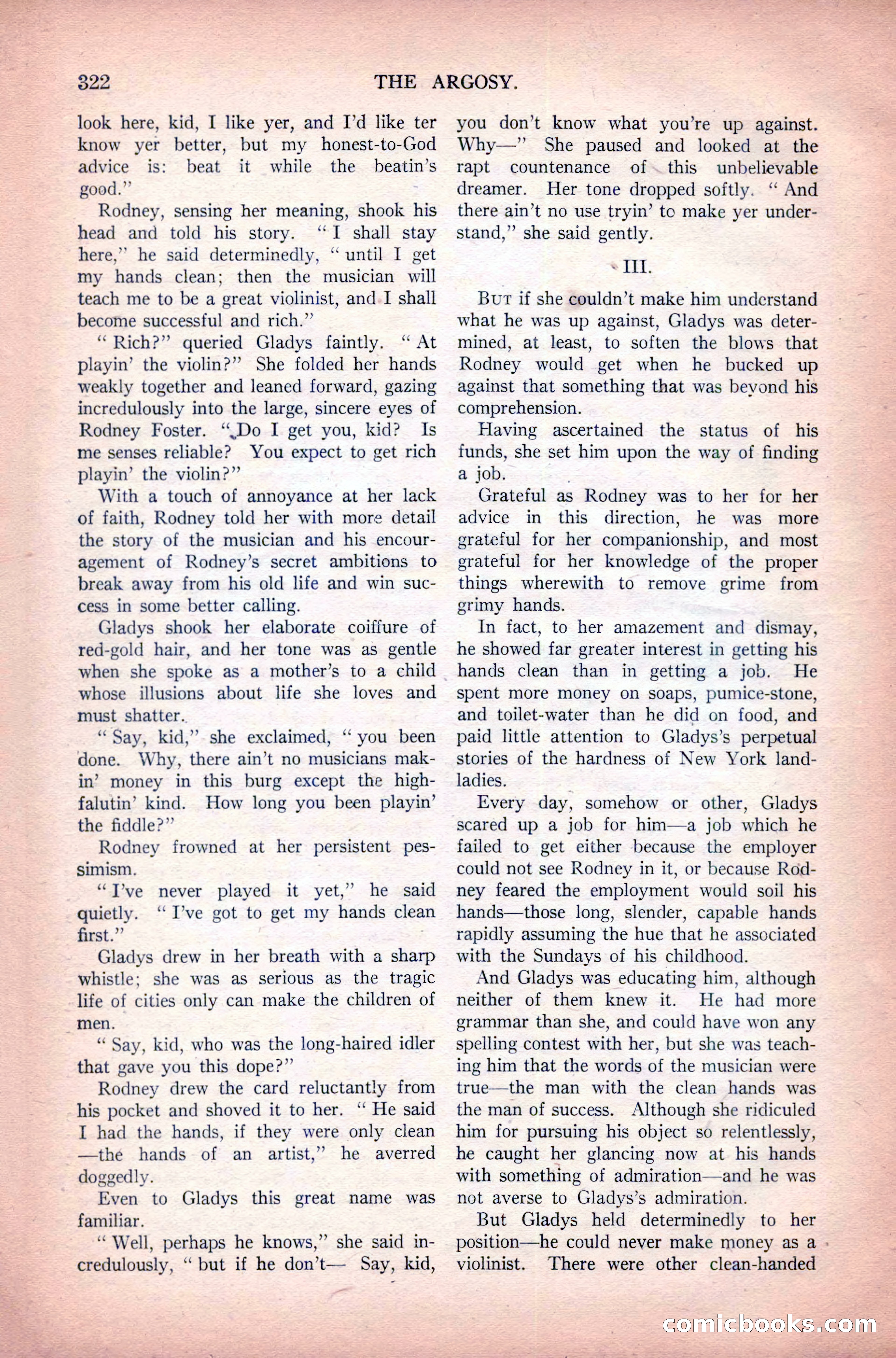
A restored page from Pulp Fiction, 1919. Page through the whole issue in the reader above.
📄 Transcribed text from this page (OCR, searchable)
Machine-transcribed from the original scan — historical spelling and the odd misread are preserved.
* O22 look here, kid, I like yer, and Id like ter know yer better, but my honest-to-God advice is: beat it while the beatin’s good.” Rodney, sensing her meaning, shook his head and told his story. “I shall stay here,’ he said determinedly, “ until I get my hands clean; then the musician will teach me to be a great violinist, and.I shall become successful and rich.” “Rich?” queried Gladys faintly. “ At playin’ the violin?” She folded her hands weakly together and leaned forward, gazing incredulously into the large, sincere eyes of Rodney Foster. “Do I get you, kid? Is me senses reliable? You expect to get rich playin’ the violin?” With a touch of annoyance at her lack of faith, Rodney told her with more detail the story of the musician and his encour- agement of Rodney’s secret ambitions to break away from his old life and win suc- cess in some better calling. Gladys shook her elaborate coiffure of red-gold hair, and her tone was as gentle when she spoke as a mother’s to a child whose illusions about life she loves and must shatter. “Say, kid,” she exclaimed, “‘ you been done. Why, there ain’t no musicians mak- in’ money in this burg except the high- falutin’ kind. How long you been playin’ the fiddle?” Rodney frowned at her persistent pes- simism. ‘“T’ve never played it yet,” he said quietly. ‘“ I’ve got to get my hands clean first.” Gladys drew in her breath with a sharp whistle; she was as serious as the tragic life of cities only can make the children of men. “Say, kid, who was the long-haired idler that gave you this dope?”’ Rodney drew the card reluctantly from his pocket and shoved it to her. ‘“‘ He said I had the hands, if they were only clean —the hands of an artist,” he averred doggedly. Even to Gladys this great name was familiar. ‘Well, perhaps he knows,” she said in- credulously, ‘ but if he don’t— Say, kid, ) THE ARGOSY. you don’t know what you’re up against. Why—” She paused and looked at the rapt countenance ofthis unbelievable dreamer. Her tone dropped softly. ‘‘ And there ain’t no use tryin’ to make yer under- stand,” she said gently. ~ TTT. Burt if she couldn’t make him understand what he was up against, Gladys was deter- mined, at least, to soften the blows that Rodney would get when he bucked up against that something that was bevond his comprehension. Having ascertained the status of his funds, she set him upon the way of finding a job. Grateful as Rodney was to her for her advice in this direction, he was more grateful for her companionship, and most grateful for her knowledge of the proper things wherewith to remove grime from grimy hands. In fact, to her amazement and dismay, he showed far greater interest in getting his hands clean than in getting a job. He spent more money on soaps, pumice-stone, and toilet-water than he did on food, and paid little attention to Gladys’s perpetual stories of the hardness of New York land- ladies. Every day, somehow or other, Gladys scared up a job for him—a job which he failed to get either because the employer could not see Rodney in it, or because Rod- ney feared the employment would soil his hands—those long, slender, capable hands rapidly assuming the hue that he associated with the Sundays of his childhood. And Gladys was educating him, although neither of them knew it. He had more grammar than she, and could have won any spelling contest with her, but she was teach- ing him that the words of the musician were true—the man with the clean hands was the man of success. Although she ridiculed him for pursuing his object so relentlessly, he caught her glancing now at his hands with something of admiration—and he was not averse to Gladys’s admiration. But Gladys held determinedly to her position—he could never make money as a » violinist. There were other clean-handed Gomichbooks