
Pulp Fiction, 1919 · page 150 of 196
Argosy, Vol. 112, No. 2 — page 150: what you’re looking at
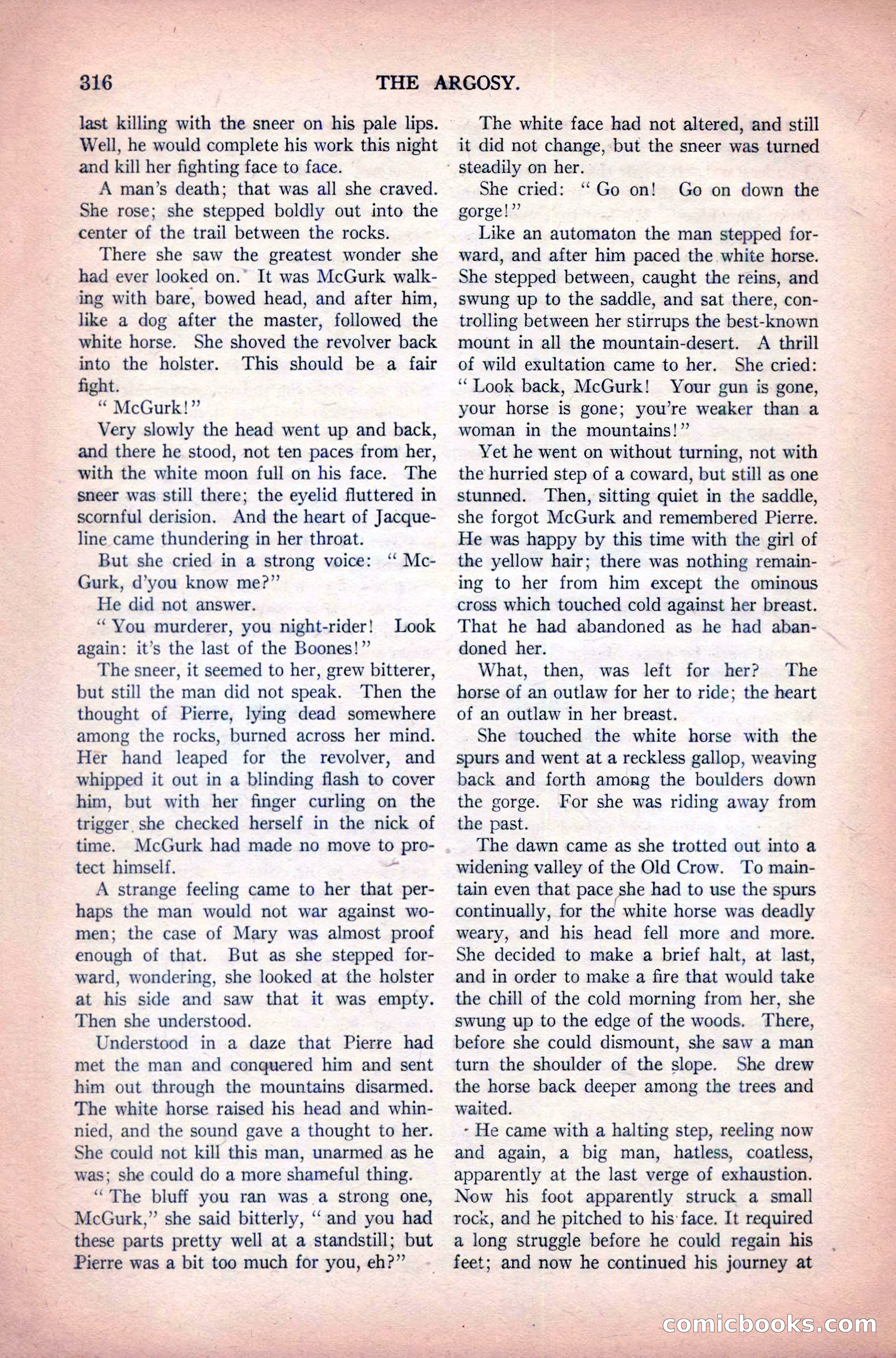
A restored page from Pulp Fiction, 1919. Page through the whole issue in the reader above.
📄 Transcribed text from this page (OCR, searchable)
Machine-transcribed from the original scan — historical spelling and the odd misread are preserved.
316 last killing with the sneer on his pale lips. Well, he would complete his work this night and kill her fighting face to face. A man’s death; that was all she craved. She rose; she stepped boldly out into the center of the trail between the rocks. There she saw the greatest wonder she had ever looked on.” It was McGurk walk- ing with bare, bowed head, and after him, like a dog after the master, followed the white horse. She shoved the revolver back into the holster. This should be a fair fight. “ McGurk!” Very slowly the head went up and back, and there he stood, not ten paces from her, with the white moon full on his face. The sneer was still there; the eyelid fluttered in scornful derision. And the heart of Jacque- line came thundering in her throat. But she cried in a strong voice: ‘“ Mc- Gurk, d’you know me?” He did not answer. ‘You murderer, you night-rider! Look again: it’s the last of the Boones!” The sneer, it seemed to her, grew bitterer, but still the man did not speak. Then the thought of Pierre, lying dead somewhere among the rocks, burned across her mind. Her hand leaped for the revolver, and whipped it out in a blinding flash to cover him, but with her finger curling on the trigger she checked herself in the nick of time. McGurk had made no move to pro- tect himself. < A strange feeling came to her that per- haps the man would not war against wo- men; the case of Mary was almost proof enough of that. But as she stepped for- ward, wondering, she looked at the holster at his side and saw that it was empty. Then she understood. Understood in a daze that Pierre had met the man and conquered him and sent him out through the mountains disarmed. The white horse raised his head and whin- nied, and the sound gave a thought to her. She could not kill this man, unarmed as he was; she could do a more shameful thing. “The bluff you ran was a strong one, McGurk,” she said bitterly, “‘ and you had these parts pretty well at a standstill; but Pierre was a bit too much for you, eh?” THE ARGOSY. The white face had not altered, and still it did not change, but the sneer was turned steadily on her. She cried: Go on down the gorge!”’ Like an automaton the man stepped for- ward, and after him paced the white horse. She stepped between, caught the reins, and swung up to the saddle, and sat there, con- trolling between her stirrups the best-known mount in all the mountain-desert. A thrill of wild exultation came to her. She cried: ‘Look back, McGurk! Your gun is gone, your horse is gone; you’re weaker than a woman in the mountains!” Yet he went on without turning, not with the hurried step of a coward, but still as one stunned. Then, sitting quiet in the saddle, she forgot McGurk and remembered Pierre. He was happy by this time with the girl of the yellow hair; there was nothing remain- ing to her from him except the ominous cross which touched cold against her breast. That he had abandoned as he had aban- doned her. What, then, was left for her? The horse of an outlaw for her to ride; the heart of an outlaw in her breast. She touched the white horse with the spurs and went at a reckless gallop, weaving back and forth among the boulders down the gorge. For she was riding away from the past. The dawn came as she trotted out into a widening valley of the Old Crow. To main- tain even that pace she had to use the spurs continually, for the white horse was deadly weary, and his head fell more and more. She decided to make a brief halt, at last, and in order to make a fire that would take the chill of the cold morning from her, she swung up to the edge of the woods. There, before she could dismount, she saw a man turn the shoulder of the slope. She drew the horse back deeper among the trees and waited. - He came with a halting step, reeling now and again, a big man, hatless, coatless, apparently at the last verge of exhaustion. Now his foot apparently struck a small rock, and he pitched to his face. It required a long struggle before he could regain his feet; and now he continued his journey at ‘“ Go on! migbooks (E@)