
Pulp Fiction, 1919 · page 14 of 196
Argosy, Vol. 112, No. 2 — page 14: what you’re looking at
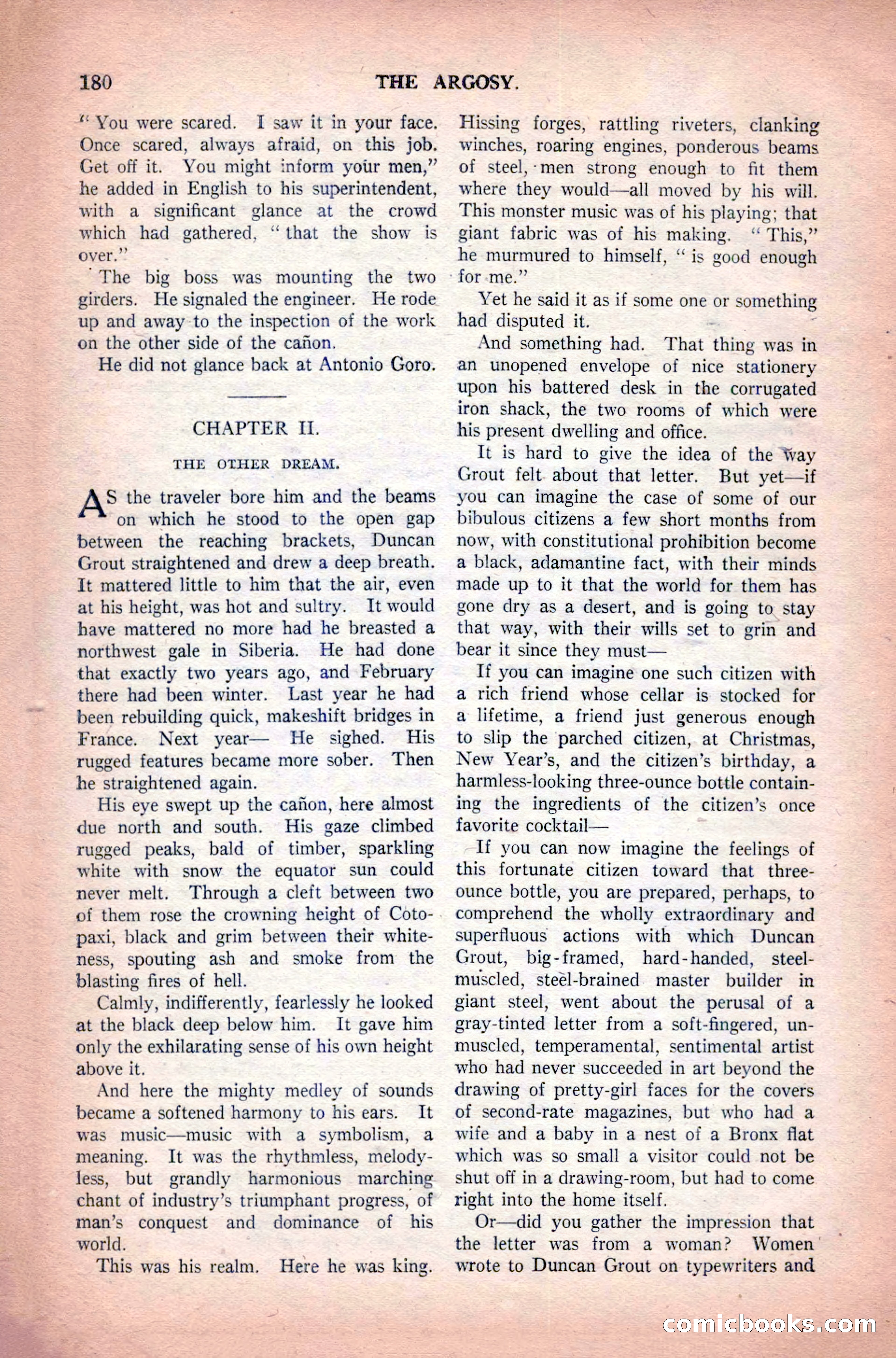
A restored page from Pulp Fiction, 1919. Page through the whole issue in the reader above.
📄 Transcribed text from this page (OCR, searchable)
Machine-transcribed from the original scan — historical spelling and the odd misread are preserved.
180 “You were scared. I saw it in your face. Once scared, always afraid, on this job. Get off it. You might inform your men,” he added in English to his superintendent, with a significant glance at the crowd which had gathered, “that the show is over.”’ ~The big boss was mounting the two girders. He signaled the engineer. He rode up and away-to the inspection of the work on the other side of the canon. He did not glance back at Antonio Goro. CHAPTER II. THE OTHER DREAM, S the traveler bore him and the beams on which he stood to the open gap between the reaching brackets, Duncan Grout straightened and drew a deep breath. It mattered little to him that the air, even at his height, was hot and sultry. It would have mattered no more had he breasted a northwest gale in Siberia. He had done that exactly two years ago, and February there had been winter. Last year he had been rebuilding quick, makeshift bridges in France. Next year— He sighed. His rugged features became more sober. Then he straightened again. His eye swept up the cafon, here almost due north and south. His gaze climbed rugged peaks, bald of timber, sparkling white with snow the equator sun could never melt. Through a cleft between two of them rose the crowning height of Coto- paxi, black and grim between their white- ness, spouting ash and smoke from the blasting fires of hell. Calmly, indifferently, fearlessly he looked at the black deep below him. It gave him only the exhilarating sense of his own height above it. And here the mighty medley of sounds became a softened harmony to his ears. It was music—music with a symbolism, a meaning. It was the rhythmless, melody- fess, but grandly harmonious marching chant of industry’s triumphant progress, of man’s conquest and dominance of his world. This was his realm. Here he was king. THE ARGOSY. Hissing forges, rattling riveters, clanking winches, roaring engines, ponderous beams of steel,-men strong enough to fit them where they would—all moved by his will. This monster music was of his playing; that giant fabric was of his making. “ This,” he murmured to himself, “ is good enough ‘for me.” Yet he said it as if some one or something had disputed it. And something had. That thing was in an unopened envelope of nice stationery upon his battered desk in the corrugated iron shack, the two rooms of which were his present dwelling and office. It is hard to give the idea of the Way Grout felt. about that letter. But yet—if you can imagine the case of some of our bibulous citizens a few short months from now, with constitutional prohibition become a black, adamantine fact, with their minds made up to it that the world for them has gone dry as a desert, and is going to stay that way, with their wills set to grin and bear it since they must— If you can imagine one such citizen with a rich friend whose cellar is stocked for a lifetime, a friend just generous enough to slip the parched citizen, at Christmas, New Year’s, and the citizen’s birthday, a harmless-looking three-ounce bottle contain- ing the ingredients of the citizen’s once favorite cocktail— If you can now imagine the feelings of this fortunate citizen toward that three- ounce bottle, you are prepared, perhaps, to comprehend the wholly extraordinary and superfluous actions with which Duncan Grout, big-framed, hard-handed, steel- muscled, steél-brained. master builder in giant steel, went about the perusal of a gray-tinted letter from a soft-fingered, un- muscled, temperamental, sentimental artist who had never succeeded in art beyond the drawing of pretty-girl faces for the covers of second-rate magazines, but who had a wife and a baby in a nest of a Bronx flat which was so small a visitor could not be shut off in a drawing-room, but had to come right into the home itself. Or—did you gather the impression that the letter was from a woman? wrote to Duncan Grout on typewriters and Women ECOMIEHOOKS.com —