
Pulp Fiction, 1919 · page 128 of 196
Argosy, Vol. 112, No. 2 — page 128: what you’re looking at
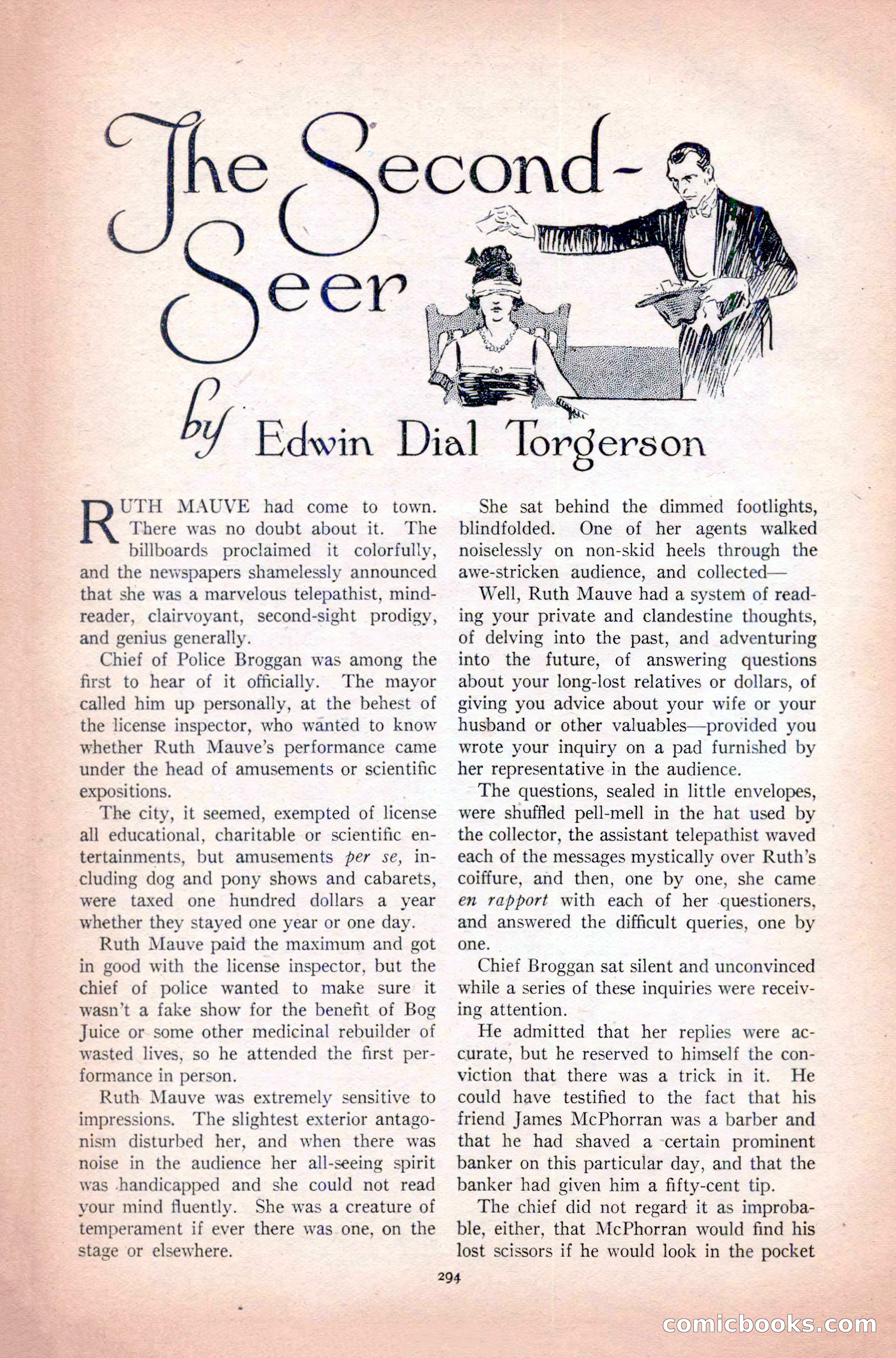
A restored page from Pulp Fiction, 1919. Page through the whole issue in the reader above.
📄 Transcribed text from this page (OCR, searchable)
Machine-transcribed from the original scan — historical spelling and the odd misread are preserved.
he econd- cCcr hy Edwin Dial ar UTH MAUVE had come to town. There was no doubt about it. The billboards proclaimed it colorfully, and the newspapers shamelessly announced that she was a marvelous telepathist, mind- reader, clairvoyant, second-sight prodigy, and genius generally. Chief of Police Broggan was among the first to hear of it officially. The mayor called him up personally, at the behest of the license inspector, who wanted to know whether Ruth Mauve’s performance came under the head of amusements or scientific expositions. The city, it seemed, exempted of license all educational, charitable or scientific en- tertainments, but amusements per sé, in- cluding dog and pony shows and cabarets, were taxed one hundred dollars a year whether they stayed one year or one day. Ruth Mauve paid the maximum and got in good with the license inspector, but the chief of police wanted to make sure it wasn’t a fake show for the benefit of Bog Juice or some other medicinal rebuilder of wasted lives, so he attended the first per- formance in person. Ruth Mauve was extremely sensitive to impressions. The slightest exterior antago- nism disturbed her, and when there was noise in the audience her all-seeing spirit was handicapped and she could not read your mind fluently. She was a creature of temperament if ever there was one, on the stage or elsewhere. She sat behind the dimmed footlights, blindfolded. One of her agents walked noiselessly on non-skid heels through the awe-stricken audience, and collected— Well, Ruth Mauve had a system of read- ing your private and clandestine thoughts, of delving into the past, and adventuring into the future, of answering questions about your long-lost relatives or dollars, of giving you advice about your wife or your husband or other valuables—provided you wrote your inquiry on a pad furnished by her representative in the audience. The questions, sealed in little envelopes, were shuffled pell-mell in the hat used by the collector, the assistant telepathist waved each of the messages mystically over Ruth’s coiffure, and then, one by one, she came en rapport with each of her questioners, and answered the difficult queries, one by one. Chief Broggan sat silent and unconvinced while a series of these inquiries were receiv- ing attention. He admitted that her replies were ac- curate, but he reserved to himself the con- viction that there was a trick in it. He could have testified to the fact that his friend James McPhorran was a barber and that he had shaved a certain prominent banker on this particular day, and that the banker had given him a fifty-cent tip. The chief did not regard it as improba- ble, either, that McPhorran would find his lost scissors if he would look in the pocket 204 Gomichbooks Eon