
Pulp Fiction, 1919 · page 11 of 196
Argosy, Vol. 112, No. 2 — page 11: what you’re looking at
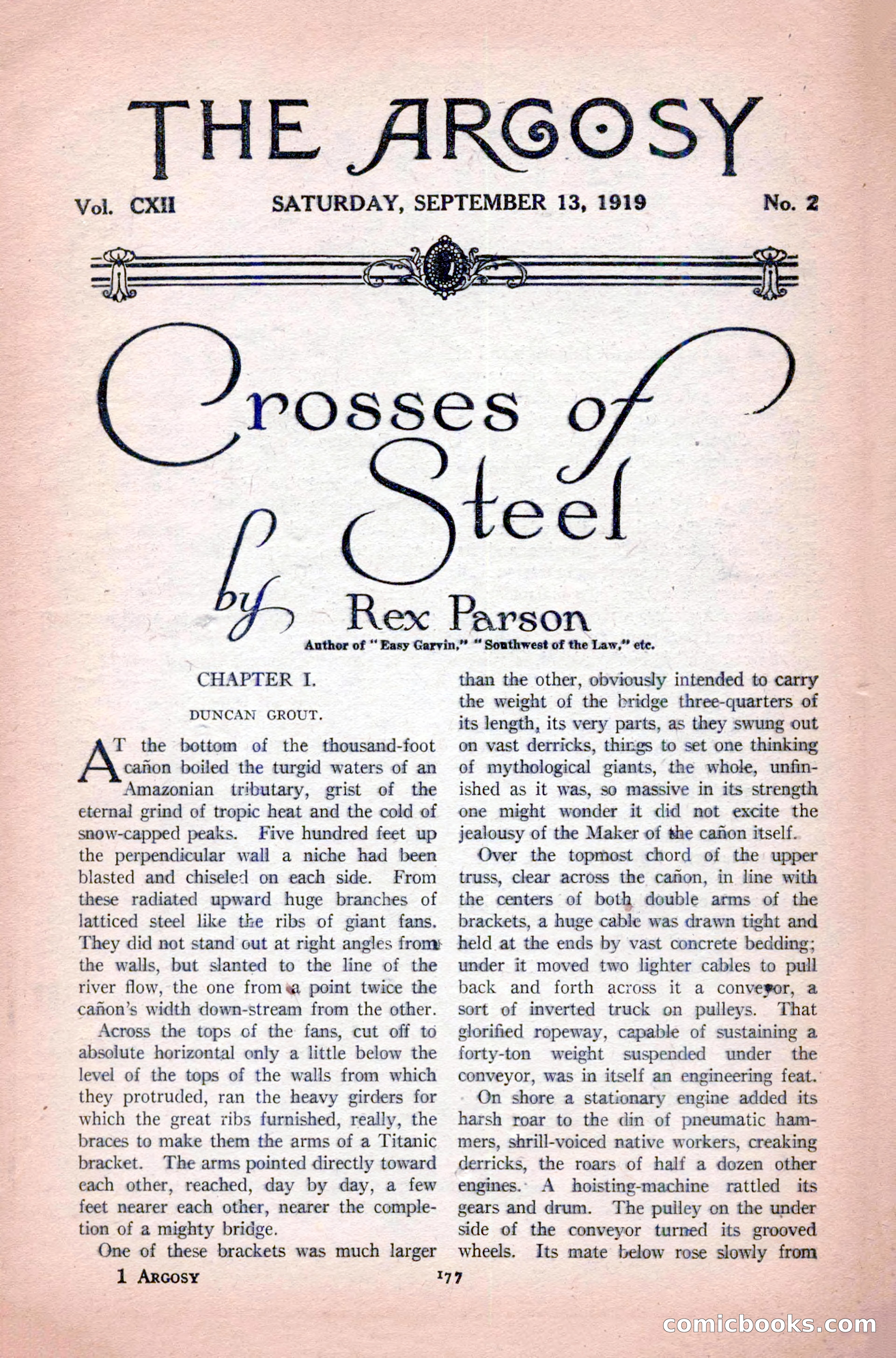
A restored page from Pulp Fiction, 1919. Page through the whole issue in the reader above.
📄 Transcribed text from this page (OCR, searchable)
Machine-transcribed from the original scan — historical spelling and the odd misread are preserved.
THE ARGOSY SATURDAY, SEPTEMBER 13, 1919 Vol. CXil No. 2 POSSECS O met Rex Parson fs of “‘ Easy Garvin,” “ Southwest of the Law,” etc. CHAPTER I. DUNCAN GROUT. T the bottom of the thousand-foot canon boiled the turgid waters of an Amazonian tributary, grist of the eternal grind of tropic heat and the cold of snow-capped peaks. Five hundred feet up the perpendicular wall a niche had been blasted and chiseled on each side. From these radiated upward huge branches of latticed steel like the ribs of giant fans. They did not stand out at right angles from: the walls, but slanted to the line of the river flow, the one froma point twice the canon’s width down-stream from the other. Across the tops of the fans, cut off to absolute horizontal only a little below the level of the tops of the walls from which they protruded, ran the heavy girders for which the great ribs furnished, really, the braces to make them the arms of a Titanic bracket. The arms pointed directly toward each other, reached, day by day, a few feet nearer each other, nearer the comple- tion of a mighty bridge. One of these brackets was much larger 1 Arcosy than the other, obviously intended to carry the weight of the bridge three-quarters of its length, its very parts, as they swung out on vast derricks, things to set one thinking of mythological giants, the whole, unfin- ished as it was, so massive in its strength one might wonder it did not excite the jealousy of the Maker of the canon itself. Over the topmost chord of the upper truss, clear across the cafion, in line with the centers of both double arms of the brackets, a huge cable was drawn tight and held at the ends by vast concrete bedding; under it moved two lighter cables to pull back and forth across it a convepor, a sort of inverted truck on pulleys. That glorified ropeway, capable of sustaining a forty-ton weight suspended under the conveyor, was in itself an engineering feat. On shore a stationary engine added its harsh roar to the din of pneumatic ham- mers, shrill-voiced native workers, creaking derricks, the roars of half a dozen other engines.. A hoisting-machine rattled its gears and drum. The puiley on the under side of the conveyor turned its grooved wheels. Its mate below rose slowly from 177 (E(0) .OO €O