
Pulp Fiction, 1919 · page 102 of 196
Argosy, Vol. 112, No. 2 — page 102: what you’re looking at
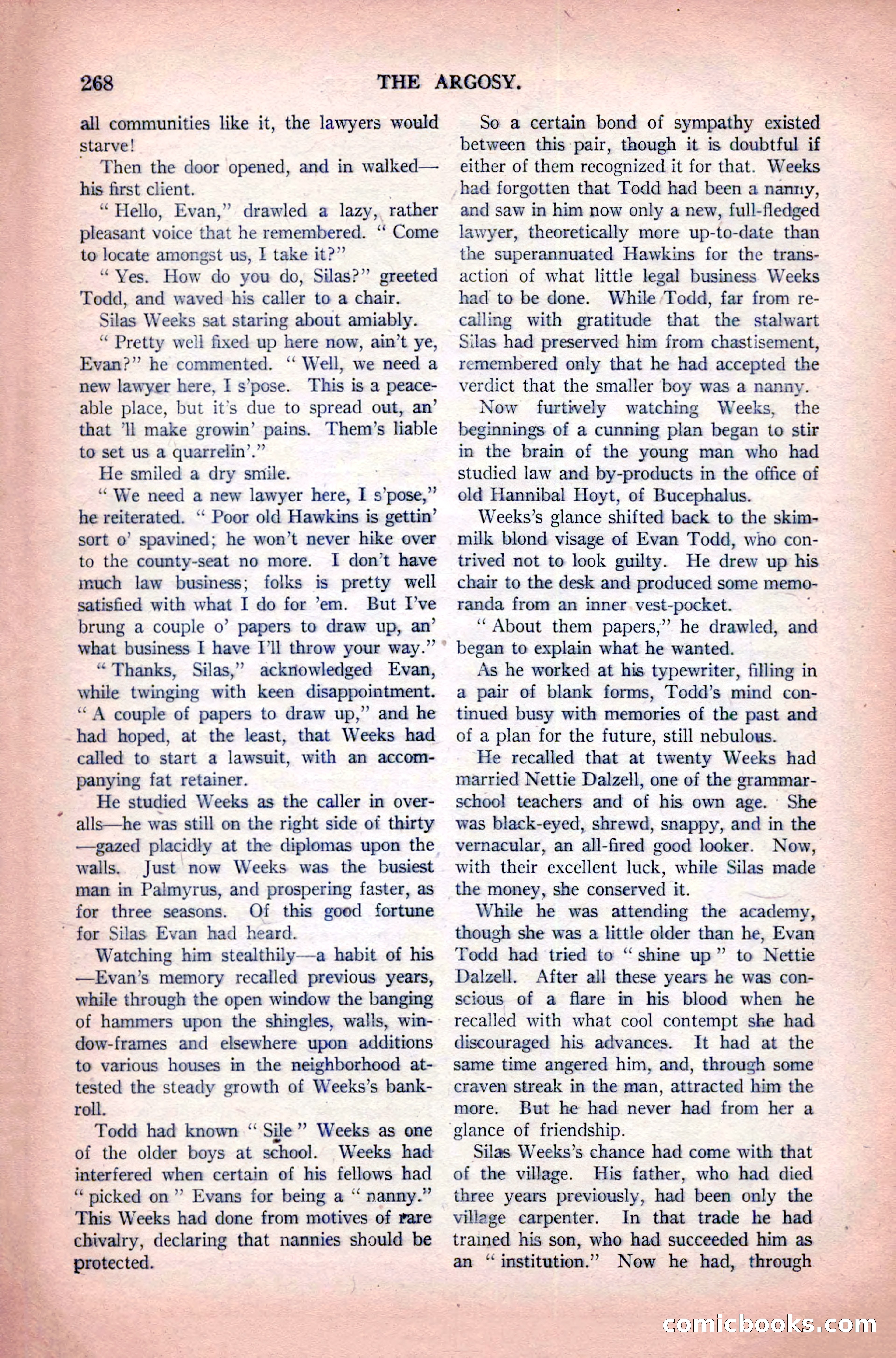
A restored page from Pulp Fiction, 1919. Page through the whole issue in the reader above.
📄 Transcribed text from this page (OCR, searchable)
Machine-transcribed from the original scan — historical spelling and the odd misread are preserved.
all communities like it, the lawyers would starve! ' Then the door opened, and in walked— his first client. 3 “ Hello, Evan,” drawled a lazy, rather pleasant voice that he remembered. “ Come to locate amongst us, I take it?” “Yes. How do you do, Silas?” greeted Todd, and waved his caller to a chair. Silas Weeks sat staring about amiably. “ Pretty well fixed up here now, ain’t ye, Evan?” he commented. “‘ Well, we need a new lawyer here, I s’pose. This is a peace- able place, but it’s due to spread out, an’ that ‘ll make growin’ pains. Them’s liable to set us a quarrelin’.” He smiled a dry smile. “We need a new lawyer here, I s’pose,” he reiterated. ‘“‘ Poor old Hawkins is gettin’ sort o’ spavined; he won’t never hike over to the county-seat no more. I don’t have much law business; folks is pretty well satisfied with what I do for ’em. But I’ve brung a couple o’ papers to draw up, an’ what business I have Ill throw your way.” ° “Thanks, Silas,’ ackriowledged Evan, while twinging with keen disappointment. “ A couple of papers to draw up,” and he had hoped, at the least, that Weeks had called to start a lawsuit, with an accom- panying fat retainer. He studied Weeks as the caller in over- alls—he was still on the right side of thirty —gazed placidly at the diplomas upon the walls. Just now Weeks was the busiest man in Palmyrus, and prospering faster, as for three seasons. Of this good fortune ' for Silas Evan had heard. Watching him stealthily—a habit of his —Evan’s memory recalled previous years, while through the open window the banging of hammers upon the shingles, walls, win- dow-frames and elsewhere upon additions to various houses in the neighborhood at- tested the steady growth of Weeks’s bank- roll. Todd had known “ Sile”’ Weeks as one of the older boys at school. Weeks had interfered when certain of his fellows had “ picked on” Evans for being a “ nanny.” ‘This Weeks had done from motives of vare chivalry, declaring that nannies should be protected. THE ARGOSY. So a certain bond of sympathy existed between this pair, though it is doubtful if either of them recognized it for that. Weeks had forgotten that Todd had been a nanny, and saw in him now only a new, full-fledged lawyer, theoretically more up-to-date than the superannuated Hawkins for the trans- action of what little legal business Weeks had to be done. While ‘Todd, far from re- calling with gratitude that the stalwart Silas had preserved him from chastisement, remembered only that he had accepted the verdict that the smaller boy was a nanny. Now furtively watching Weeks, the beginnings of a cunning plan began to stir in the brain of the young man who had studied law and by-products in the office of old Hannibal Hoyt, of Bucephalus. Weeks’s glance shifted back to the skim- milk blond visage of Evan Todd, who con- trived not to look guilty. He drew up his chair to the desk and produced some memo- randa from an inner vest-pocket. “About them papers,” he drawled, and began to explain what he wanted. As he worked at his typewriter, filling in a pair of blank forms, Todd’s mind con- tinued busy with memories of the past and of a plan for the future, still nebulous. He recalled that at twenty Weeks had married Nettie Dalzell, one of the grammar- school teachers and of his own age. She was black-eyed, shrewd, snappy, and in the vernacular, an all-fired good looker. Now, with their excellent luck, while Silas made the money, she conserved it. While he was attending the academy, though she was a little older than he, Evan Todd had tried to “shine up” to Nettie Dalzell. After all these years he was con- scious of a flare im his blood when he recalled with what cool contempt ske had discouraged his advances. It had at the same time angered him, and, through some craven streak in the man, attracted him the more. But he had never had from her a glance of friendship. Silas Weeks’s chance had come with that of the village. His father, who had died three years previously, had been only the village carpenter. In that trade he had trained his son, who had succeeded him as an “institution.” Now he had, through Gomicbooks i