
Pulp Fiction, 1917 · page 84 of 192
The Argosy, Vol. 84 No. 2 — page 84: what you’re looking at
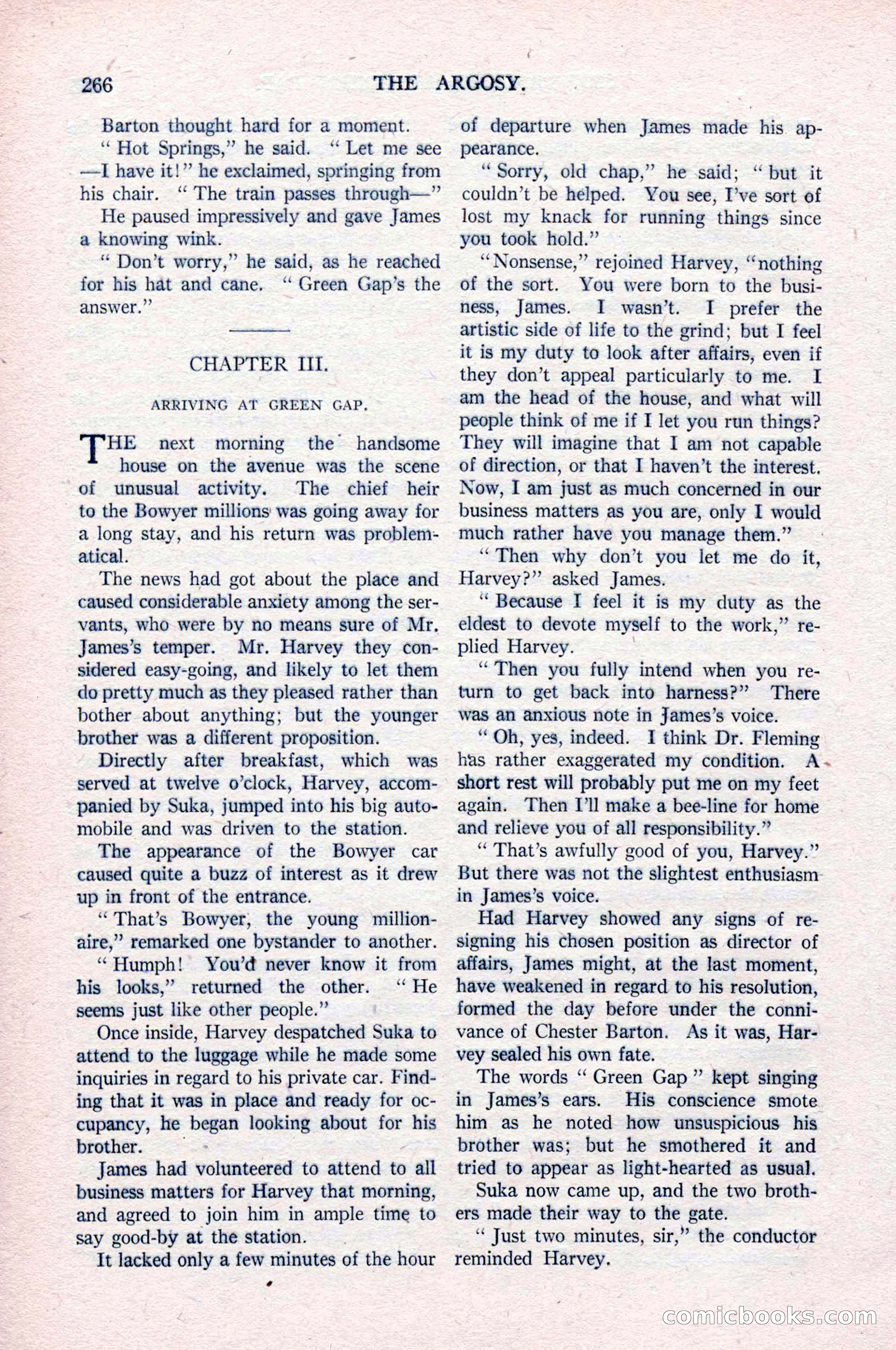
A restored page from Pulp Fiction, 1917. Page through the whole issue in the reader above.
📄 Transcribed text from this page (OCR, searchable)
Machine-transcribed from the original scan — historical spelling and the odd misread are preserved.
266 Barton thought hard for a moment. ‘Hot Springs,” he said. ‘“‘ Let me see —I have it!” he exclaimed, springing from his chair. ‘ The train passes through—” He paused impressively and gave James a knowing wink. “ Don’t worry,” he said, as he reached for his hat and cane, ‘“ Green Gap’s the answer.” CHAPTER III. ARRIVING AT GREEN GAP. HE next morning the handsome house on the avenue was the scene of unusual activity. The chief heir to the Bowyer millions was going away for a long stay, and his return was problem- atical. The news had got about the place and caused considerable anxiety among the ser- vants, who were by no means sure of Mr. James’s temper. Mr. Harvey they con- sidered easy-going, and likely to let them do pretty much as they pleased rather than bother about anything; but the younger brother was a different proposition. Directly after breakfast, which was served at twelve o’clock, Harvey, accom- panied by Suka, jumped into his big auto- mobile and was driven to the station. The appearance of the Bowyer car caused quite a buzz of interest as it drew up in front of the entrance. “That’s Bowyer, the young million- aire,” remarked one bystander to another. “ Humph! You’d never know it from his looks,” returned the other. “ He seems just like other people.” Once inside, Harvey despatched Suka to attend to the luggage while he made some inquiries in regard to his private car. Find- ing that it was in place and ready for oc- cupancy, he began looking about for his brother. = James had volunteered to attend to all business matters for Harvey that morning, and agreed to join him in ample time to say good-by at the station. It lacked only a few minutes of the hour ¢ THE ARGOSY. of departure when James made his ap- pearance. “Sorry, old chap,” he said; “ but it couldn’t be helped. You see, I’ve sort of lost my knack for running things since you took hold.” “Nonsense,” rejoined Harvey, “nothing of the sort. You were born to the busi- ness, James. I wasn’t. I prefer the artistic side of life to the grind; but I feel it is my duty to look after affairs, even if they don’t appeal particularly to me. I am the head of the house, and what will people think of me if I let you run things? They will imagine that I am not capable of direction, or that I haven’t the interest. Now, I am just as much concerned in our business matters as you are, only I would much rather have you manage them.” “Then why don’t you let me do it, Harvey?” asked James. ‘ Because I feel it is my duty as the eldest to devote myself to the work,” re- plied Harvey. | “Then you fully intend when you re- turn to get back into harness?” There was an anxious note in James’s voice. “Qh, yes, indeed. I think Dr. Fleming nas rather exaggerated my condition. A short rest will probably put me on my feet again. Then I’ll make a bee-line for home and relieve you of all responsibility.” “ That’s awfully good of you, Harvey.” But there was not the slightest enthusiasm in James’s voice. Had Harvey showed any signs of re- signing his chosen position as director of affairs, James might, at the last moment, have weakened in regard to his resolution, formed the day before under the conni- vance of Chester Barton. As it was, Har- vey sealed his own fate. The words “ Green Gap ” kept singing in James’s ears. His conscience smote him as he noted how unsuspicious his brother was; but he smothered it and tried to appear as light-hearted as usual. Suka now came up, and the two broth- ers made their way to the gate. ‘Just two minutes, sir,” the conductor reminded Harvey. COMMICLOOokKs (C@