
Pulp Fiction, 1917 · page 72 of 192
The Argosy, Vol. 84 No. 2 — page 72: what you’re looking at
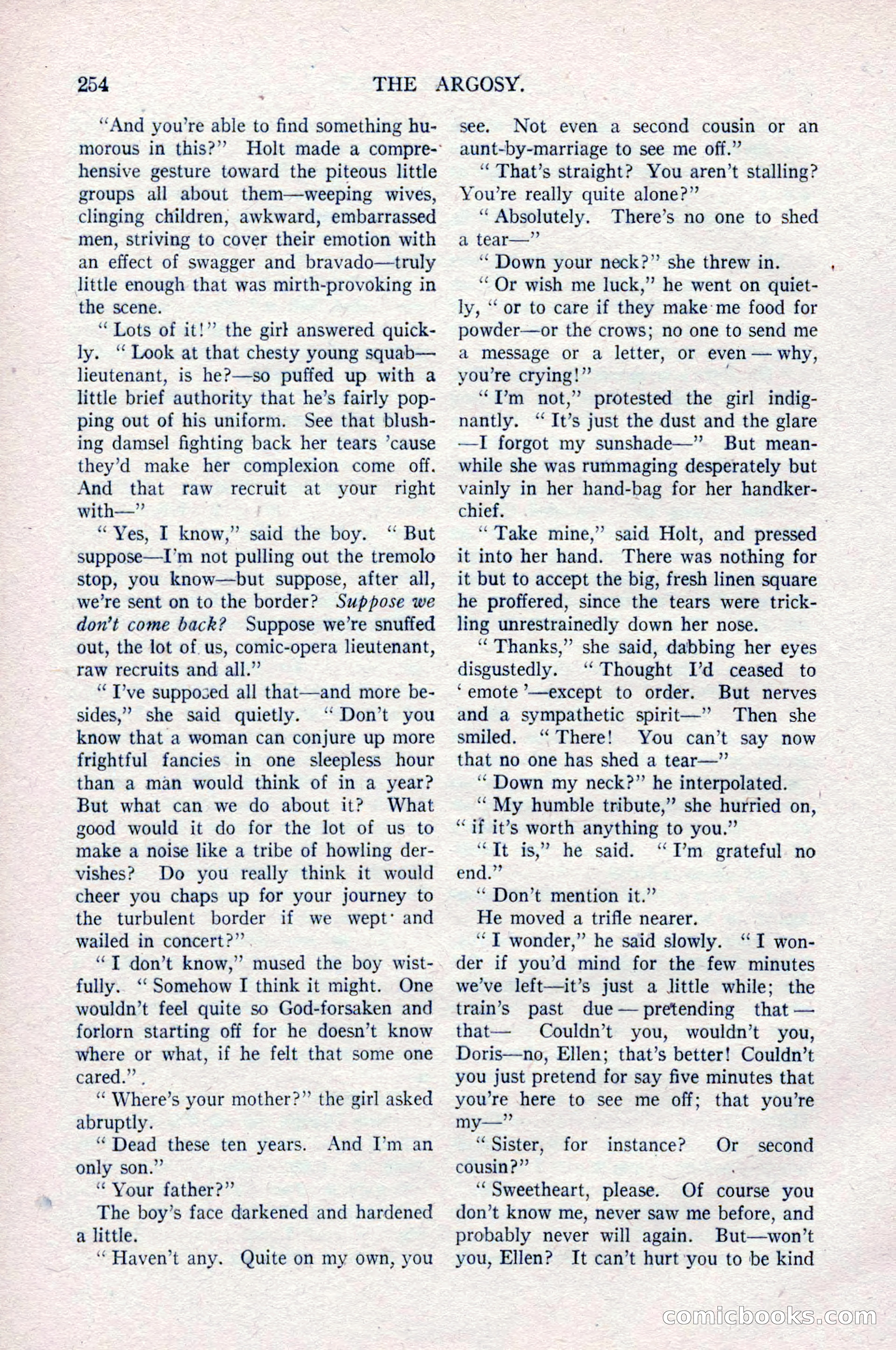
A restored page from Pulp Fiction, 1917. Page through the whole issue in the reader above.
📄 Transcribed text from this page (OCR, searchable)
Machine-transcribed from the original scan — historical spelling and the odd misread are preserved.
254 “And you're able to find something hu- morous in this?” Holt made a compre- hensive gesture toward the piteous little groups all about them—weeping wives, clinging children, awkward, embarrassed men, striving to cover their emotion with an effect of swagger and bravado—truly little enough that was mirth-provoking in the scene. ‘Lots of it!” the girt answered quick- ly. ‘“‘ Look at that chesty young squab— lieutenant, is he?—so puffed up with a little brief authority that he’s fairly pop- ping out of his uniform. See that blush- ing damsel fighting back her tears ’cause they’d make her complexion come off. And that raw recruit at your right with—” “Yes, I know,” said the boy. “ But suppose—I’m not pulling out the tremolo stop, you know—but suppose, after all, we’re sent on to the border? Suppose we don’t come back? Suppose we’re snuffed out, the lot of. us, comic-opera lieutenant, raw recruits and all.” “T’ve supposed all that—and more be- sides,” she said quietly. ‘ Don’t you know that a woman can conjure up more frightful fancies in one sleepless hour than a man would think of in a year? But what can we do about it? What good would it do for the lot of us to make a noise like a tribe of howling der- vishes? Do you really think it would cheer you chaps up for your journey to the turbulent border if we wept’ and wailed in concert?’’. ‘“T don’t know,” mused the boy wist- fully. ‘‘ Somehow I think it might. One wouldn’t feel quite so God-forsaken and forlorn starting off for he doesn’t know Where or what, if he felt that some one cared.” . ‘“ Where’s your mother?” the girl asked abruptly. “Dead these ten years. only son.” “Your father?” The boy’s face darkened and hardened a little. “Haven't any. Quite on my own, you And I’m an THE ARGOSY. see. Not even a second cousin or an aunt-by-marriage to see me off.” ‘““That’s straight? You aren’t stalling? You're really quite alone?” ‘Absolutely. There’s no one to shed a tear—” ‘* Down your neck?” she threw in. ‘“Or wish me luck,” he went on quiet- ly, ‘‘ or to care if they make'me food for powder—or the crows; no one to send me a message or a letter, or even — why, you’re crying!” : “T’m not,” protested the girl indig- nantly. “It’s just the dust and the glare —I forgot my sunshade—” But mean- while she was rummaging desperately but vainly in her hand-bag for her handker- chief. “Take mine,” said Holt, and pressed — it into her hand. There was nothing for it but to accept the big, fresh linen square he proffered, since the tears were trick- ling unrestrainedly down her nose. “Thanks,” she said, dabbing her eyes disgustedly. ‘‘ Thought I’d ceased to ‘emote ’~—except to order. But nerves and a sympathetic spirit—’’ Then she smiled. “ There! You can’t say now that no one has shed a tear—” ‘‘ Down my neck?” he interpolated. “ My humble tribute,” she hurried on, “if it’s worth anything to you.” “Tt is,’ he said. ‘I’m grateful no end.” ‘* Don’t mention it.” He moved a trifle nearer. ‘TY wonder,” he said slowly. ‘ I won- der if you’d mind for the few minutes we've left—it’s just a little while; the train’s past due—pretending that — that— Couldn’t you, wouldn’t you, Doris—no, Ellen; that’s better! Couldn’t you just pretend for say five minutes that youre here to see me off; that you’re my” ““ Sister, cousin?” “Sweetheart, please. Of course you don’t know me, never saw me before, and probably never will again. But—won’t you, Ellen? It can’t hurt ‘you to be kind for instance? Or second COMMICOOOKS (C@